Dating apps didn’t break modern romance — they exposed the hidden patterns driving how we choose partners. A sharp, science-backed read that reframes everything.
You Didn’t Swipe Right on the Wrong Person. You Just Finally Saw How You Choose
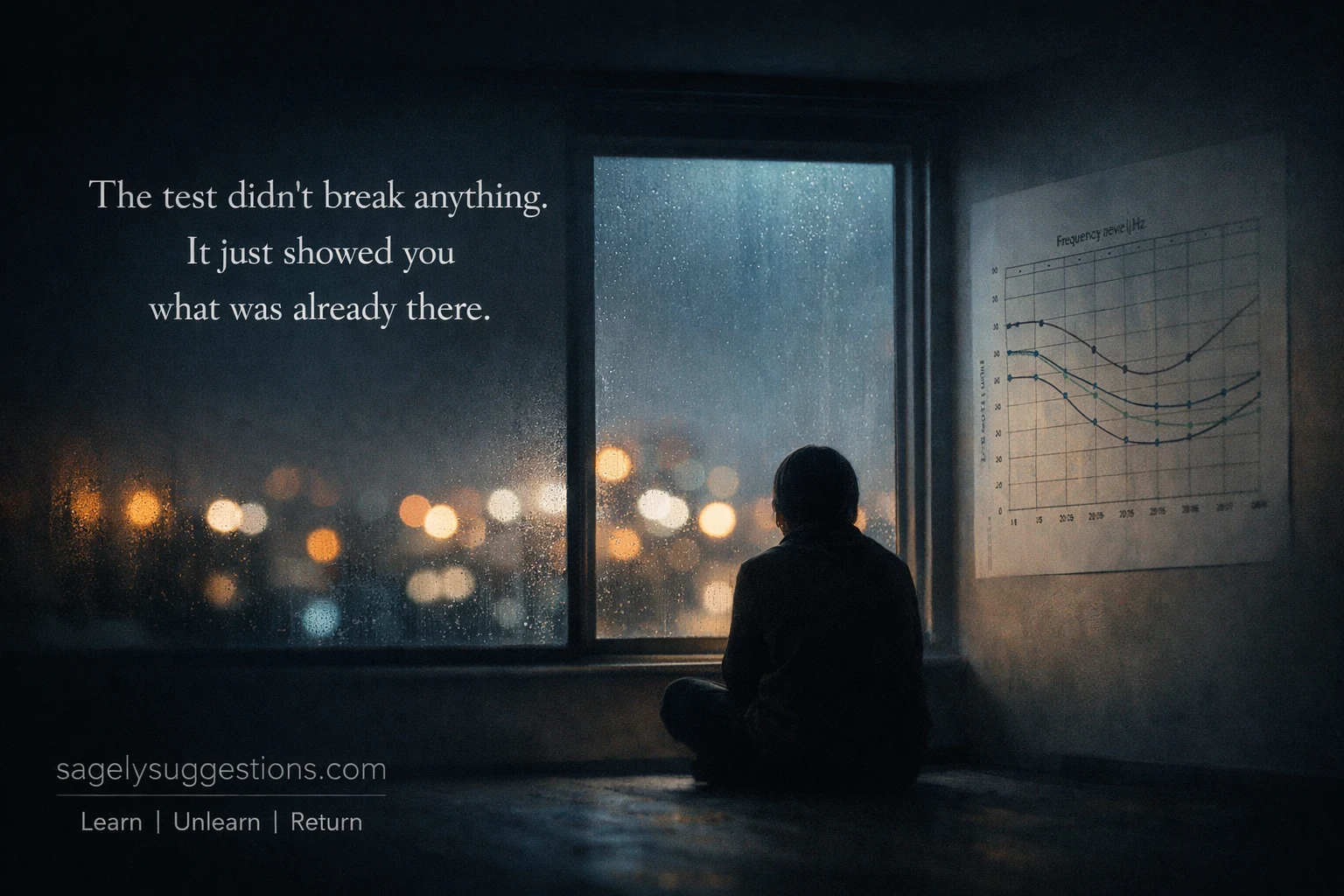
There’s a moment in an audiologist’s office that nobody warns you about. You’re sitting in a soundproofed booth, headphones clamped on, pressing a little button every time you hear a tone. The tones get quieter. Then quieter. Then you’re not sure if you heard something or just wanted to. The test ends. The audiologist returns with a graph — a clean, bureaucratic map of exactly where your hearing fails.
And here’s the thing nobody tells you: the audiogram didn’t damage your hearing. It just drew the outline of the damage that was already there. You walked into that booth the same person you walked out as. The test only made the invisible visible.
Dating apps are an audiogram for how you choose people.
Not for your standards. Not for your worth. Not even for your attachment style — the internet already sold you that particular self-help rabbit hole. For something older and quieter: the actual decision-making machinery you use when you’re selecting another human being to build a life with. The machinery most of us have never once inspected, because before 2012 or so, the whole process was mercifully blurry. You met someone at a party, you were a little drunk, the lighting was kind, and by the time you saw them clearly it was six months in and you were already emotionally entangled. The fog was a feature.
Dating apps removed the fog. That’s why everyone is furious at them.
The conventional story — the one repeated in thinkpieces, in your aunt’s kitchen, in every “why is modern dating so broken” podcast — goes like this: apps gamified romance, reduced humans to commodities, created infinite choice paralysis, and rewired our dopamine systems until we couldn’t commit to anything. The apps broke us. The apps are why you’re still single, or why you keep picking the wrong person, or why connection feels impossible now.
It’s a tidy story. It’s also doing something very convenient: it locates the problem in the technology rather than in the user holding the phone.
I want to try a different question — the one that’s harder to sit with.
What if dating apps didn’t change how we choose? What if they just showed us?
Consider what actually changed when apps arrived.
Before: you encountered a limited pool of candidates filtered by geography, social circle, and serendipity. Attraction happened in real time, in real space, with all the analog warmth and strategic ambiguity of actual human presence. You couldn’t really inspect your own preferences because you didn’t have data — you had vibes and outcomes.
After: you suddenly have an endless, searchable, sortable catalogue of human beings. You can filter by height. You make a judgment in 0.7 seconds based on a photo. You unmatch the moment conversation slows.
Brutal, yes. But here’s what that brutality actually produced: a paper trail of your own decision-making. And for a lot of people, that paper trail is uncomfortable reading.
The researcher Eli Finkel at Northwestern spent years studying online dating and found something that quietly demolishes the “apps ruined love” thesis. People don’t actually behave more shallowly online than off — they replicate, with startling fidelity, the same preference hierarchies they always had. The app just made those hierarchies explicit, rapid, and impossible to romanticize. You can no longer tell yourself you’re attracted to kindness and depth when the data of your right-swipes is sitting right there, overwhelmingly selecting for a very specific jaw structure and a bio that mentions travel.
I’ll say it plainly: the apps didn’t install new values. They held a fluorescent light over the ones you already had.
Here’s where it gets uncomfortable — and I say this as someone who spent a genuinely embarrassing portion of the mid-2000s convinced I had excellent taste in partners while repeatedly choosing people who were charismatic, emotionally unavailable, and absolutely fascinating in the way that only people who will eventually disappear are. I thought I was choosing depth. The pattern, reviewed honestly in retrospect, suggested I was choosing stimulation plus the particular comfort of emotional uncertainty. Those are not the same thing.
Most people, if you pressed them, would say they’re looking for someone kind, funny, emotionally available, honest, and interested in genuine connection. Most people, if you watched their actual behavior on an app — the swipes, the responses, the ghosting, the sudden renewed interest when an ex resurfaces — are not consistently selecting for those things.
This is not a moral failing. This is a mapping problem. What we say we want and what our nervous system actually pursues are often running on different software entirely. The apps just gave us a printout of the gap.
So what do you actually do with this? Because insight without application is just a more sophisticated way to feel bad about yourself, and I have no interest in that.
The first move is genuinely hard: stop auditing the apps and start auditing the pattern. Not “why is everyone on here so shallow” — but “what does the person I always end up messaging have in common?” Not “why doesn’t anyone want something real” — but “what did I do the last three times someone offered something real?” This isn’t self-blame. It’s diagnostic. You can’t fix a preference you haven’t named.
The second move is to introduce deliberate friction into your own process. The swipe mechanism is specifically engineered to bypass your reflective mind and route directly to your instinctive one. Fine — but your instinctive mind is the one that keeps enrolling you in the same curriculum with different teachers. Build in a pause. Before swiping left on someone whose profile doesn’t immediately spark something, ask: would I dismiss this person at a party in the first thirty seconds? If yes, fine. But if you’d actually give them twenty minutes in person, that’s information about where the app process is deforming your judgment.
The third move is the least comfortable: get genuinely curious about what you’re afraid of in the people you don’t pursue. Not what’s wrong with them. What they might be asking of you that feels like too much. Because often — not always, but often enough — the person we’d be good with is the one whose emotional availability reads as boring until we’ve done enough work to understand that what we were calling “boring” was actually just “safe.” And we were addicted to the feeling of not being safe.
None of this requires a different app, a better algorithm, or a premium subscription. It requires a different kind of honesty — the kind you practice in a soundproofed booth with headphones on, pressing a button when you hear something, even when you’re not sure you’re ready to know.
The audiogram on the wall has your name on it.
Not a verdict. A map. Maps don’t judge the territory — they just show you where you actually are, which is the only useful starting point for going somewhere different.
Dating apps didn’t ruin love. They ended the comfortable lie that you were looking for it in the ways you thought you were. That’s a harder truth to live with than “the algorithm is broken.” It’s also the only one that gets you anywhere.
The test is over. The graph is clean. What you do with the information — that’s entirely, inconveniently, yours.
Discover more from Sagely Suggestions
Subscribe to get the latest posts sent to your email.