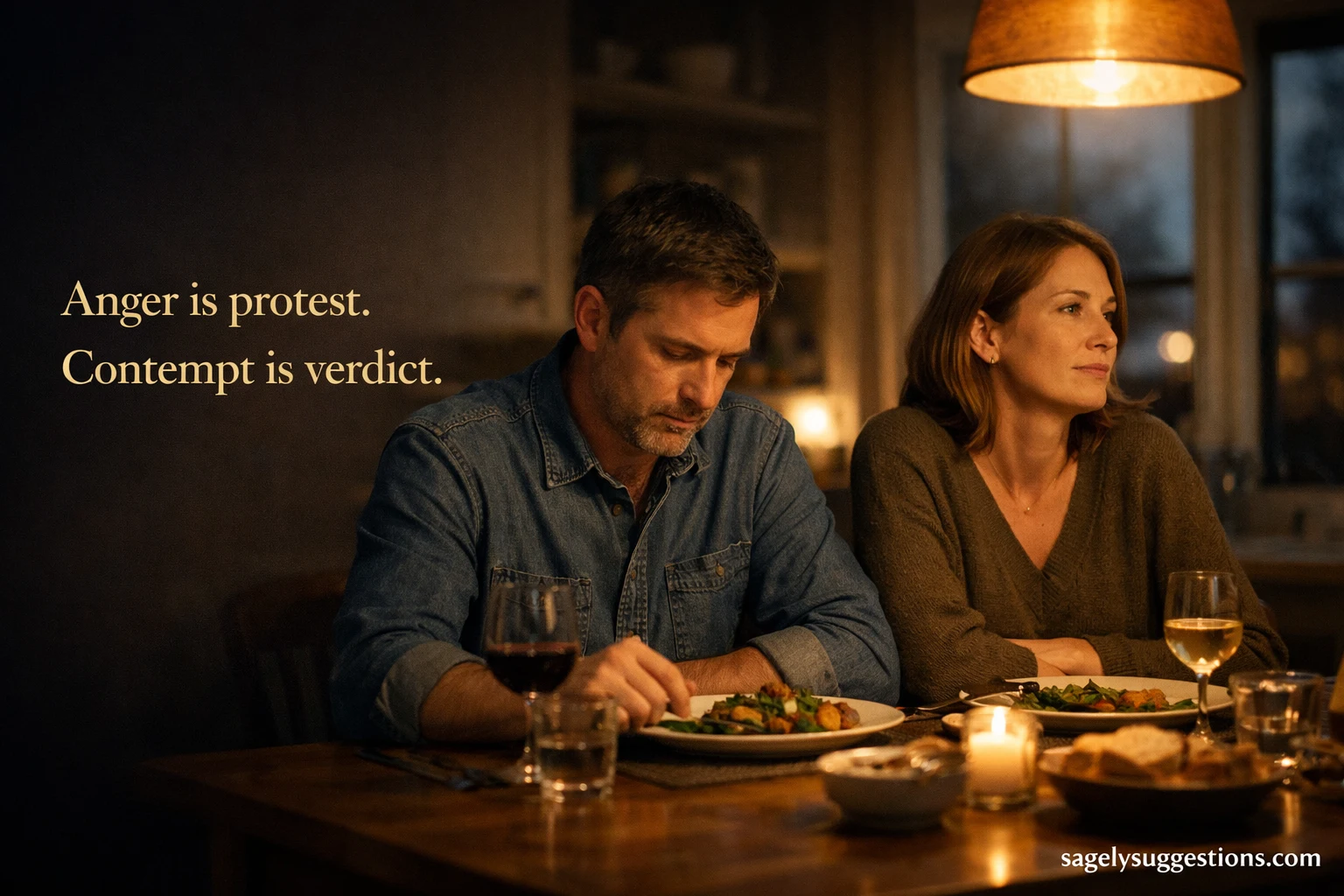
Contempt in marriage is the most dangerous predictor of divorce. Learn the signs, real causes, and research-backed steps to fix it before it’s too late.
When ocean temperatures rise just one degree too many, coral reefs don’t die. They bleach.
The structure stays. The skeleton remains. But the living color — the symbiotic algae that made the reef alive — evacuates. What’s left is white, silent, intact in form but emptied of warmth. Marine biologists will tell you this: a bleached reef isn’t dead. Not yet. But if the conditions don’t change, it becomes dead. And most people who stumble across one assume the worst, walk away, and never learn the difference.
I’ve been thinking about that image in the context of marriages.
Because contempt — the real kind, the Gottman-predicts-divorce kind — doesn’t look like a screaming match. It looks like a marriage that’s bleached. The routines are intact. People are showing up to dinner, coordinating school pickups, sharing a bed. But the warmth has evacuated. What remains is colder, quieter: the eye-roll when he starts talking. The invisible sigh. The internal monologue that sounds less like frustration and more like dismissal.
If you recognized yourself just now — if you felt that land somewhere specific — this article is for you.
What Is Contempt in a Relationship?
Psychological Definition
John Gottman spent four decades studying couples in an actual research apartment — tracking heart rates, facial microexpressions, the whole architecture of how people treat each other when the stakes are real. Out of that work came what he called the Four Horsemen: criticism, defensiveness, stonewalling, and contempt.
Contempt is the one he flags as uniquely dangerous. Not because it’s the loudest, but because of what it communicates at a level below language: I don’t just disagree with you. I find you beneath me.
Psychologically, contempt is viewing your partner from a position of moral superiority. Disgust mixed with disdain. And unlike anger — which still implies you believe the other person is capable of change — contempt has quietly stopped expecting anything better. That’s the tell. Anger is protest. Contempt is verdict.
Why It’s Dangerous
Here’s the part most articles skip. Contempt doesn’t just hurt feelings — it does biological damage. Couples who regularly experience contempt show elevated stress hormones, suppressed immune function, and measurably higher rates of illness over time. The body registers contempt as a threat and responds accordingly.
But the more insidious damage is structural. Contempt erodes the willingness to repair. Every healthy couple has conflict. What separates stable marriages from failing ones isn’t the absence of conflict — it’s the capacity to repair after it. Contempt corrodes that capacity. It convinces both partners that repair isn’t worth attempting.
A pattern you’ll notice in couples who’ve lived with contempt for years: they’ve stopped fighting about things, because they’ve quietly stopped expecting resolution. The arguments dried up. People assume that’s peace. It isn’t.
10 Signs of Contempt in Marriage
Verbal Behaviors
The most recognizable signs are linguistic, and they have a specific flavor — they don’t criticize behavior, they attack character. “You’re so pathetic” isn’t a complaint about the dishes. “I can’t believe I married someone this clueless” isn’t frustration — it’s condemnation. Sarcasm that isn’t funny to both people. Mockery. Name-calling dressed up as “just joking.” The joke that isn’t quite a joke but you’re supposed to laugh anyway.
There’s also a subtler version: the habit of correcting your partner in public. The dismissive actually before they’ve finished their sentence. The way one person starts speaking for the couple in social settings — not because they’re talkative, but because they’ve stopped trusting the other to represent them adequately.
Non-Verbal Cues
The eye-roll is the signature move, and Gottman’s research identified it as one of the most reliable predictors of divorce. Not the occasional exasperated roll — the habitual one. The one that’s almost automatic now, almost unconscious.
But there’s a broader category here that’s harder to name: studied indifference. The partner who gets home and doesn’t ask about your day — not because they forgot, but because they’ve stopped being interested. The physical recoil when the other person sits close. The face that goes carefully neutral when a certain person enters the room.
If you’ve ever caught yourself feeling relief when your partner cancels plans, that’s worth sitting with for a moment.
Real-Life Examples of Contempt
Let me be specific, because “eye-rolling and sarcasm” doesn’t quite capture the texture of it.
Marcus and Diane had been married nine years. Their arguments, on the surface, were about the same rotating set of things — the laundry, the budget, who forgot what. But something deeper had shifted. When Marcus talked about something he was excited about, Diane’s face would go carefully blank. Not hostile. Just absent. Like she’d left the room without moving.
Marcus noticed. Of course he noticed. So he started sharing less, talking less, being smaller in the relationship. Which Diane experienced as him being “checked out” — which made her more dismissive — which made him more withdrawn. That spiral, contempt triggering retreat triggering more contempt, is the actual mechanism. It feeds itself. And neither person necessarily started it maliciously.
Or consider this: the partner who has genuinely tried — brought it up, asked for change, made their needs clear — and been met with deflection, avoidance, or dismissal for years. At some point, that partner stops bringing it up. They also stop believing. What you’re watching when you see contempt in that person isn’t cruelty. It’s grief that calcified.
What Causes Contempt Between Partners?
This is where most articles get it exactly wrong.
They treat contempt as the disease. It isn’t. It’s the symptom. And the disease is almost always the same: accumulated, unaddressed resentment that was never given a fair hearing.
Contempt rarely appears in year one, or year three. It builds slowly, in layers, the way sediment builds. A request for change that got dismissed. A hurt that was minimized. A recurring dynamic where one person consistently felt like the less-important one in the room. Over time, the expectation of being taken seriously quietly dies. And when the expectation dies, something colder moves in.
Here’s an insight most articles would not offer you: the person expressing contempt is often the person who originally cared most deeply. They’re the one who brought it up first, asked for change, tried to bridge the gap. Contempt is what happens when that effort was met with nothing. It’s the scar tissue over a wound that never healed cleanly.
This matters enormously for how you fix it. If you’re treating the contempt itself — managing tone, avoiding triggers — you’re rearranging furniture over a structural problem.
Can a Marriage Survive Contempt?
Yes. With a specific caveat that almost no one says clearly: the marriage that survives contempt won’t look like the marriage that existed before it. It will have to be rebuilt — not repaired. Repair implies patching something mostly intact. What contempt requires is more like restoration.
The marriages that don’t survive are typically those where one partner was willing to do the work and the other wasn’t, or where the underlying cause — abuse, chronic betrayal, fundamental incompatibility of values — isn’t something behavioral change can address.
But for couples where contempt grew out of neglect, poor communication, and accumulated distance? Recovery is genuinely possible. Not easy. Not quick. But possible with the same certainty I’d tell you a bleached reef can recover — if, and only if, the conditions that caused the bleaching change.
How to Fix Contempt in Marriage
Communication Reset
Standard advice here is “communicate better,” which is the kind of thing you’d find on a motivational poster — useful to no one. Let’s go deeper.
The first step isn’t learning to communicate differently. It’s identifying the specific, unspoken grievances that have never been fully heard. Not the surface arguments — the deeper ones. The ones that got dismissed or avoided so many times that both people quietly stopped mentioning them.
A serious internal exercise: write down the three moments in this relationship where you felt most unseen, most dismissed, or most alone. Not three recent arguments — three moments that still carry weight when you think about them years later. Those moments are where the contempt is rooted.
Then comes the harder step: bringing them up without blame architecture. Not “you always” — but “I felt invisible when.” The distinction isn’t just linguistic. It shifts the conversation from prosecution to revelation. It gives the other person somewhere to go besides defensive.
What makes this fail: timing it when both people are exhausted or mid-conflict. What makes it work: creating a specific container for the conversation — a designated time when neither person is under pressure, with the agreement going in that both are there to understand, not to win.
Rebuilding Respect
Gottman’s antidote to contempt is building what he calls a “culture of appreciation.” That sounds abstract, so here’s what it looks like concretely.
For 21 days, commit to one genuine, specific acknowledgment of your partner per day. Not “you’re great” — that’s wallpaper. Something specific: The way you handled that situation with the kids last week. I noticed that. That was thoughtful. Specificity is the entire point. Generalized compliments bounce off; specific ones land.
The reason this works isn’t chemistry or luck — it’s that it interrupts the negative attribution bias that contempt runs on. In contemptuous relationships, both partners have unconsciously begun explaining each other’s behavior through the most negative lens available. He forgot the appointment → he doesn’t care. She sighed → she thinks I’m an idiot. Deliberate, specific appreciation introduces competing data to a brain that has stopped looking for any.
When it fails: when it’s performed rather than felt, or when only one person is doing it. This is a bilateral intervention. One person can start it. Both people need to maintain it.
Therapy Options
Emotionally Focused Therapy (EFT) has the strongest evidence base for couples dealing with contempt and chronic disconnection. It works by getting underneath the behavioral patterns to the attachment needs driving them. Most couples’ fights are about dishes and schedules on the surface, and about “do I actually matter to you?” at the core. EFT addresses the core.
The Gottman Method is another strong option — more structured and behavioral, with specific tools for de-escalation and repair attempts.
Both require a therapist trained in the modality, and both require genuine participation. There’s a version of couples therapy where both people sit in the room and perform willingness. That version doesn’t work. The version where at least one person is vulnerable enough to actually be moved — that one does.
For couples not ready for in-person therapy, or where one partner resists it, Gottman’s The Seven Principles for Making Marriage Work is not a self-help gimmick. It’s a research-grounded manual. Start there.
FAQs
Can contempt be one-sided?
Yes, and the direction matters. Contempt can come from one partner while the other remains hurt, confused, or still reaching for connection. Knowing which direction it flows — and why — shapes the work that needs doing.
Is contempt the same as falling out of love?
No, and this is one of the most disorienting aspects of it. You can feel contemptuous toward someone you still love — especially when that love has been consistently frustrated or met with indifference. Contempt that coexists with residual affection is usually grievance-based and recoverable. Contempt with nothing underneath is a harder picture.
How long does it take to fix?
Longer than you’d like. Research on EFT suggests meaningful improvement in eight to twenty sessions. The behavioral shifts — interrupting contemptuous habits, rebuilding appreciation — require sustained practice beyond that. Think months, not weeks. That sounds discouraging. Here’s the counter: the alternative is more years of what you already have. Months of difficult work, or years of quiet erosion. That math isn’t complicated.
What if my partner won’t acknowledge the problem?
Start with yourself. Identify your own contemptuous behaviors and the grievances underneath them. You cannot force your partner to participate in repair. You can make repair possible by doing your half. And doing your half consistently sometimes creates enough safety that the other person can begin to do theirs. Bold move, starting alone. Difficult — but not the wrong call.
Here’s what the marine biologists learned about bleached reefs: they don’t recover simply when the stressor is removed. They recover when the conditions become actively supportive of life again.
Removing the contempt isn’t enough. The cold glances need to be replaced with warmth. The silence needs to be replaced with curiosity. The distance needs to be replaced with — and this is the uncomfortable part — the willingness to be hurt again while trying to reconnect. That vulnerability is the temperature change the reef needs.
Most couples who come back from contempt will tell you it felt, at some point, like a choice to walk back into a burning building. It wasn’t. It was a choice to recognize that the fire was manageable, that the structure was still sound, and that walking away from something they’d spent years building was worth one more serious attempt.
Your marriage isn’t dead. If it were, you wouldn’t still be reading.
Discover more from Sagely Suggestions
Subscribe to get the latest posts sent to your email.