Faith wasn’t a belief you held — it was the operating system your identity ran on. Losing it is an involuntary factory reset, not a failure of character.
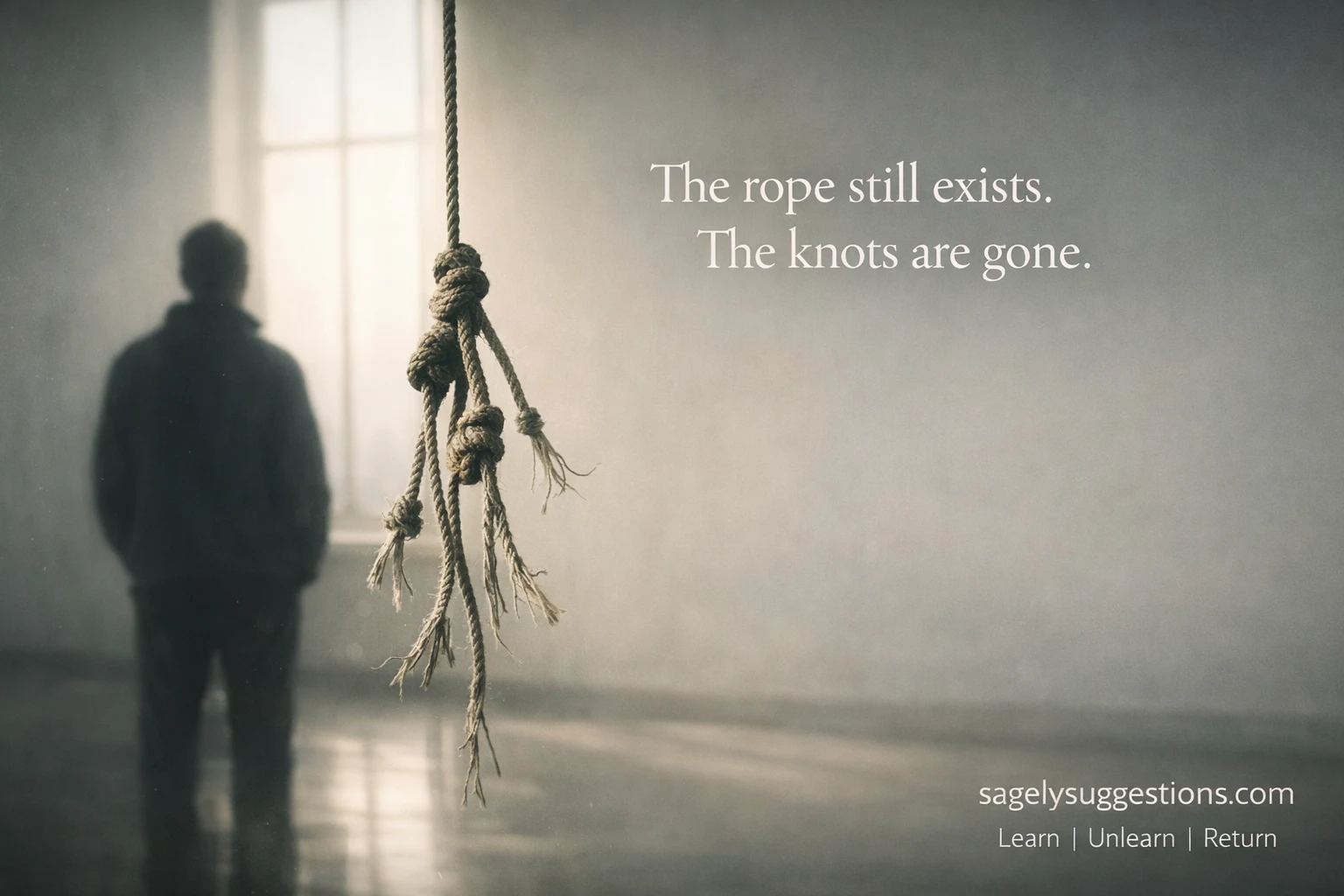
The Andean quipu looks, at first glance, like a bunch of rope. A central cord. Dozens of hanging strings. Nothing remarkable. But those strings weren’t decoration — they were the entire record. Births. Debts. Harvests. Identity. The Inca encoded who they were not in words, not on stone, but in the knots.
Remove the knots, and you have rope. Intact, functional, perfectly good rope. But you can no longer tell who anyone was, what they owed, whether last year’s harvest was enough to survive.
You’re not the missing knots. You’re the rope, sitting there wondering why you feel like nothing.
Here’s the thing nobody tells you about losing your faith — and I mean really losing it, not the mild “I skipped church for a few months” version, but the full unraveling — it doesn’t feel like losing a belief. It feels like losing a self.
You wake up and your opinions feel borrowed. Your sense of humor feels like it belongs to someone else. The things you used to care about seem to have moved out while you were sleeping, and you’re standing in an apartment that still has your furniture but isn’t yours anymore. You’re not sad, exactly. You’re untethered.
And the people around you? They don’t understand it. Your newly-atheist friends from the internet keep sending you “congratulations on your freedom” energy, like you’ve just escaped a cult — cheerful, a little smug — and you’re standing there thinking: this doesn’t feel like freedom. This feels like a factory reset with no backup.
“That’s not confusion. That’s your operating system uninstalling itself while you were still using it.”
They’re not wrong that something was holding you. They’re just wrong about what it was holding.
What faith actually was
Here’s the uncomfortable neuroscience of it. Human beings aren’t built to generate identity from scratch. We’re built to inherit frameworks — absorb them in childhood, reinforce them through community, and then run our whole personality on top of them like an app on an operating system. The OS is invisible. You don’t think about it. You just launch your apps: your ambitions, your humor, your values, your taste in music, your sense of what matters on a Tuesday morning.
For a lot of us who grew up religious — not nominally religious, but deeply religious — faith wasn’t just a belief sitting in a folder somewhere. It was the operating system. Your concept of purpose ran on it. Your moral intuitions ran on it. Your sense of why you were worth something ran on it. Even your personality traits — your warmth, your drive, your willingness to sacrifice for strangers — were connected to the theological framework underneath, even when you couldn’t see the wiring.
When that framework goes, the apps don’t immediately crash. That’s the cruel part. You keep running for a while. You still crack the same jokes. You still feel the same pull toward compassion. But there’s a new latency. A wobble. And at some point, usually around 2 a.m., you notice: nothing feels like mine anymore.
Your personality was the quipu. Faith was the knots. And somebody’s been untying them while you were busy debating theology online.
The conventional wisdom is useless here
The standard advice for ex-religious folks goes something like this: “Explore! Build your own values! Science is amazing! You’re free now!” Which — look, I don’t want to be rude about people’s genuine attempts to help, but this advice is about as useful as telling someone whose house just burned down to “enjoy the open floor plan.”
The problem isn’t that you don’t know how to find meaning. The problem is that your meaning-making apparatus was built inside a specific framework, and that framework is gone. You’re not starting fresh — you’re debugging a system that was compiled for an environment that no longer exists. “Just build your own values” assumes the scaffolding is still there. It isn’t. That’s the whole point.
And the other piece of advice — the gentle pastoral one, usually from well-meaning believers — is “just come back.” As if faith is a jacket you left at a restaurant. As if the issue is that you need to just try harder to believe again. This isn’t a commitment problem. This is a structural problem. The knots didn’t loosen. Someone cut the strings.
Here’s what’s actually happening
Psychologists have a term for this that’s almost aggressively clinical: identity foreclosure followed by diffusion. In plain language: you had a self handed to you early, you committed to it, and now the commitment has collapsed and you’re in the fog that follows. William Bridges, who spent decades studying transitions, noted something important — that the most disorienting part of any major change isn’t the change itself, but the period he called “the neutral zone.” Not the ending. Not the new beginning. The in-between, where you’ve lost the old identity but haven’t constructed the new one yet.
The neutral zone feels like nothing. Which your brain, starved of the certainty it used to operate on, interprets as being nothing.
You’re not nothing. You’re rope waiting to be knotted differently.
Here’s the paradox buried under the conventional wisdom on this: we assume that identity is something you have — a stable possession, like a passport. But identity is actually something you do. It’s a continuous act of meaning-making, performed in real time, anchored to whatever framework gives the actions coherence. Remove the framework and the actions don’t vanish — they just lose their coherence. The humor is still there. The warmth is still there. Your particular flavor of stubbornness is absolutely still there (trust me). What’s missing is the story that made them cohere.
That’s not a permanent amputation. That’s a translation problem.
What to actually do with this
I want to be honest here, the way someone who’s watched a lot of humans do this would be honest: there’s no fast version of what I’m about to say. Anyone selling you a fast version is selling you something. But there’s a real version, and it looks like this.
Stop trying to feel like yourself again immediately. The “yourself” you’re missing was a composite built over decades inside a specific context. It’s not coming back as-was, and spending energy trying to resurrect it is working against you. What you’re aiming for isn’t restoration — it’s reconstruction. Different project entirely.
Notice what survives the removal. The parts of you that are still there — still running, still lighting up when certain things happen — those are yours in a way that transcends the framework. The instinct toward fairness that you thought was theological? Still there? That’s yours. The way you feel when you’re in nature, or making something with your hands, or staying up too late talking about something that matters? Still there? Those are the strings. They don’t need the old knots to be real. They just need new ones.
Rebuild slowly, with things that are actually true for you. This isn’t “build your own values” advice — it’s more specific. Pick one thing you know is real, the way you used to know things were real. Maybe it’s your body’s reaction to injustice. Maybe it’s the undeniable weight of someone else’s grief in your chest. Maybe it’s the fact that you can’t be in a room with a child who’s scared without doing something about it. Those aren’t opinions. Those are data. Start there. Add knots slowly. Don’t try to build the whole quipu in a weekend.
Find the people who are two steps ahead of you in this. Not the ones who’ve “moved on” (insufferably cheerful, will recommend podcasts). The ones who are still a little tender about it, who understand that what you lost was real and worth grieving, and who have nonetheless started finding new ways to mean something. They exist. They’re usually quieter than the evangelists on both sides.
I thought I understood this once. Then I watched someone I’d known for twenty years go through it — someone for whom faith wasn’t a hobby but a whole architecture — and I realized I’d been thinking about it wrong. I’d been thinking of faith-loss as subtraction. One thing gone, everything else intact.
It’s not subtraction. It’s closer to what happens when you pull the central cord of a quipu. The hanging strings don’t fall away immediately. They stay, for a while, in roughly the same shape. You could almost convince yourself nothing changed. Then slowly, over days and weeks, the pattern that gave them meaning stops holding — and you’re left holding a handful of strings that used to be a record of everything you were.
The strings are still there.
That’s not nothing. That’s everything you need to start again.
Discover more from Sagely Suggestions
Subscribe to get the latest posts sent to your email.