TL;DR: A first-of-its-kind regulator report just confirmed what a lot of Americans suspected but couldn’t prove: insurers aren’t just raising your homeowners premium, they’re increasingly declining to renew you at all — even if you’ve never missed a payment or filed a claim. Nonrenewal rates have jumped 96% to 216% since 2018, depending on where you live. Below: why it’s happening, the hidden mortgage trap almost nobody warns you about, and the specific, dollar-verified moves that actually lower your odds of getting dropped.
Here’s a scene playing out in mailboxes across the country right now.
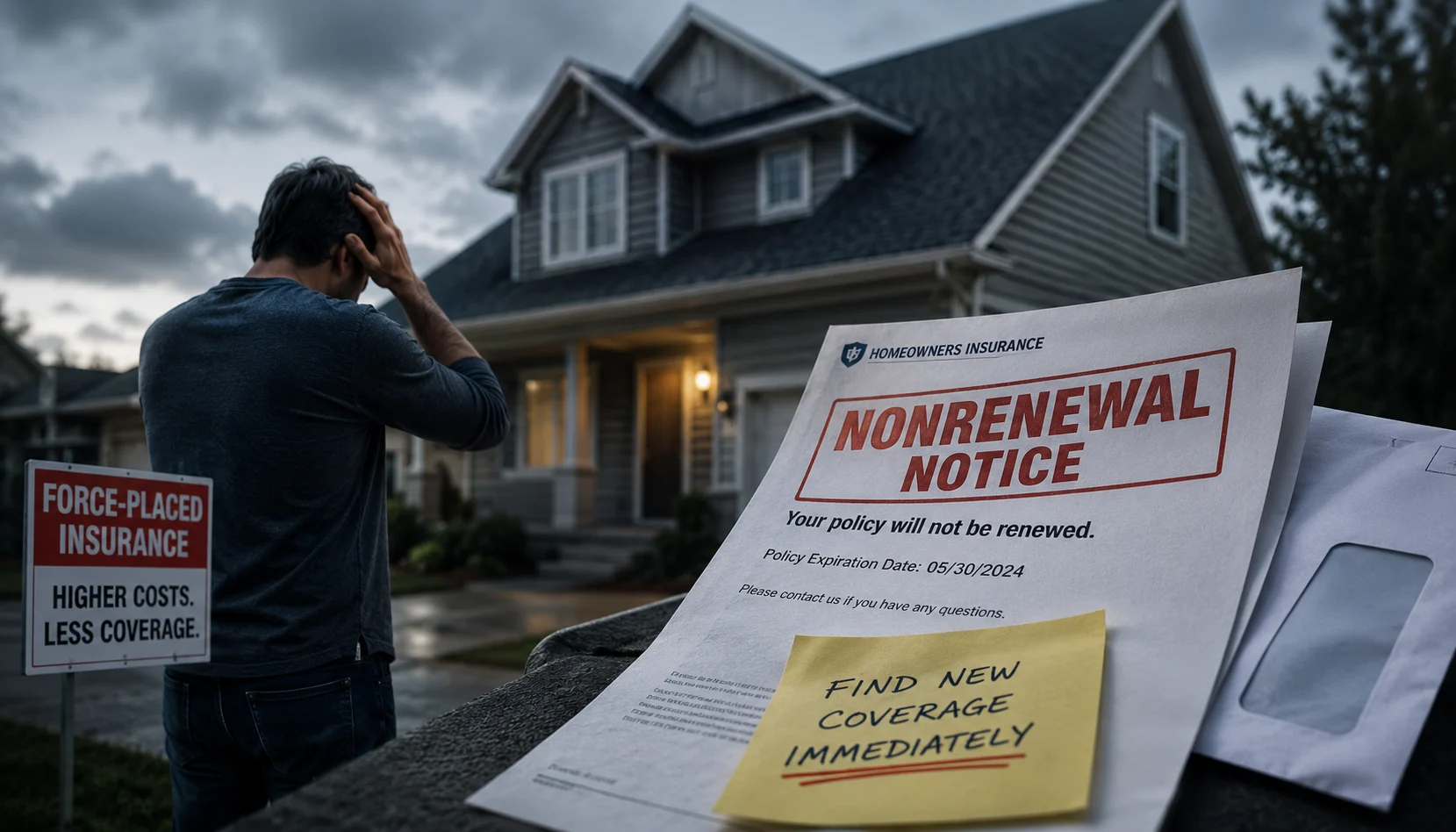
You open an envelope from your insurance company. You brace for a rate hike — you’ve been bracing for one every year since 2021. Instead, you get something worse: a nonrenewal notice. Your policy is ending. Not because you missed a payment. Not because you filed a fraudulent claim. Just… because.
If that’s happened to you, you’re not imagining a pattern, and you’re not alone. A new national analysis from the National Association of Insurance Commissioners — the first report of its kind — just put hard numbers behind something regulators, agents, and homeowners have been circling for years: insurance companies are cutting people loose at a pace that’s genuinely startling.
Let’s talk about what’s actually happening, why it’s not your fault, and — this is the part most articles skip — the specific, unglamorous steps that measurably improve your odds of staying insured.
The Report Nobody Sent You, But Should Have
The NAIC pulled seven years of state-collected data — 2018 through 2024 — from 715 insurance companies writing coverage nationwide. It’s the most complete national picture of the homeowners insurance market anyone has ever assembled, and the headline number is blunt: company-initiated nonrenewal rates rose between 96% and 216% across every region of the country during that span.
Read that again. Not premiums — nonrenewals. The rate at which insurers decide, unilaterally, that they no longer want your business.
Here’s how it breaks down by region:
| Region | Nonrenewal rate increase (2018–2024) | Inflation-adjusted premium increase |
|---|---|---|
| West | +216% | +43% |
| Northeast | +147% | +18% |
| Midwest | +125% | +25% |
| Southeast | +96% | +27% |
The West got hit hardest on both fronts — insurers pulling back and charging more for what’s left. But notice the Northeast: nonrenewals jumped 147% even though premium growth there was comparatively mild. That tells you something important. This isn’t just a “prices are up” story. It’s a “the door is closing” story, and it’s closing in places that don’t fit the wildfire-and-hurricane stereotype.
As of 2024, there were roughly 103 million homeowners insurance policies in force nationwide. Even a small percentage shift in nonrenewals means millions of real households scrambling for coverage — often with 30 to 60 days’ notice, sometimes on a home they’ve lived in for decades.
Why Insurers Are Doing This (It’s Colder Than You’d Think)
Peter Kochenburger, a law professor and NAIC-funded consumer representative, put it plainly to CNBC: insurers nonrenew when they decide the risk of keeping you outweighs the profit potential of insuring you. That’s it. That’s the whole calculation. Your loyalty, your on-time payments, your clean claims history — none of it factors in if the actuarial math says your zip code got riskier.
And the math has been moving fast. Claim frequency and severity climbed sharply between 2021 and 2024, driven by a hotter, wetter, more volatile climate and the rising cost of materials and labor to rebuild after a loss. The NAIC’s own co-authors described a market that’s “overall operationally robust but nonetheless under pressure and exhibiting signs of stress” — corporate-speak for: the insurers are fine, you might not be.
More than half of insurers in every region reduced their total policy count since 2018, even while total industry participation stayed roughly steady. Translation: insurers aren’t fleeing the business — they’re getting pickier about who’s in it. If your roof is old, your neighborhood floods more than it used to, or a wildfire model just got updated to include your street, you can become “undesirable” without doing anything differently at all.
The Trap Almost Nobody Warns You About
Here’s the part that gets buried in most coverage of this story, and it’s the part that can actually cost you real money fast: what happens between the day your policy ends and the day you find a new one.
If you have a mortgage, your lender doesn’t just hope you stay insured — they require it, in writing, in your loan agreement. Their automated systems typically detect a coverage gap within days, not weeks. And when they do, they don’t wait around for you to sort it out. They buy insurance for you, called force-placed (or lender-placed) insurance, and bill you for it.
This is not a deal. Force-placed insurance typically costs two to three times more than a standard policy, and it only protects the lender’s financial stake in the structure — not your belongings, not your liability, not your additional living expenses if you have to move out during repairs. You end up paying more for meaningfully less. If your premium runs through an escrow account, the shortfall gets recalculated and spread across your future mortgage payments, often adding an extra $100 to $300 or more per month until you prove you’ve got real coverage back in place.
There is a federal guardrail here, at least: under rules tied to the Real Estate Settlement Procedures Act, your servicer generally has to send written notice before force-placing a policy, and must cancel that policy within 15 days of you providing proof of your own valid coverage — refunding any overlapping premium. But that protection only helps if you know it exists and you act fast. Most homeowners don’t find out about it until they’re already staring at a higher mortgage bill.
The takeaway: a nonrenewal notice isn’t just an insurance problem. If you let the gap sit for even a few weeks, it can quietly become a mortgage-cost problem too.
If You’ve Already Gotten a Nonrenewal Notice: The First Two Weeks Matter Most
Insurers are required to give advance notice — usually 30 to 60 days, though some states require up to 120. That window is your entire negotiating position, so don’t sit on it.
1. Read the notice for the actual reason. By law, insurers have to tell you why. Sometimes it’s fixable — an aging roof, an overdue tree branch near the house, a trampoline without a fence. Sometimes it’s not — your insurer is simply exiting your state or zip code, in which case nothing you do will change their mind, and you should stop trying and start shopping.
2. Call your agent or insurer before you assume it’s final. If the reason is fixable, ask directly whether a repair or upgrade reverses the decision. Sometimes it does.
3. Start shopping immediately, in parallel — don’t wait to see how step 2 goes. Compare quotes from at least three carriers. If your notice says the insurer is leaving your market entirely, filter your search to carriers still writing new policies there; your state insurance department’s website usually lists who’s active.
4. If the private market says no, look at your state’s FAIR Plan (Fair Access to Insurance Requirements). These are the insurer-of-last-resort programs that exist specifically for homes the standard market has declined. Coverage is typically bare-bones and fire-focused, so you may need to layer a separate policy for the gaps — but it keeps you insured while you keep looking for something better.
5. If something about the process feels wrong — insufficient notice, a reason that doesn’t check out, or you can’t find any coverage — contact your state’s Division of Insurance. Colorado’s consumer advisory is a good example of what these offices actually do: they field complaints, clarify your rights, and can intervene when an insurer isn’t following the law. Every state has an equivalent office, and it’s free.
The Move That Actually Changes Your Odds (Not Just Your Feelings)
Most advice here stops at “shop around after you’re dropped.” That’s damage control. The more useful question is: what actually lowers the odds you get nonrenewed in the first place?
The single most measurable lever, especially if you’re in a wind- or hurricane-exposed state, is your roof. Carriers increasingly price — and nonrenew — based on roof age and construction quality, because roofs are where most catastrophe claims originate. The IBHS FORTIFIED Roof standard, a documented, third-party-verified construction standard that goes beyond typical building code, is the clearest example of insurers putting their money where the data is.
The numbers are unusually concrete for an insurance topic:
- A peer-reviewed 2025 study from the University of Alabama’s Center for Risk and Insurance Research found FORTIFIED-designated homes had 73% fewer insurance claims and 72% lower total losses than standard-construction homes after Hurricane Sally.
- Depending on the state and insurer, FORTIFIED designation can unlock 10% to 40%+ off the wind portion of your premium — and some coastal states now legally require carriers to offer that discount.
- Several states, including Louisiana and Alabama, run grant programs that cover a meaningful chunk of the retrofit cost, precisely because a stronger roof means fewer catastrophe payouts down the line.
You don’t have to live on the coast for the underlying principle to apply. Whatever your regional risk is — wildfire defensible space, updated electrical and plumbing in an older home, sump pumps and backwater valves for flood-prone basements — insurers reward documented mitigation because it changes their actual loss math, not just their impression of you. Ask your agent directly: “What specific upgrade would move my file into a lower-risk category?” It’s a more useful question than “can I get a discount,” and it tends to get a more honest answer.
The second move costs nothing: audit your policy before renewal season, not after a notice arrives. Call your insurer roughly 60–90 days before your renewal date and ask two questions — has anything changed about how they’re rating your property, and is there anything on file (old roof, prior claim, missing mitigation credit) that could trigger a nonrenewal. You’re not asking them to promise anything. You’re getting an early warning while you still have time to act on it, instead of finding out for the first time in a notice letter with a clock already running.
What This Means for You, Bigger Picture
If your state and premium have gotten off relatively easy so far, don’t assume that continues. Nonrenewals rose in every NAIC region, not just the obvious disaster zones. If you’re in a lower-risk pocket today, mitigation and an early relationship with your agent are cheap insurance against becoming next year’s headline.
If you’re already in the middle of this — nonrenewal letter in hand, FAIR Plan looming, escrow account climbing — you’re not being singled out, and you’re not out of options. You have a notice window, a state regulator whose job is literally to help you, and, if you own the underlying asset long-term, real, provable moves (roof, mitigation, documentation) that change how carriers see your risk on paper.
The bottom line: this isn’t a story about your bad luck. It’s a structural shift in how insurers price climate and construction risk, and understanding the mechanics — nonrenewal timelines, force-placed insurance traps, and mitigation credits — is the difference between reacting to a crisis and quietly staying ahead of one.
Got a nonrenewal story of your own, or a mitigation upgrade that actually moved your premium? Drop it in the comments — real numbers from real homeowners are worth more than another projection from an industry report.