Husband won’t stand up to his mother? Discover the small car-ride script that finally got him to defend me — no ultimatum, no cutting off family.
A Wife’s Honest Story of Marrying Into an Enmeshed Family — and the Exact Conversation That Finally Changed Things
I counted the seconds. Four, five, six.
It’s an old habit from labor and delivery — you time things without meaning to, contractions, decels, the space between one sound and the next. At my mother-in-law’s dining room table in Silver Lake, spaghetti sauce drying on my toddler’s bib, I was timing my husband’s silence.
Anthony’s mother had just told me, mid-bite, that I was “letting” our two-year-old eat like an animal. Not asking. Telling. And Anthony — six inches to my left, fork still moving through his own plate, eyes down — said nothing. Again.
If you’ve already had the car-ride-home version of this conversation a dozen times — the one where you finally say something once you’re both buckled in and safe, and he tells you “she doesn’t mean anything by it, that’s just how she is,” and you let it go because starting a fight over spaghetti sauce feels insane — I’m not here to tell you to go no-contact with his whole family. I actually like most of Anthony’s family. This isn’t that.
The Loneliest Seat at a Full Table
Here’s the thing nobody warns you about marrying into a close, loud, loving family: the closeness doesn’t automatically include you defending yourself.
It’s not really about the toddler’s spaghetti, or even about Anthony’s mother specifically. It’s about the particular ache of loving a family this tightly knit and still being the only person at that table required to let things go.
Blind Spot or Choice? The Question That Changes Everything
I didn’t figure anything out that night. I figured it out three Sundays later, in the car, staring at the same stretch of Atwells Avenue I’d stared at a hundred times before, finally asking myself a different question than the one I’d been asking.
I’d been asking, every single time, why won’t he defend me. That question only ever led me to being hurt and him being defensive, which is its own kind of dead end. The question that actually got me somewhere was this: is Anthony choosing his mother over me, every single time, on purpose — or has nobody in his entire life ever taught him that silence itself is a choice?
Those are two completely different problems. They need two completely different responses, and if you use the wrong one on the wrong problem, you’ll spend years like I did.
I built a rough gut-check, over a few weeks of paying closer attention, and if you’re sitting where I was, it might save you some time. Ask yourself three things. Does he acknowledge what happened when you bring it up privately — or does he minimize it, deny it, tell you you’re reading into it? Has this exact pattern of going quiet around his mother existed since before you were even in his life — meaning, on some level, this was never actually about you? And in the moment itself, does he show any discomfort at all — a stiffness, a look, a fork that stops moving for half a second — even if he doesn’t act on it?
Anthony failed the first question a little, every time, softening it into “she doesn’t mean anything by it.” He passed the second one completely — his cousins had told me stories about his mother running the table since he was twelve. And he passed the third one, barely, in a way I’d been too hurt to notice: he never actually defended her either. He just went quiet and hoped it would pass.
That’s a blind spot. A wicked frustrating one. But it’s not the same thing as a man choosing his mother over his wife on purpose, and once I could actually see the difference, I stopped being furious in the same helpless way and started being useful instead.
Here’s a term for what I was seeing, in case you want the word for it: family therapist Salvador Minuchin named this pattern “enmeshment” back in the 1970s — a family system where the emotional boundaries between a parent and child never really separated, so an adult child’s instinct to protect a spouse gets quietly overridden by decades of protecting the parent’s feelings first. You don’t need the word to fix your Sunday dinners. But it’s useful to know that this didn’t start with you, and it isn’t really about you, even when it lands on you.
The Car-Ride Script That Actually Landed
For three years, I asked Anthony for the wrong thing.
I asked him to “stand up to his mother,” which sounds reasonable until you say it out loud to a grown man who has spent thirty-one years being taught that upsetting his mother is a five-alarm fire. “Stand up to your mother” is enormous. It’s abstract. It’s the kind of ask a person nods along to in the car and then has absolutely no idea how to execute three Sundays later when his mother’s already three sentences into criticizing your parenting and the moment is already moving too fast for him to catch up to a vague, sweeping promise.
So I stopped asking for the big thing.
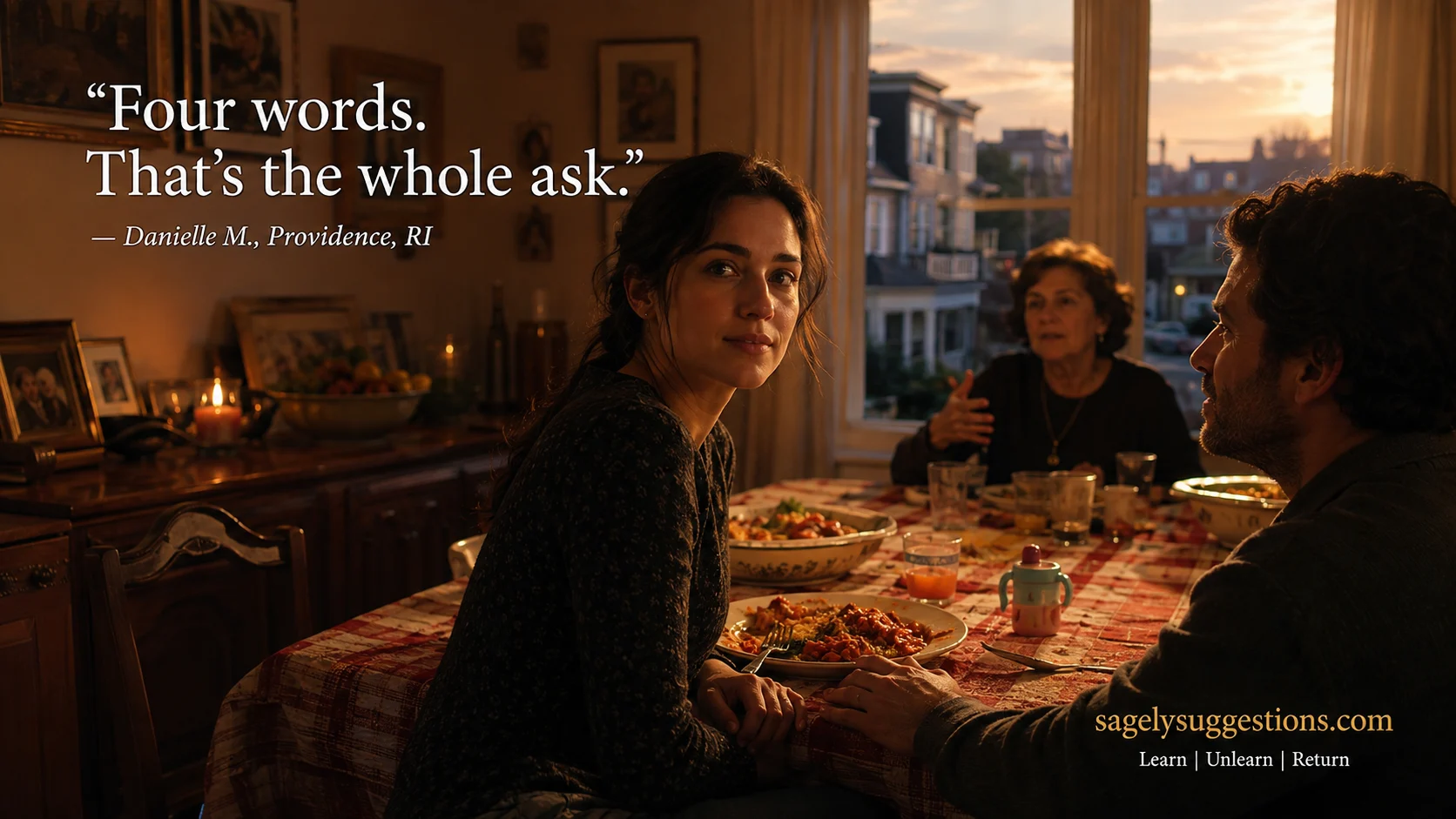
The night this actually turned around, I didn’t say “I need you to stand up for me with your mom.” I said: “Next time she says something like that, I don’t need you to fight with her. I need you to say my name and change the subject. Or just say ‘hey, that’s not fair.’ Four words. That’s it. That’s the whole ask.”
I watched something shift in his face when I said it that small. Because I think, for the first time, he could actually picture doing it.
Try this tonight, whatever your specific version of Anthony’s mother is: don’t ask for the abstract stand. Ask for the one sentence. Next time this happens, I don’t need you to fix her. I need you to say something — anything — on my side, out loud, in the moment. Small and specific beats big and vague every time, because small and specific is a thing a person can actually rehearse in his head before he needs it.
What Changed at the Next Dinner
The following Sunday, same dining room, same tablecloth, a fresh sauce stain in almost the exact same spot as three weeks before.
His mother started in again — something about the toddler’s shoes, this time, not being weather-appropriate, said in that same mid-bite, offhand way that always somehow lands like a verdict.
Anthony’s fork stopped.
It set down, flat, against the plate. Not dramatic. Not a scene. Just — down. And he said, quiet enough that only the people close to us really heard it, “Ma, that’s not fair to Dani.”
That was the entire thing. No blowup. No standing ovation moment. His mother blinked, moved the conversation somewhere else within about four seconds, and dinner kept going like nothing had happened.
But something had happened.
I didn’t make a big deal of it at the table — that would’ve turned his one small brave sentence into a performance, and performances don’t get repeated. I waited until we were back in the car, and I put my hand on his knee, and I said, “Hey. Thank you for that.” That’s all. Four words back, for his four words.
Giving It a Few Weeks, Not One Dinner
Here’s where I could’ve messed the whole thing up: by deciding, right then, that everything was fixed.
One good Sunday isn’t proof of anything yet. It’s a start, and starts are fragile, and if I’d walked into the next family gathering expecting the new Anthony to show up fully formed every single week, I would’ve set us both up to fail. If your brain does the thing mine does — replaying every interaction afterward, grading it, waiting for the other shoe — you’re not broken, you’re just tired, and there’s actually solid research on how to quiet that specific loop that has nothing to do with your in-laws and everything to do with giving your own nervous system a break.
What I did instead was give it a month. Not a running scorecard I held over his head at every dinner — nothing that would turn this into a test he could fail in front of his whole family. Just one honest, private check-in, weeks later, in the kitchen, no audience: “How do you feel like Sundays have been going?” That’s a completely different conversation than “did you defend me enough this month,” and it’s the one that actually keeps a person trying instead of getting defensive.
Where We Are Now
We still go to Sunday dinner. I still love most of that family — genuinely, not performed, not “I’m choosing to love them because I have to.” His mother still says things sometimes that land wrong.
But there’s a new detail in that same dining room now. Before Anthony says anything — sometimes before there’s even anything to say yet — his hand finds my knee under the table first. A small, private signal. I’ve got this one. Not every single time. I’m not going to pretend it’s every time, because it isn’t, and I’m not gonna pretend that was fine, because it wasn’t, for a long stretch of our marriage.
I’m still the one who counts seconds sometimes, out of old habit. But I’m not counting them alone anymore, and there’s a version of this table where I’m not the only person required to let things go.
If you’re driving home from your own version of that dinner tonight, replaying it, rehearsing what you wish you’d said — you don’t need the big speech. You need the four words. Ask him for those instead, and see what he does with them.