Found out your husband hid debt from you? Discover the exact 48-hour action plan, solo credit protection steps, and conversation scripts.
A Wife’s Honest Account of Discovering Financial Infidelity — and the Scripts, Steps, and Hard Truths for the First Week After
The window over the kitchen sink was fogged from the pasta water boiling on the front burner, and my son’s blue nylon backpack was unzipped across two chairs.
It was 4:40 on a Tuesday afternoon in Bloomfield.
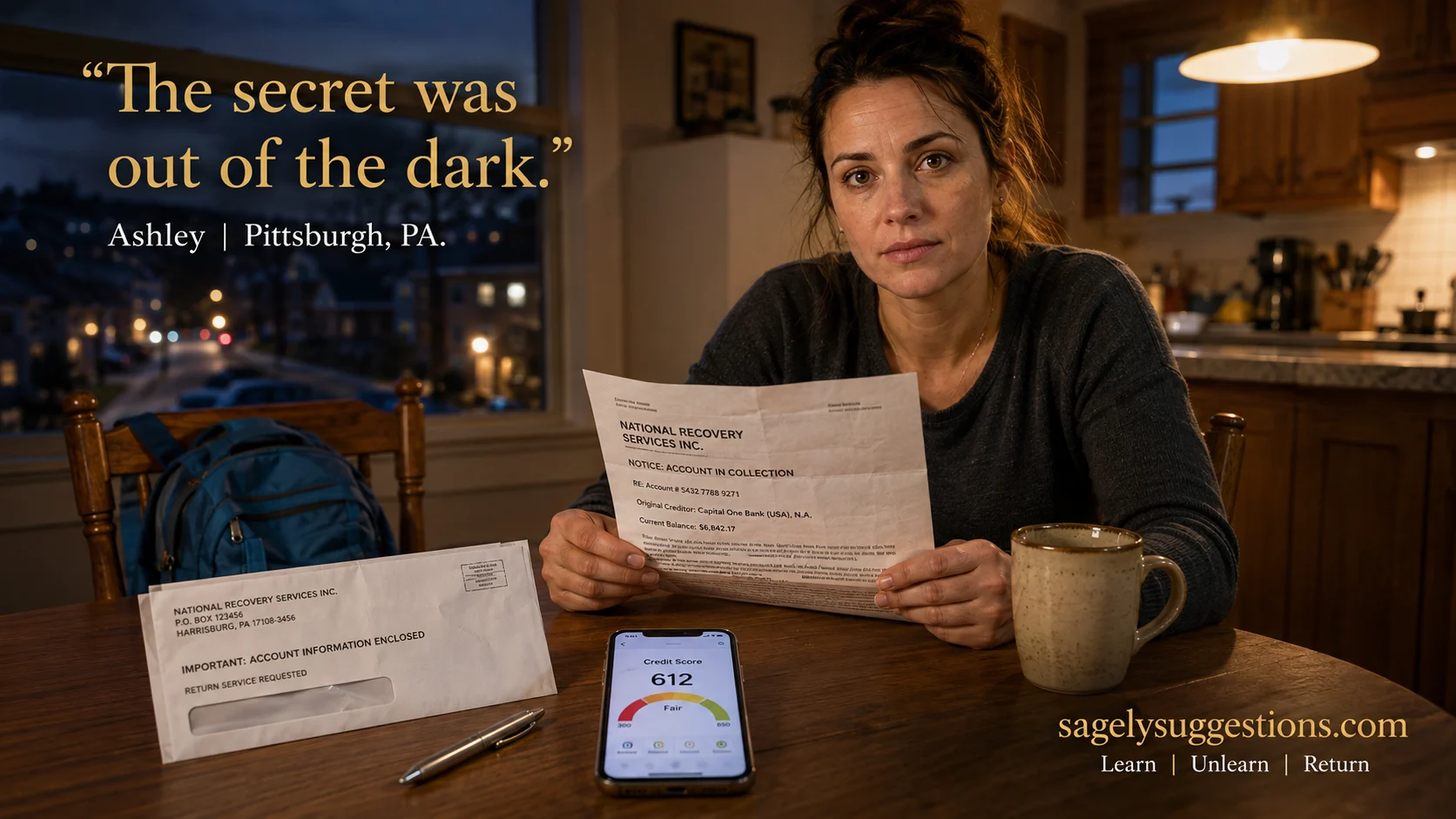
In my left hand, I was holding a white window envelope with a return address from a Columbus collections agency, and for the fourth time in ten minutes, I folded it back along its original crease, smoothing the paper flat against my thumb.
Dave’s shift at the substation ended at 5:30. He’d be home by 6:15, smelling like ozone and cold air, expecting a pan of ziti and a quick rundown of whether I’d remembered to call the pediatric dentist.
If you’ve already tried the quiet approach—checking our joint checking account app every night after he fell asleep, convincing yourself that last month’s missing three hundred dollars was just a cleared check from the hardware store, or asking him generally if everything was okay with money and accepting his quick yeah, we’re fine because you didn’t want to start a fight—you already know what my stomach felt like right then.
It felt like lead dropped into ice water.
Let’s get one thing out of the way immediately, before you decide to close this tab. This isn’t an article telling you to pack his bags, call a lawyer, or march into the bedroom tonight ready to serve papers. I’m not here to hand you a script for a divorce. I’m here because six months ago, I was standing right where you are, holding a piece of mail that turned my six-year marriage into a stranger’s house, and what I needed wasn’t a lecture on emotional regulation.
I needed to know what the hell I was supposed to do in the next two hours before he walked through that front door.
The 48 Hours Before You Say Anything
The number on that letter wasn’t the worst part. The forty thousand dollars across three delinquent accounts and a signature loan I’d never signed for wasn’t even what made my hands shake so hard I dropped my phone on the linoleum.
It was the memory of how ordinary the last six weeks had felt.
We had gone to Shop ‘n Save on Saturday. We had argued about whether to get the name-brand paper towels. We had talked about putting $50 away a month for his brother’s wedding in Erie.
When you find out about hidden debt, the shock isn’t just financial. It’s cognitive whiplash. You realize you’ve been living inside a narrative where you were co-authoring the script, only to find out you were an extra in a play you never auditioned for.
My first instinct—and I’m guessing it was yours, or close to it—was to march into the bedroom, hold the paper under his nose, and demand to know what else he was lying about.
I didn’t do it.
Instead, I sat down at the kitchen table and spent the next two hours doing four things that kept me from losing my footing before Dave pulled into the driveway.
If you are reading this on your phone in a parked car, or standing in your kitchen with your heart in your throat, do these exact things right now.
- Pull your solo credit report on your phone. Do not check the joint apps yet. Go to AnnualCreditReport.com or use a free app like Credit Karma, and check your individual report. You need to know immediately whether any of those hidden accounts were opened using your Social Security number or joint credit.
- Screenshot every joint bank and credit card statement. Do not tell anyone you are doing it. Open your banking apps, take screenshots of the last three months of statements, and email them to a personal email account your husband doesn’t have access to, or save them to a secure cloud folder. When the conversation starts, apps can be logged out of or accounts can be locked. You need a paper trail frozen in time.
- Identify what is legally yours versus his. In Pennsylvania, as in most states, debt incurred during a marriage isn’t automatically shared unless you co-signed or it’s a joint account [1]. But joint assets can be drained in an afternoon. You need to know what cash you have independent access to before you open your mouth.
- Text a trusted friend or family member a location pin and a brief heads-up. Not to gossip. Not to ruin him. Just so someone other than you knows you are walking into a high-conflict conversation alone. I texted my sister Julie: “Found some mail I wasn’t expecting. Going to talk to Dave tonight. Just keeping you in the loop.” That was it.
Protecting yourself financially is not the same thing as deciding to leave. It is simply refusing to be blindsided twice.
The First Sentence Does Most of the Work
At 6:12pm, the headlights swept across the living room wall.
I heard the truck door slam—that heavy, familiar thud of his Ford F-150. I heard his boots on the concrete steps.
When he walked in, he tossed his keys on the counter, leaned over to kiss the top of my head, and said, “Rough one today. Substation three had a breaker blow out.”
For a second, my throat closed up. The normal script was right there waiting for me: ask about his day, nod sympathetically, hand him a beer, let the evening slide into its usual tracks.
Instead, I stayed sitting at the kitchen table. The envelope was face-down under my phone.
I didn’t yell. I didn’t cry. I used the sentence I had scribbled on the back of a grocery receipt twenty minutes earlier.
“Dave, wash your hands and sit down. I opened a letter from a collections agency today addressed to you, and I need you to explain it to me before either of us says anything else.”
The secret to the first sentence during a financial infidelity discovery is simple: lead with the physical evidence, not your interpretation of his character [2].
If you start with “You’re a liar” or “How could you do this to us?”, his nervous system will instantly register it as an attack, and he will go into fight-or-flight or complete shutdown [3]. Men’s heart rates spike faster during conflict and take longer to recover—which means by the time you are ready to have a rational conversation about forty thousand dollars, his body is treating you like a physical threat [4].
You don’t need to coddle him. But you do need to keep the spotlight on the facts long enough that he can’t dodge them.
Here is how the standard emotional traps compare to what actually works during those first ten minutes:
| What We Want to Say (Emotional Trap) | What It Triggers in Him | What to Say Instead (The Direct Fact) |
|---|---|---|
| “What the hell is this? Have you been lying to me our entire marriage?!” | Immediate defensiveness, denial, or yelling about how you’re always interrogating him. | “I found a collections notice for a personal loan I didn’t know existed. Walk me through what this is.” |
| “Are there any other secret credit cards or loans I don’t know about? Tell me right now!” | Panic and partial truth-telling, because admitting everything at once feels like signing a death warrant. | “I need a complete list of every debt or account outside our joint knowledge by tomorrow morning.” |
| “I can’t believe you did this. We are completely screwed, our lives are over.” | Despair and withdrawal; he shuts down and stops talking entirely. | “This is a massive breach of trust, but we are going to look at the numbers together right now.” |
He sat down. He looked at the envelope.
And then, very slowly, Dave put his face in his hands and rubbed his palms hard against his eyes.
“I was waiting for the right time to tell you,” he whispered.
That was when the real work started.
Shame, Addiction, or Deception — Why the Difference Matters
If you stay in the conversation long enough past the initial shock, you will hit a fork in the road.
Most online forums will tell you that hiding debt is financial infidelity, period, and that infidelity means someone is rotten to the core. But real life isn’t a Reddit thread. When you’re sitting across the table from the person who built your life with you, you have to figure out what kind of broken thing you are actually dealing with.
Over the next three days, as we sat at that kitchen table through late nights with cold coffee and yellow legal pads, I realized you have to ask three brutal questions to diagnose what happened:
- Is this contained to a specific period and a specific cause, or is it an ongoing lifestyle? Dave’s debt didn’t come from a secret gambling addiction or a hidden second family. It started two and a half years ago when his union local went through a four-month strike and a subsequent reduction in hours. Instead of telling me—because he was terrified of looking like a failure after my dad had spent five years telling me I married a hard worker—he took out a high-interest personal loan to cover our mortgage payment for two months. Then another. Then interest compounded. By the time he went back to full hours, the snowball was rolling downhill faster than his paycheck could chase it.
- Did he stop hiding it the moment he was confronted, or did he minimize, lie further, or try to snatch the paper away? If someone’s immediate instinct is to gaslight you, hide phone screens, or claim the bill is a scam when you know it isn’t, you are dealing with active deception. If their shoulders drop and they stop fighting you—even if they cry or get defensive at first—you are dealing with a man drowning in paralyzing shame.
- Is there a pattern of financial secrecy before the marriage? Check the history. Was he evasive about credit scores when you bought the car? Did he dodge talking about student loans? If this is a chronic operating system, it’s a character flaw. If it’s an acute crisis born of pride and panic, it’s a structural disaster—which is terrible, but it can be repaired.
Shame makes people do monumentally stupid things. It makes grown men who love their wives stare at a pile of past-due notices and pretend that if they don’t open them, the mail carrier is hallucinating.
That doesn’t excuse it. Not for a second. I told Dave that night: “Your pride almost cost us our family. You protected your ego while letting me walk around blindfolded.”
He didn’t argue with that. He just nodded and slid the rest of the collection letters out of his work bag and put them on the table. All of them.
What You Say to Everyone Else
By Thursday morning, my head was throbbing behind my eyes, and my phone kept buzzing with group texts from my mom asking if we wanted to come over for Sunday pierogies.
The hardest part of week one isn’t just managing your husband. It’s managing the perimeter.
Your first instinct will be to either lock down like a vault—telling absolutely no one because you’re terrified of what people will think of your marriage—or calling your sister, your mom, or your best friend in tears and giving them every gory detail.
Both instincts will poison you.
If you tell no one, you are carrying a forty-thousand-dollar secret alone inside your own house, which makes you feel like an accomplice to his lie. But if you tell your family every raw detail in the heat of anger, you cross a line you can never uncross. Once your mother knows your husband lied about forty grand, she will never look at him the same way again—even if you two forgive him and rebuild next year.
You need a middle gear. What I call the vague-but-honest perimeter script.
When my mom called on Thursday afternoon asking why my voice sounded tight, I didn’t lie, but I didn’t give her the headline either.
“Mom, Dave and I are dealing with some heavy financial stress right now—some unexpected debt we’re sorting out. We’re going to be a little quiet for the next week or so while we get our heads around it. I know you love us, but we just need some space to handle it between the two of us first.”
Notice what that script does:
- It names the reality without inviting an immediate interrogation.
- It sets a boundary before opinions can be offered.
- It protects your husband’s dignity from permanent family collateral damage while ensuring you aren’t pretending everything is fine.
You don’t owe the world your marital audit. But you do owe yourself a safe harbor where you don’t have to fake a smile.
The Pivot
By Sunday evening, the yellow legal pad on our kitchen table was covered in columns of numbers, interest rates, and a tentative debt-management schedule we’d pulled together using a free online calculator.
Dave had called the collections agencies on speakerphone while I sat across from him with a pen, making sure he didn’t agree to any payment plans we couldn’t sustain on our actual take-home pay.
The collections letter from Columbus—the one that started it all—was no longer folded up in my hand like a weapon.
It was sitting flat and uncreased under a heavy ceramic coffee mug, right in the center of the table where we both had to look at it.
The Close
We didn’t fix forty thousand dollars in forty-eight hours.
Our checking account balance didn’t magically rebound, and my chest still tightens every time an unfamiliar piece of mail drops through our front door slot. Trust isn’t something you superglue back together over a weekend; it’s something you rebuild brick by brick by leaving your phone unlocked and checking the statements together on the first of every month.
When you find out your husband has been keeping secrets behind your back, your entire world shrinks down to the size of a single room.
You feel foolish for not seeing the signs earlier, and furious that you have to clean up a mess you didn’t start.
But as I sat across from him on Sunday night while he typed up a spreadsheet of his overtime hours, I realized something that kept me from drowning.
The secret was out of the dark.
The letter was flat on the table, and for the first time in six years, we were both looking at the exact same numbers.
If you are holding that letter tonight, take a breath, lock down your solo credit, and remember that whatever is written on that paper doesn’t define your strength. You are not the naive wife, and you are not trapped.
Open the envelope, set the facts on the table, and demand an honest accounting.
You can decide what to build from there. But tonight, you are no longer walking in the dark alone.
References
- Pennsylvania General Assembly. (2024). Title 23 – Domestic Relations – Marital Property and Debt. Pennsylvania Consolidated Statutes. https://www.legis.state.pa.us/
- Gottman, J. M., & Silver, N. (2015). The Seven Principles for Making Marriage Work: A Practical Guide from the Country’s Foremost Relationship Expert. Harmony. https://www.gottman.com/
- Sagely Suggestions. (2025). Stop Overthinking and Communicating Under Stress: Research-Backed Strategies. https://sagelysuggestions.com/stop-overthinking-research-backed-strategies/
- Levenson, R. W., & Gottman, J. M. (1983). Marital interaction: Physiological linkage and affective exchange. Journal of Personality and Social Psychology, 45(3), 587–603. https://doi.org/10.1037/0022-3514.45.3.587