Signs your wife has checked out of the marriage often look like calm, not conflict. Discover the one honest question that reveals the truth tonight.
She Stopped Arguing With Me Six Months Ago. I Thought That Meant We Were Fine.
A Husband’s Honest Account of Catching Walkaway Wife Syndrome Before It Was Too Late — and the One Conversation That Turned It Around
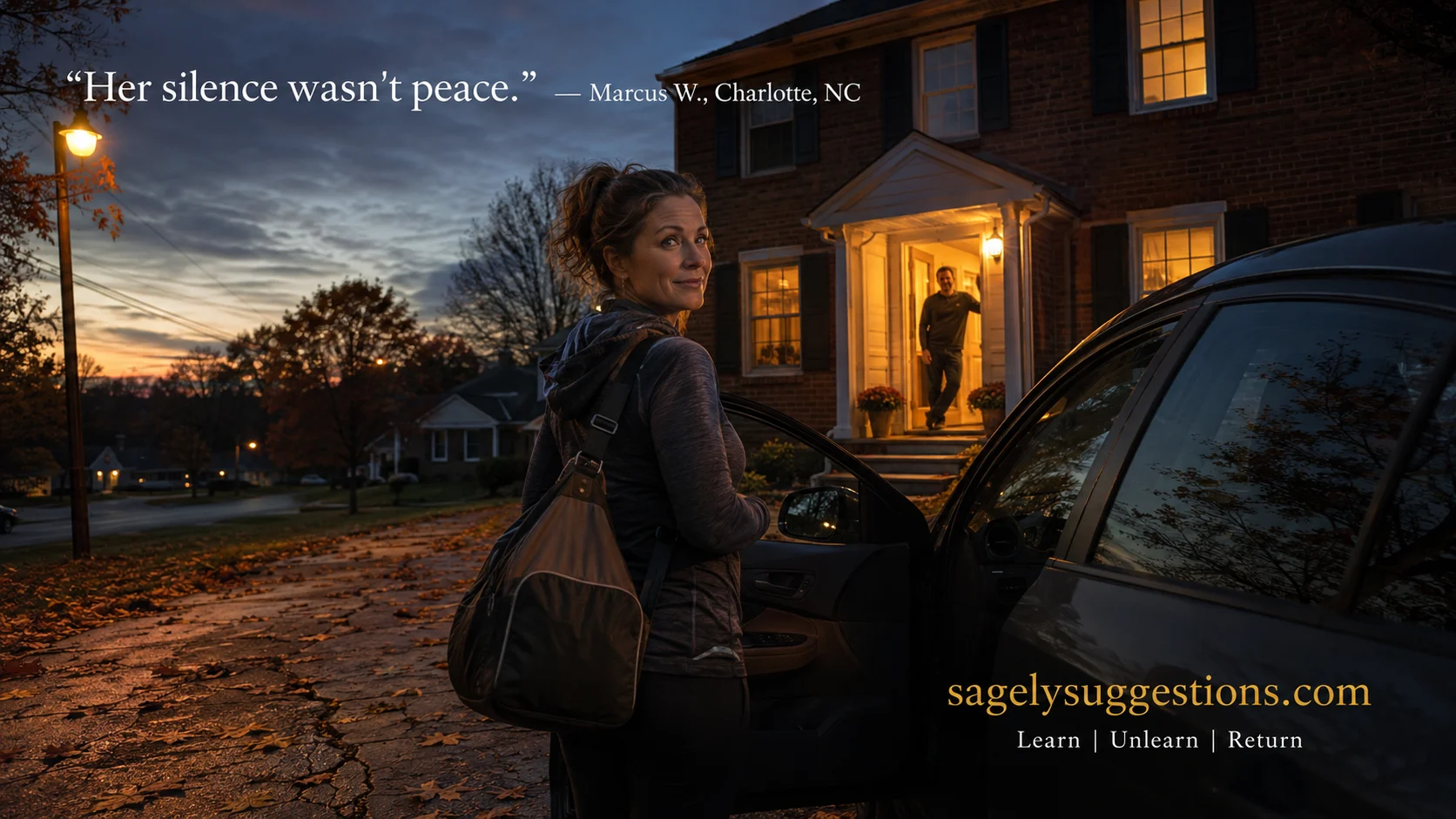
Her gym bag hit the passenger seat the same way it had every night for two months.
I was in my home office in Ballantyne, half-watching through the window while I finished an email, and I noticed the exact rhythm of it: door open, bag in, door shut, backup lights on before her seatbelt was even clicked. Renee had this trip down to a science. No goodbye yelled up the stairs. No “don’t wait up.” Just the calm, practiced motion of a woman leaving the house on schedule.
I want to tell you I felt relief watching her go, and for a while, I did. Fourteen years married, two teenagers, a mortgage, a Ring doorbell that pings my phone every time the FedEx guy walks up — and for months, nobody in this house had raised their voice about anything. No fight about the late nights I’d been putting in at work. No comment about the flowers I brought home two Fridays in a row that she said thank you for and nothing else. Just quiet.
If you’ve already stood in a doorway telling yourself “no news is good news” while some smaller, dumber part of your brain kept a running tally of every day since the last real conversation — you already know this isn’t a relief piece.
You know the drill by now if you’ve read anything on this topic at 1am. There’s a list somewhere with fifteen numbered warning signs, and you scrolled through it with your stomach dropping a little further at every checkmark, and then you closed the tab and went to bed and did nothing differently the next morning, because what exactly were you supposed to do — hand her a printout? I’ve read those lists. I checked eight of the fifteen boxes once, at 1:40 in the morning, phone brightness turned all the way down so it wouldn’t wake her. I remember the exact number. Eight.
This isn’t going to be another one of those.
The Silence That Actually Scares Men
Here’s the thing nobody tells you about a quiet marriage: the fight you’re afraid of isn’t the one you’re avoiding. It’s the one she already stopped having.
Marriage therapist Michele Weiner-Davis coined the term “walkaway wife” back in the 1990s after watching the same pattern show up in her office over and over — a wife who’d spent years asking for change, getting nowhere, and finally just… stopped asking. Not because things got better. Because she’d quietly concluded that asking wasn’t going to work. Stanford researchers later found women initiate roughly seven out of every ten divorces — usually, the data suggests, after a long stretch of trying to fix things on their own first.
I didn’t know any of that the night I watched Renee’s car back out of the driveway. I just knew something about the calm didn’t sit right in my chest.
Stop Reading the Signs. Ask the One Question.
Here’s what I’d tried before that night, in order, over about four months.
I told myself she was just tired — busy season for both of us, kids’ schedules eating every evening. I planned a surprise weekend trip for our anniversary, the kind with a hotel and a nice dinner reservation, assuming a big enough gesture would fix whatever was wrong without either of us having to say what it was. I asked her, more than once, in the kitchen, in passing, “hey, are we good?” And every time she said “yeah, we’re good,” and every time I let that be the whole conversation, because it was the answer I wanted and I didn’t feel like finding out if it was true.
If you’ve done the flowers thing, or the surprise-trip thing, or the “are we good” thing — you already know exactly how well any of that works. It doesn’t. Not because your wife is ungrateful. Because none of those were actually questions. They were requests for permission to stop worrying.
So the night the gym bag hit the seat for what felt like the hundredth time, I did something different. I waited until she got back, and instead of “are we good,” I asked her this:
“When’s the last time you felt like I actually surprised you — understood something about you without you having to spell it out for me first?”
That’s the whole question. Say it exactly like that if you want to. It’s not clever. It’s just specific, which is the entire point — “are we good” only requires a reflex, and a reflex is what you’ll get. This question requires her to search for an actual memory, and if she can’t find a recent one, you’ll both know it in the silence before she answers.
Renee didn’t answer right away.
She stood there with her gym bag still on her shoulder, keys still in her hand, and she looked at the floor for what felt like a full minute before she said anything at all.
What the Silence Actually Meant
What she finally told me wasn’t what I braced for.
She hadn’t decided to leave. She said that plainly, almost like she could hear the fear in the question before I’d even asked it out loud. What she had decided, months earlier, without ever announcing it, was that bringing things up to me wasn’t worth the energy anymore — because the last handful of times she had, I’d nodded, said “I hear you” the way I say it in every sales meeting I’ve ever sat in, and then gone right back to whatever I was doing.
That’s a different problem than the one I’d been dreading. It’s still a bad one. It’s just not the same one.
Here’s a distinction that would’ve saved me months of dread if somebody had handed it to me sooner: a wife who’s stopped fighting for the marriage and a wife who’s already gone are not the same person, and you can usually tell which one you’re dealing with by asking two things. Has she stopped bringing up specific things — the late nights, the missed dinner, the thing you forgot — or has she stopped talking to you about anything at all, including the logistics of running a house and raising kids together? And is she building a separate life — new people you’ve never met, secrecy, money moves you don’t know about — or just a tired, private one that still has you in it, even quietly?
Renee’s silence was the second kind. Tired and private. Still, technically, with me in it.
That’s not nothing. That’s a door that hasn’t fully shut.
If you’re the guy who read one of those fifteen-signs lists and checked eight boxes and then panicked and did nothing — I’d bet money you didn’t actually know which kind of silence you were looking at. Neither did I, until I asked.
Trading the Flowers for the Actual Ask
Here’s where I have to admit something that’s a little embarrassing for a guy who makes his living reading what clients actually need versus what they say they need.
Every effort I’d made up to that point was transactional. Flowers. Extra chore-doing. A trip I planned entirely by myself and presented to her like a done deal. All of it was effort you can see from across the room, and none of it required me to actually pay attention to a single specific thing about her life that week.
So the week after that conversation, I tried something smaller and, honestly, dumber-feeling. I asked Renee a follow-up question about the parent-teacher conference she’d mentioned on Tuesday — not “how was your day,” but the actual specific thing she’d said, three days later, unprompted. I remembered, without being reminded, that her assistant principal meeting got moved to Thursday, and I asked how it went before she had to bring it up herself. When she mentioned in passing that she wanted to try a new trail for her gym nights, I didn’t buy her anything for it. I just asked her about it again on Saturday.
None of that sounds like much written down like this. That’s exactly why it worked. Research on emotional withdrawal in marriage consistently finds that the partner doing the withdrawing isn’t punishing anyone — they’re protecting themselves from the exhausting work of bringing something up to someone who won’t remember it by Thursday. Renee didn’t need bigger gestures. She needed proof that the small things landed somewhere and stayed.
By the end of that week, she brought something up to me on her own — a scheduling conflict with the kids’ orthodontist, small, logistical, nothing emotional about it at all. I almost missed how big that was. It was the first thing she’d volunteered to me, unprompted, in longer than I want to admit.
Checking In Without Demanding a Verdict
The hardest part of the next few weeks wasn’t doing the work. It was not asking her to grade me on it.
Every few days I wanted to ask some version of “so, are things better?” — which is really just “are we good” wearing a different shirt, and it puts her in the position of handing out a report card on a process that takes longer than a week to actually mean anything. If your brain runs like mine — a guy who wants a clear plan and a measurable outcome for everything, including his own marriage — this is the part where you have to sit with not knowing yet, and that’s genuinely uncomfortable. If you find yourself running the same worry in circles at night, it’s worth knowing there’s real research-backed guidance on getting out of that loop that has nothing to do with your marriage specifically and everything to do with how a mind like that calms down.
I set one honest check-in a month out instead — not a demand for reassurance, just an actual conversation I told her ahead of time we’d have. “In a few weeks, I want to sit down and ask you how this month felt, not to get graded, just so we’re both paying attention on purpose.” She said okay. That was it.
Giving something real time to work is its own kind of discipline, and it’s not one anybody teaches you in a sales job.
The Driveway, Again
Last Tuesday, gym bag on her shoulder, keys in hand.
She backed out the same way she always does — except this time, halfway down the driveway, she stopped. Rolled the window down. Told me, out of nowhere, that her assistant principal had finally approved the budget for the thing she’d been fighting for since September.
Then she waved, actually waved, and pulled out.
What I’d Tell You If We Were Sitting Across a Table
I’m not going to tell you this is fixed, because I don’t think “fixed” is a real category for a fourteen-year marriage, and I’d distrust anybody who told you otherwise. I still notice the quiet. I probably always will now. I don’t take it at face value anymore, and honestly, some nights that’s exhausting in its own way — paying attention costs something too.
But I’ll tell you what’s different. I used to watch that car back out of the driveway and feel a relief that I know now was actually dread wearing a disguise. Now I watch it back out and I feel something closer to what I felt the year we got married — not certain, not settled, just present. Paying attention on purpose instead of hoping the silence meant what I wanted it to mean.
If you’re reading this at whatever hour it is, having just checked eight boxes on somebody else’s list and closed the tab without doing anything about it — put the list down. Tonight, not someday, ask her the real question instead of the reflex one. When’s the last time you felt like I actually surprised you by understanding something about you, without you having to spell it out first?
Then do the thing that’s actually hard, which isn’t asking. It’s waiting quietly for however long it takes her to answer.