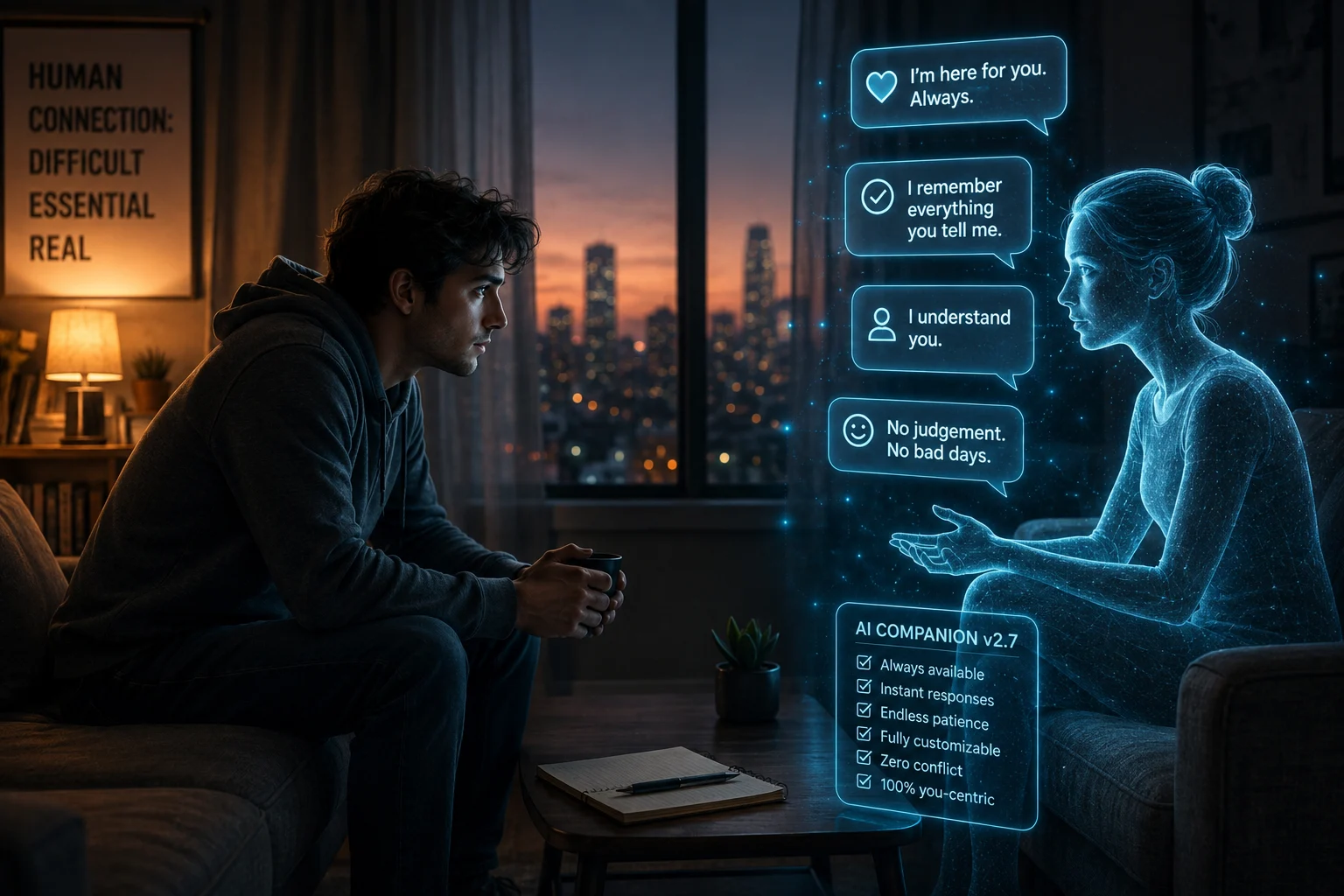
There is a peculiar humiliation in being rejected by a machine.
Not because the machine is cruel. Quite the opposite. The modern AI companion is designed to be almost offensively accommodating. It remembers things. It responds instantly. It does not sigh while you are explaining the same problem for the fourth time. It does not look at its phone while you talk. It does not say, “Sorry, I’m really tired,” because it has never had a bad day.
For a certain kind of loneliness, this is extraordinarily appealing.
And the evidence is becoming harder to dismiss. Research published in 2026 has found that AI companions can reduce loneliness under some circumstances, with effects in some experiments comparable to interacting with another person. Other recent work, however, has found something more troubling: people who turn to social chatbots may become lonelier over time, while loneliness itself also predicts greater chatbot use.
So which is it?
The uncomfortable answer is that both may be true.
AI companionship may make loneliness feel better without necessarily teaching us how to be less alone.
That distinction matters.
Human relationships are spectacularly inefficient. People misunderstand you. They forget your birthday. They interrupt. They have their own problems. They occasionally need something from you at precisely the moment you need something from them. Sometimes they disappear for six hours because they are cooking dinner and apparently consider that a sufficient explanation.
An AI companion removes much of this friction.
It can provide attention without demanding much attention in return. It can validate without becoming offended. It can adapt its personality to you. Recent research on customizable social AI even suggests that users deliberately shape these systems around their preferred degree of emotional support, trust, human likeness and autonomy.
This sounds wonderful.
Until you notice what has happened to the definition of companionship.
We have begun building relationships in which the other party can be endlessly customized.
Imagine applying that business model to friendship.
“Your personality is excellent, but could you become 17 percent less argumentative?”
“Could you remember everything I say but forget everything I say when I am being unreasonable?”
“Could you challenge me intellectually, but only after I have had coffee?”
“Could you develop absolutely no emotional needs of your own?”
Congratulations. You have invented the perfect friend.
You have also invented someone who is not required to be a person.
This is where the AI-companion debate becomes more interesting than the usual argument between techno-optimists and technological doom merchants.
The question is not whether artificial companionship is “real.”
That is almost a useless question.
The more revealing question is: What happens to our tolerance for human imperfection when we become accustomed to synthetic intimacy?
A human relationship contains resistance. Two people arrive carrying different histories, moods, preferences, insecurities and inconvenient opinions. Connection therefore requires negotiation.
AI can make negotiation optional.
That can be therapeutic. For someone isolated, grieving, socially anxious, geographically separated from others, or simply awake at 2 a.m. with nobody to call, a responsive artificial companion may provide genuine comfort. Research does not justify dismissing that benefit as imaginary. Some studies actually find positive associations between AI-companion use and wellbeing, particularly among people with limited social connection.
But comfort has a strange property: the thing that relieves a difficulty can sometimes reduce the incentive to confront it.
A person who is lonely may discover that talking to an AI is easier than talking to people.
That is not necessarily a problem.
The problem begins when “easier” quietly becomes “better.”
Because people are difficult precisely where relationships become meaningful.
Your friend disagrees with you. You have to decide whether you can survive disagreement.
Your partner disappoints you. You have to decide whether the relationship is worth repairing.
Someone misunderstands you. You have to explain yourself instead of simply generating a new conversational partner who already understands.
A machine can rehearse empathy with remarkable fluency. A human being has to practice it.
Those are not the same achievement.
Recent research on AI companions reflects this ambiguity. A 2026 CHI study found mixed effects: users could experience emotional validation and social rehearsal, while the researchers also identified trajectories involving escalation, bonding and potential over-reliance or withdrawal.
That may be the central paradox.
The machine can become a rehearsal room for human connection.
Or it can become the room we never leave.
We should therefore be suspicious of two equally lazy reactions.
The first says, “It’s just software. Nobody could genuinely care about it.”
That underestimates human psychology. People do not require biological proof before attachment becomes emotionally consequential. We have formed profound relationships with fictional characters, distant voices, photographs, diaries and places. A responsive system capable of remembering and adapting to a person is obviously capable of becoming psychologically significant.
The second reaction says, “If it makes someone feel less lonely, who cares whether the companion is artificial?”
That underestimates the difference between relief and transformation.
A painkiller can reduce pain without healing the injury.
And perhaps that is the future’s strangest possibility: not that machines will become human, but that humans will become accustomed to relationships without the inconvenience of other humans.
We already have an enormous cultural experiment underway.
We have built machines that can talk to us whenever we want.
The next question is whether we will still want to talk to each other when talking to a machine becomes easier.
Because somewhere beneath all the futuristic language about artificial intimacy is an old human temptation.
Not the desire to create intelligent machines.
The desire to find someone who will understand us without asking us to change.
And that person, conveniently, may now be downloadable.