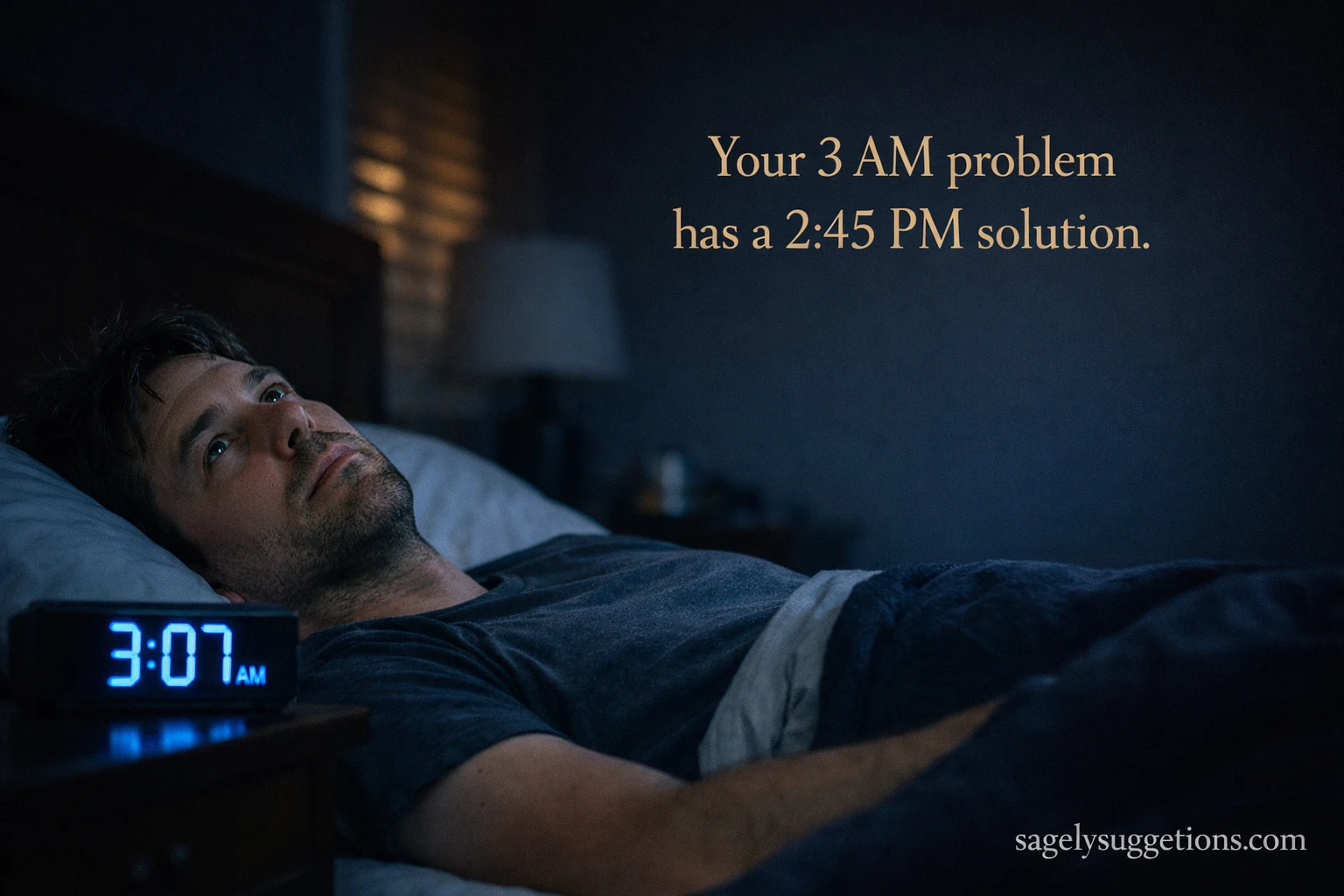
Why you wake up at 3 AM traces to choices made hours earlier. This forensic breakdown reveals the caffeine, blood sugar, and cortisol chain — and three fixes.
Your 3 AM Wake-Up Has a Paper Trail — Here’s What It Says
You’re not broken — you’re predictable. This forensic breakdown traces the exact daily decisions that trigger your 3 AM cortisol spike, hour by hour.
It’s 3:07 AM. You’re awake. Without moving, you’ve already done the math — if you fall asleep in the next ten minutes, you can still get 3 hours and 28 minutes. You know, because you’ve done this math before. Last Tuesday. The Tuesday before that. Most Tuesdays, and most non-Tuesdays too.
You’re not anxious about anything specific. Work is fine-ish. The kids are asleep. There’s no active crisis demanding attention at this hour. And yet here you are, ceiling-gazing at a time that has no place in your schedule, watching your sleep score sink in real time and wondering, again, what you’re doing wrong.
Here is the thing no article has told you — and it’s the reason you’re still searching at three in the morning: that math you’re running right now, the desperate 3:07 AM sleep arithmetic, is itself a cortisol-producing act. Your brain just read the situation as a problem to be solved and fired accordingly. But that’s not where the story starts. The story started at 2:45 PM, when you reached for your third coffee of the day.
Your 3 AM wake-up is not a sleep problem. It is a daytime behavior problem wearing sleep’s clothes — and it arrives on a 12-hour biological delay so consistent that, once you see the paper trail, you won’t be able to unsee it.
More than one in three American adults report waking in the middle of the night multiple times per week. Most of them have already tried melatonin. Most found it solved the wrong crime — it helped them fall asleep faster but did nothing for the 3 AM event, which is a categorically different biological phenomenon. And if you’ve also tried moving your last coffee earlier and still woke up at 3, you’re ahead of most people. You’re still missing the mechanism that matters most.
Let’s reconstruct the day.
The Mechanism
What Your Body Is Actually Doing Between 2 AM and 4 AM
The human sleep cycle isn’t a single unbroken arc of unconsciousness. By 2–3 AM, the body has already completed its heaviest slow-wave sleep phases and is shifting into lighter, REM-dominant territory. Simultaneously, cortisol — your primary alerting hormone — begins its natural pre-dawn rise, preparing the body for wakefulness several hours in advance. This is the cortisol awakening response, and it is not a malfunction. It is your biology operating exactly as designed.
The problem is a matter of threshold. A healthy sleeper’s cortisol rise at 3 AM is gradual enough that they stir briefly and drift back under without surfacing to full wakefulness. In someone whose baseline arousal is already elevated — from unmetabolized caffeine, a blood glucose crash, or psychological activation — that same cortisol signal clears the threshold. The eyes open. The math begins.
Cortisol and melatonin operate in direct opposition: each suppresses the other. When daytime choices elevate your baseline arousal into the evening, they suppress melatonin more aggressively — leaving less of it available to dampen the 3 AM cortisol rise. The see-saw tips, and you wake up fully instead of stirring briefly.
Think of it as a relay race where the baton was dropped at 2:45 PM. Each runner passes it across several hours: caffeine arousal feeds into blood glucose disruption, which feeds into an insulin response, which feeds into a glucose crash, which triggers a counter-regulatory cortisol release. By the time the last runner crosses the 3 AM threshold, the original baton-drop is almost invisible. Which is exactly why — lying awake at 3:07 AM — nothing feels like it should be causing this.
It already happened. Hours ago. The 3 AM moment is just where the invoice arrives.
Fingerprint One
The 7:15 PM Dinner Nobody Suspects
This is the piece that almost no mainstream sleep content covers, and it’s the one most likely to make you look back at last night’s dinner with entirely new eyes.
A high-carbohydrate evening meal — a large plate of pasta with garlic bread, say, eaten around 7:15 PM — produces a predictable blood glucose arc. Glucose rises sharply in the 60–90 minutes after eating, peaks somewhere around 9–10 PM, and then triggers an insulin response. As insulin does its job, glucose drops. In many adults, particularly those with any degree of early insulin sensitivity disruption, that nadir arrives right around 2:30–3:00 AM.
When blood glucose drops low enough, the body interprets it as a physiological emergency. The counter-regulatory response is to release cortisol — specifically to prompt the liver to release stored glucose and restore balance. This mechanism, known as the Somogyi Effect, is more commonly discussed in diabetic contexts, but it operates on a spectrum across the general population. Your body does not check whether you’re trying to sleep before it fires the alarm. It fires the alarm. And you’re awake.
7:15 PM: pasta dinner consumed. 9:00 PM: blood glucose peaks. 10:30 PM: insulin response, glucose begins dropping. 2:45–3:15 AM: glucose nadir; cortisol counter-response fires. 3:07 AM: you’re awake, doing math that makes it worse.
The fix isn’t to skip dinner or eat sparingly. It’s to shift the glycemic profile and, where possible, the timing. A dinner built around protein, healthy fats, and fiber-dense carbohydrates produces a slower, shallower glucose arc — one that doesn’t bottom out at the same depth or the same hour. Moving dinner from 7:15 PM to 6:00 PM shifts the entire timeline by 75 minutes, which can be the precise difference between a glucose nadir arriving at 2:15 AM, when you’re still in deeper sleep stages and unlikely to surface, versus 3:00 AM, when the cortisol wave is already rising and the threshold is paper-thin.
That’s not vague dietary advice. That’s a mechanism, a timestamp, and a lever you can actually pull.
Fingerprint Two
The 2:45 PM Coffee and Its 12-Hour Shadow
Caffeine has a half-life of approximately 5–7 hours in most adults, though genetics and liver enzyme activity can push that range toward 9–10 hours in some individuals. Take a working average of 6 hours for purposes of this reconstruction.
A standard large coffee contains roughly 200mg of caffeine. At 2:45 PM, that’s the third cup of the day. Run the half-life math forward:
200mg active
Peak concentration. Adenosine receptors are blocked. Alertness is elevated. This is the cup that “gets you through the afternoon.”
~100mg active
First half-life. You feel tired, but not as tired as you should be. Melatonin onset is delayed. You reach for your phone in bed because you’re not quite ready to sleep.
~50mg active
Second half-life. You’re asleep — but slow-wave sleep architecture is compressed. Your brain is spending less time in the deepest, most restorative stages.
~25mg active
Still enough to sustain light sleep staging. When the cortisol wave arrives, there’s no depth of sleep to absorb it. The threshold is cleared. Eyes open.
This is the mechanism that explains why moving your coffee from 2:45 PM to 1:00 PM helps a little but doesn’t fully solve the problem. One hour of earlier timing removes roughly one partial half-life’s worth of caffeine from the midnight calculation — a real improvement at the margins, but not a resolution if the blood glucose crash is still arriving at 3 AM on schedule. You’ve removed one of two triggers, not both.
Research on afternoon caffeine and sleep architecture has been consistent: caffeine consumed even six hours before bed measurably reduces slow-wave sleep, even in people who report no trouble falling asleep. The problem, again, isn’t falling asleep. It’s the sleep depth that determines how vulnerable you are to that 3 AM cortisol rise. Shallow sleep and a rising cortisol curve is not a combination that keeps you unconscious.
For reliable 3 AM protection, the practical caffeine cutoff isn’t 2 PM or 1 PM — it’s before noon for any third cup, or before 2 PM if you’re keeping total daily intake under 300mg. The goal isn’t to feel less alert in the afternoon. The goal is to arrive at 3 AM in deep sleep, not light sleep, so the cortisol wave finds you where it can’t reach.
Fingerprint Three
The 3:07 AM Loop That Builds a Second Spike
You’re awake. The biological triggers have already done their work. Now here is where the forensic trail gets self-generating — and where most articles on this subject stop paying close attention.
The moment you check the clock and begin calculating remaining sleep, your brain classifies that activity as a cognitive task under conditions of urgency. That classification triggers its own cortisol release — a psychological stress spike layered directly on top of the biological one already in progress. Research on mid-sleep psychological activation suggests this secondary spike can extend the light-sleep window by 40–90 minutes. Which is why you finally drift off around 4:30 AM and the 6:10 alarm feels like an act of institutional cruelty.
The compounding is the real problem. The biological spike gets you to the surface. The psychological response keeps you there. And every behavior that feels most instinctive in those first 60 seconds of wakefulness — checking the clock, calculating, beginning to narrate the problem to yourself — is precisely what guarantees the extended wake window. The wake-up builds its own extension.
There’s also a pattern-reinforcement layer worth naming directly. If you’ve been waking at 3 AM for weeks, your brain has begun anticipating it. Conditioned arousal — where the brain learns to activate at a specific hour because it has done so repeatedly — can sustain the wake-up pattern even after the original biological triggers are partially resolved. The 3 AM event can outlast its causes by two weeks or more. This is not a failure of willpower. It’s your brain being efficient in exactly the wrong direction.
This conditioned loop is also the reason that the obsessive optimization impulse can become its own liability. Downloading a sleep-tracking app to solve a sleep problem sometimes deepens the anxiety around sleep, wiring the brain to treat unconsciousness as a performance metric. That’s a category error. Sleep that is evaluated is sleep that is watched — and sleep that is watched is sleep that is harder to sustain.
The 3 AM behavioral rule is this: do nothing. Don’t check the clock. Don’t calculate. Don’t reach for the phone. Don’t narrate the problem internally. Your only job in that window is to be as physiologically boring as possible. No cognitive task — no matter how small or apparently harmless — is neutral at 3 AM. Each one adds cortisol to an already-active system. Stillness is the only input that doesn’t make it worse.
Counterintuitive? Completely. More effective than any supplement, white noise machine, or breathing protocol? Consistently — because it addresses the mechanism, not the symptom. The secondary cortisol spike is optional. It only fires if you generate the cognitive input that triggers it. You can, with some practice, simply not.
Case Closed
Three Changes. Three Timestamps. One Paper Trail.
The evidence is in. Your 3 AM wake-up is not a character flaw, a stress disorder, or a sign that something is fundamentally wrong with your body. It is a biological chain of events that your daytime decisions set in motion, arriving on a delay precise enough to feel random but consistent enough to trace. You loaded every chamber before you went to bed. The 3 AM event just pulled the trigger.
Your cortisol system is functioning correctly. The problem is that you handed it a glucose nadir at 3 AM, a quarter-dose of caffeine still circulating in your central nervous system, and a shallow sleep architecture with no buffer depth to absorb the wave. Of course it woke you up. The biology is doing exactly what it was built to do. The question is whether your daytime choices are asking it to do that at 3 AM or letting it do it quietly at 5:45, when it won’t cost you anything.
The Verdict: Three Adjustments, Three Timestamps
Before 12:00 PM — cap or cut the third coffee. Keep total daily caffeine under 300mg and end intake by 1:00 PM at the latest. Not because caffeine is the enemy, but because its half-life math leaves roughly 25mg still circulating at 2:45 AM — just enough to keep you in the light-sleep window where the cortisol wave can catch you. An earlier cutoff removes that cushion from the 3 AM equation entirely.
Before 6:00 PM — finish dinner, or shift its composition. If 6 PM isn’t realistic, change the meal: more protein and fiber-dense vegetables, fewer high-glycemic carbohydrates, smaller portion. The goal is a slower, shallower blood glucose arc — one whose nadir arrives at 2:15 AM while you’re still in deeper sleep, not at 3:00 AM when the cortisol rise is already underway. Every 30 minutes you move dinner earlier shifts the nadir approximately 20–25 minutes earlier.
At 3:07 AM — do nothing. This is the least intuitive and the most immediately impactful of the three changes. Don’t check the clock. Don’t calculate. Don’t engage cognitively with the situation in any form. The biological spike will pass in 15–25 minutes if you don’t feed it a second stimulus. The moment you engage, you generate a secondary cortisol surge and add 40–90 minutes to the wake window. Boredom, practiced deliberately, is the protocol.
Two of those three changes happen before 6 PM. Your 3 AM problem has a 2:45 PM solution — and a 7:15 PM accomplice. The paper trail was always there. Now you know where to look.
The next time your sleep score lands in the 60s, don’t audit last night. Audit yesterday afternoon.
Discover more from Sagely Suggestions
Subscribe to get the latest posts sent to your email.