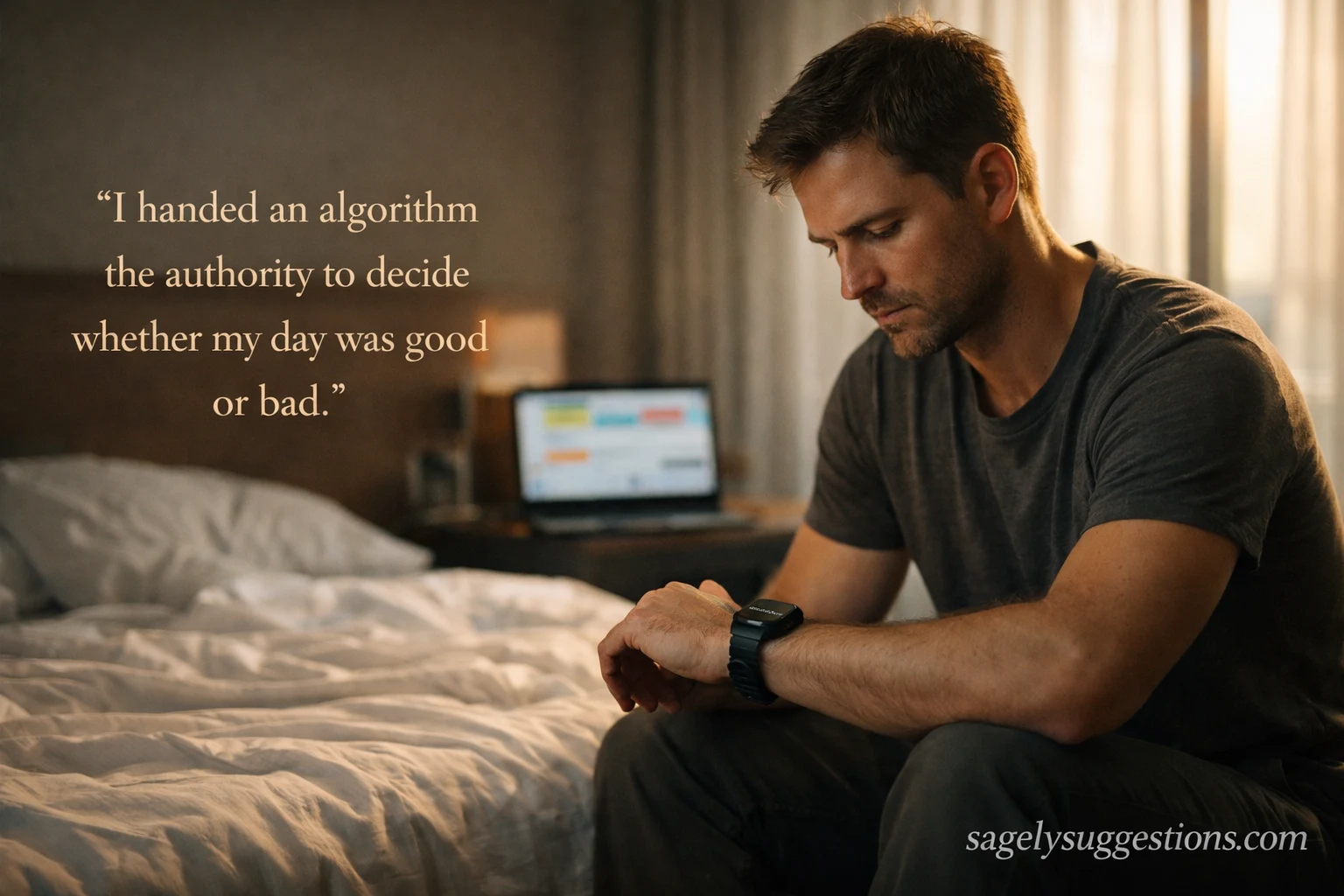
When habit tracking became self-surveillance, I crashed. This raw essay explores why wellness culture burns us out — and one simple practice that rebuilt my internal compass.
I Tracked Everything and Got Worse at Being Me
I optimized my sleep, habits, and mood for 18 months. Then I crashed. Here’s what happens when self-improvement becomes self-surveillance — and how I found my way back without throwing the Garmin into the ocean.
It was 6:47 AM in a Cancún hotel room on the first morning of a vacation I’d spent four months planning, and I was anxious. Not about anything real. My Garmin said my body battery was at 34.
Thirty-four. Out of a hundred. I lay there running a silent triage in my head — not of the day ahead, not of the beach, not of the margarita I’d mentally promised myself at noon. I was auditing my sleep data, trying to figure out which of the previous night’s variables had betrayed me. Was it the airport food? The redeye? The single whiskey at 10 PM? My wife asked if I was okay. I said yes. What I meant was: my recovery score is sub-optimal and I’m not sure how to process that emotionally.
Yeah. I was that guy.
I’m writing this because I spent eighteen months building what I genuinely believed was the most rigorously optimized version of my daily life — and somewhere inside all that structure, I had quietly stopped living it. This isn’t a productivity piece with a softer tone. I’m not going to suggest five fewer things to track. What happened to me was stranger than burnout and more specific than stress, and if you’ve felt the dull anxiety of opening a wellness app and finding the number wrong before you’ve even decided how you feel, you already know what I mean.
Part OneHow a Reasonable Person Ends Up Here
Nobody decides to surveil themselves. That’s the thing nobody writes about, because it makes the story harder to tell and easier to recognize. You don’t wake up one day and declare: from now on, an algorithm will determine whether I had a good morning. You just make a sequence of small, individually sensible decisions, and one day you look up and the apparatus is complete.
For me it started with a Garmin — a birthday gift, nothing sinister. Sleep tracking felt like useful data. Then came the HRV readings, because HRV predicts stress response and I was heading into a heavy stretch at work. Then a journaling app because the research on expressive writing for anxiety is genuinely solid. Then a Notion dashboard because I was already logging the data and it seemed wasteful not to structure it. Then a breathwork app because my stress scores were “elevated.” Then a reading tracker. Then hydration reminders. Each layer made sense. Together they formed something that didn’t.
Optimization is a gradient, not a switch. The slide from self-improvement to self-monitoring to self-surveillance happens slowly enough that you don’t feel the terrain change beneath you. You just notice one morning that you’re in Cancún feeling guilty about a number, and you start to wonder when the number became the point.
The move from useful tracking to compulsive surveillance doesn’t feel like a fall. It feels like diligence. Every step looks responsible in isolation. The trap is invisible until the moment it closes.
The sociologist Jeremy Bentham designed the Panopticon — a prison where a single guard could observe every cell simultaneously. The prisoners, never knowing when they were being watched, eventually began policing themselves. Michel Foucault used this image to describe how modern institutions produce well-behaved subjects without brute force: the watching eye gets internalized. I’m not suggesting your Oura ring is a panopticon. I’m suggesting that what happened in my Cancún hotel room was structurally identical: I had become my own guard, and I was never off duty.
Part TwoThe Thing the Apps Don’t Tell You About Your Own Body
Here is the piece of information I wish someone had handed me eighteen months earlier, written on an index card and taped to my first tracker: you already have a dashboard. It’s been running your entire life. It’s called interoception — the neurological system by which your brain registers and interprets signals from inside your body. Heart rate, hunger, fatigue, emotional temperature, the quality of your attention. It’s how you knew you were tired before you checked the app. It’s how you knew something was off before you could name it. It is, in short, the instrument you were born with for the exact purpose you bought the wearable.
Here is the part that should concern you: interoceptive intelligence — your ability to accurately read those internal signals — is a capacity that can be strengthened or weakened by behavior. Sustained mindfulness practice reliably improves it. And external monitoring, over time, can degrade it. Not because the data is wrong. Because every time you check the app before checking yourself, you’re training a small but consequential habit: I don’t trust my own read. Let me ask the machine.
The metrics don’t reveal your internal state. They progressively replace your relationship with it. What begins as a supplement to self-knowledge quietly becomes a substitute for it.
“The tracker isn’t making you healthier. It’s making you more dependent on external permission to feel okay.”
Think about the student who, instead of learning the material, spends all their study time color-coding their notes. The notes become immaculate. The exam still fails them. The ritual of preparation has replaced the substance of preparation. That was me — in a wellness costume, color-coding my Notion dashboard at 9 PM instead of asking myself a simpler question: how do I actually feel right now?
By the time I hit Cancún, I had 547 days of continuous mood-logging and I genuinely could not tell you what my baseline emotional state was without checking. That’s not data richness. That’s a disconnection problem wearing a quantified-self hat.
Constant external metric-checking trains your brain to distrust interoception — your native ability to sense your own internal states. The app doesn’t make you more self-aware over time. It makes you less capable of self-awareness without the app.
The Moment I Understood What I’d Actually Done
I want to be precise about the moment things shifted, because it wasn’t the Cancún morning — that was just the symptom I couldn’t ignore. The actual recognition happened three weeks later, in a conversation with a friend who works in behavioral psychology. I was explaining my system to her, which I did with a sort of sheepish pride, the way you describe an elaborate sandwich you’ve been quietly perfecting. She listened carefully. Then she asked one question.
“When you say you had a good day — how do you know?”
I opened my mouth and what came out, after a pause long enough to be embarrassing, was: “I check my Notion. Deep work hours logged, HRV was decent in the morning, mood log was a six or above, gym box is ticked.”
She nodded. Then: “So the day has to pass a review before you’ll let it be good?”
I didn’t have an answer. Because the answer was yes, and the implications of yes were uncomfortable. I had outsourced my capacity for self-satisfaction to a system I had designed — which meant I was both the warden and the prisoner, and I’d been so busy maintaining the prison that I’d forgotten to ask if anyone actually needed to be locked up.
This is what separates what I went through from ordinary productivity burnout. I wasn’t overworked. My calendar was manageable. The issue was that I had confused measuring myself with knowing myself — and those are not the same activity. The data had become a proxy for self-understanding rather than a tool in service of it. And the gap between those two things is where the anxiety lived.
The cultural scaffolding that made this easy to miss
The wellness-optimization complex is a remarkably efficient machine for producing the experience of self-improvement without requiring much actual change. Wearables, premium apps, personalized supplement stacks, biohacking protocols — what they sell, beneath the clinical framing and the clean UI, is something simpler and more seductive: a feeling. The feeling of working on yourself. The sensation of being the kind of person who takes this seriously. And that feeling is real, and genuinely pleasurable, and it can be reliably produced by the act of tracking — whether or not the tracking produces any underlying improvement.
The tracker scratches the itch. It does not close the wound. And if the itch returns — if the anxiety spikes again, if you wake up hollow despite green metrics — the system’s implicit answer is always the same: you need more data, better inputs, a tighter protocol. The cure for not feeling better is always more optimization. Which is how you end up anxious in Cancún, interrogating a wrist score, on day one of the vacation that was supposed to be the reward.
Part FourRecalibration, Not Quitting
I didn’t throw the Garmin away. This isn’t that kind of story. I’m not going to perform a dramatic renunciation of technology and pretend I now live on morning walks and handwritten journals. I still use the tracker. I still log. What changed was the order of operations — and that change was small enough to sound trivial and large enough to rearrange everything.
The practice is this: before I check anything external, I check in with myself first. Not in a meditative, incense-and-intention way — just a ten-second pause before picking up the phone. How do I feel? Not how did I sleep? Not what does my HRV say about my readiness? Just: what’s actually happening inside me, right now, before the machine has had a chance to tell me?
It sounds almost insultingly simple. But what it does is restore the correct hierarchy: interoception as primary instrument, external data as supporting evidence. Your body’s read comes first. The app’s read is available for corroboration, context, or curiosity — not for permission.
Forget “rest days from tracking.” That’s a behavioral intervention for an identity problem. The real shift is reversing the order of operations: feel first, then check data. Always. This is how you rebuild interoceptive trust — not by using fewer tools, but by insisting your own read goes first.
The distinction the apps will never teach you is the one between data as servant and data as authority. A servant shows up when you ask. An authority decides whether you qualify. For eighteen months I had let a collection of sensors serve as my authority, and what I got in exchange was a very detailed record of a life I was simultaneously failing to inhabit.
The metrics haven’t changed. My sleep score last Tuesday was 71 — “fair,” per the app. I woke up feeling genuinely rested and spent two quiet hours finishing a book I’d been meaning to read for months. The day was good. I noticed that first. The app’s assessment was a minor footnote — interesting the way weather data is interesting. Context, not verdict.
That’s what recovery from self-surveillance looks like. Not a dramatic protocol. A quiet restoration of the thing that was always meant to be in charge.
The most self-aware thing I’ve done in the last year wasn’t a habit, a practice, or an optimized morning block. It was admitting that I had mistaken measurement for understanding — and that the cost of that mistake was a kind of alienation from myself that no amount of green metrics was ever going to fix.
You already have the most sophisticated biometric sensor ever built. It’s been running continuous diagnostics since the day you were born. It doesn’t need a subscription, doesn’t require calibration, and its data is never wrong about what it means to be you — specifically, today, in this moment. The only question worth asking about your wellness stack is whether the tools are serving that instrument, or slowly replacing it.
And if you’re not sure, try this once: tomorrow morning, before you look at a single score, a single metric, a single color-coded cell — ask yourself how you feel. Then wait for the answer. Not the data. Your answer.
See whose voice comes back.
One action, starting tomorrow: Place your phone face-down and spend sixty seconds doing an honest body check — not a mindfulness protocol, just a real question: how am I? — before touching your tracker or opening any app. Write the answer in one sentence if you want. Then look at the data. Do this for seven days. You’re not abandoning the system. You’re reclaiming your seat at the head of it.
Discover more from Sagely Suggestions
Subscribe to get the latest posts sent to your email.