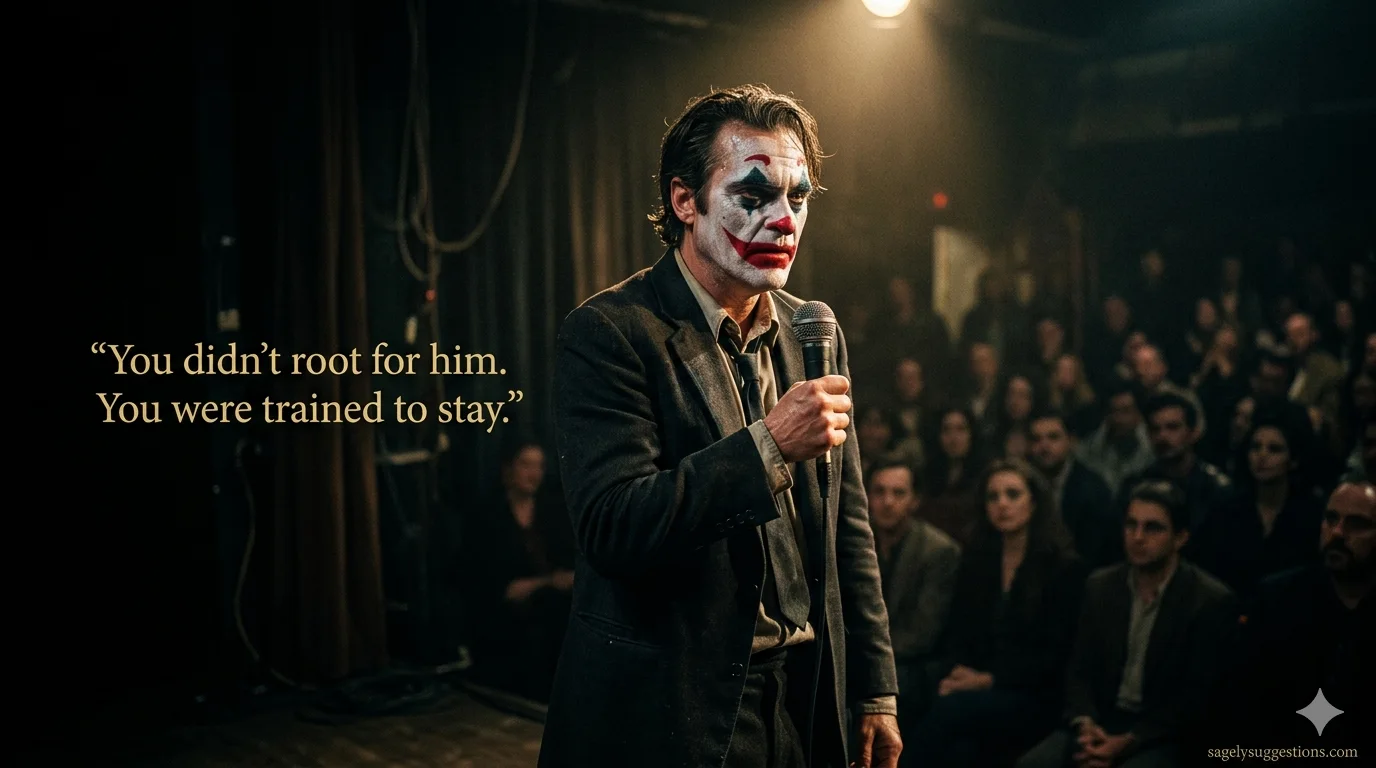
Joker film psychology reveals how audience manipulation and storytelling shaped your empathy. Discover the hidden mechanics behind your reaction. Read now.
Joker 2019: Why You Rooted for a Killer Before You Knew It
The studio lights burn hot. Murray Franklin sits behind his desk, smiling that practiced television smile. Arthur stands center stage, red suit tailored just right, green hair catching the glare. He pulls the revolver from his jacket. The safety clicks off. One shot. Murray’s head snaps back. Blood blooms across the white shirt like spilled paint.
The audience in the theater doesn’t gasp. Doesn’t look away. Some lean forward.
That exhale—that’s the moment this article exists to examine. Not whether Arthur Fleck deserved to pull that trigger. Not whether Todd Phillips made a dangerous film. But why your nervous system accepted violence as catharsis before your conscious mind could intervene.
If you’re reading this at 11:47 PM after a ten-hour day designing interfaces for healthcare software you don’t believe in, if you caught yourself thinking “I get it” during the subway scene and spent the next twenty minutes wondering what that says about you—this isn’t an intervention. It’s an excavation.
The riot was already won before Arthur fired a shot. Here’s how Todd Phillips reverse-engineered your sympathy—scene by scene, lie by lie.
The Sympathy Ladder: How the Film Climbed Your Nervous System
Most analyses treat Joker as Arthur’s descent. That’s the wrong direction. The film doesn’t move downward—it moves through you. Each act of violence isn’t a destination; it’s a checkpoint the film had been building toward in your own emotional architecture.
Think of it like a legal defense closing argument. The attorney doesn’t ask you to approve of the crime. They ask you to understand the client well enough that you can’t apply full moral weight to the verdict. Research on cinema empathy shows that audiences form parasocial bonds with characters through repeated exposure to their suffering, regardless of subsequent actions.
The Bus Scene: Isolation Before Incident
Arthur tries to cheer a crying child. The mother recoils. You witness rejection before violence. Your mirror neurons fire for his pain, not the child’s safety.
The Clown Attack: Victim Blaming by Framing
Teenagers beat Arthur for no reason. The camera stays on Arthur’s face during the assault, not the attackers’ motives. You feel his helplessness, not their humanity.
The Subway Shooting: Violence as Self-Defense
Three men corner him. One touches Sophie without consent. The film positions the killing as protective before it positions it as murder.
The Mother’s Hospital Scene: Betrayal Before Break
Arthur discovers Penny’s lies. His entire identity collapses. The Murray shooting now feels like grief, not psychosis.
The Murray Franklin Show: Televised Catharsis
By now, you’ve climbed four rungs. The fifth doesn’t feel like a choice. It feels like arrival.
This isn’t accidental. Cinematographer Lawrence Sher confirmed that the camera never shot Arthur at eye level in early scenes—always high or low, fractured, isolated. The frame itself taught you how to feel before Phoenix moved a muscle.
The Proximity Paradox: The shots of Arthur are very close but on wider lenses—intimate within close proximity. This creates a neurological conflict: your brain registers closeness (safety) while the lens distorts (danger). That conflict is where sympathy lives.
Pillar 1: The Architecture of Earned Violence
What Came Before Each Killing
The subway shooting doesn’t happen in a vacuum. It happens after:
- Arthur being fired from his only job
- His comedy notebook stolen and mocked
- The social worker cutting his therapy sessions
- Three grown men following him onto public transit
Each indignity functions as a pre-loading mechanism. By the time Arthur pulls the trigger, your nervous system has already processed four separate injustices. The violence doesn’t feel like initiation—it feels like culmination.
“Everything we tried to do there is to try to draw the audience into Arthur’s point of view.” — Lawrence Sher, Director of Photography
This is craft, not accident. The film positions each violent act as the only available response to accumulated harm. You’re not asked to condone murder. You’re asked to recognize the pressure that made it feel inevitable.
Pillar 2: What the Camera Chose Not to Show
Dehumanization by Omission
The three men on the subway have no names. No backstories. No moments of tenderness shown on screen. They exist only as threats to Arthur’s body. This isn’t oversight—it’s strategic erasure.
Studies on parasocial interaction demonstrate that audiences extend empathy proportionally to screen time and emotional access. The film gives you Arthur’s laughter, his dance, his tears. The victims get silhouettes and screams.
Consider the inverse: if the film had shown one of those men texting his daughter before following Arthur, would the shooting land the same way? The answer disturbs you because you already know it.
The Moral Weight Distribution: Every minute of screen time is a vote for whose pain matters. Joker allocates 97% of its emotional access to Arthur. The remaining 3% goes to people who hurt him. This isn’t representation—it’s recruitment.
Pillar 3: Hildur Guðnadóttir’s Score as Emotional Pre-Loading
Music Before Motion
Here’s the fact most analyses miss: Hildur Guðnadóttir composed most of the score before filming began. Todd Phillips played her cello-heavy compositions on set while Phoenix performed. The actor wasn’t interpreting a scene—he was interpreting music that had already decided what you should feel.
The bathroom dance scene—often cited as Arthur’s transformation moment—was Phoenix’s real-time response to Guðnadóttir’s track. The music told him how to move before he knew where the camera was.
This reverses the standard filmmaking process. Usually, composers score to picture. Here, the picture scored to emotion. The result: your nervous system receives the emotional instruction before the visual information lands. You feel before you see.
“He was having a bit of a hard time getting into the character and finding this transformation. The director started playing this music to him on set. This scene is Joaquin’s response to the music.” — Hildur Guðnadóttir
Pillar 4: The Unreliable Narrator Problem and Its Moral Consequences
Does Knowing Change Feeling?
Todd Phillips has confirmed that Arthur is an unreliable narrator. Sophie’s relationship with him may not have existed. His mother’s abuse may be memory or delusion. Approximately one-third of the film’s emotional content exists only in Arthur’s head.
Here’s the question that keeps Marcus up at night: Does knowing this retroactively change how you felt during it?
If your answer is no—that’s the film’s real achievement. It engineered sympathy so effectively that factual uncertainty doesn’t dissolve it. Your emotional investment survived the revelation that some of it was built on fiction.
This isn’t a bug. It’s the feature. The film argues that emotional truth and factual truth operate on separate tracks. You can know something is constructed and still feel it as real. That’s not weakness. That’s how cinema works.
The film isn’t about whether Arthur deserved better from society. It’s about whether the filmmakers deserved better from their own ambition—because the movie works emotionally precisely by refusing to resolve the moral question it raises. That irresolution isn’t depth. It’s strategy.
It’s an audience conditioning study disguised as a villain origin story.
The real transformation isn’t Arthur’s. It’s yours.
What This Means for You (Yes, You)
You watched Joker in 2019. Or maybe you watched it last month on a streaming service after someone mentioned it in a Slack thread. Either way, something happened in your chest during the Murray Franklin scene that you haven’t fully examined.
Neuroscience research on cinematic empathy distinguishes between two modes: automatic embodied simulation (your body responding before your mind processes) and cognitive perspective-taking (your mind analyzing what your body felt). Joker targets the first mode so aggressively that the second mode never catches up.
This doesn’t make you dangerous. It makes you human with a nervous system that responds to craft. The question isn’t whether you should have felt what you felt. The question is whether you’re willing to examine why you felt it.
Marcus, if you’re still reading at 12:34 AM with your student loan payment due in six days and a lease that just went up 18%—this article isn’t asking you to feel guilty about a movie. It’s asking you to recognize that your emotional responses are data. They tell you something about the film’s construction and something about your own interior landscape.
Both are worth examining. Neither requires shame.
The Recruitment Question: You suspect the film didn’t just entertain you. It recruited you. That suspicion is correct—but recruitment isn’t inherently immoral. Every story recruits. The difference is whether the story admits it. Joker doesn’t admit it. This article does.
The Discomfort Is the Point
In 2026, with political polarization at a cultural peak, every piece of media gets interrogated for what it “makes you feel” toward the wrong people. You’re caught between a generation that pathologizes empathy for fictional villains and your own honest reaction to the film.
This article offered you a framework—not a verdict. The framework says: your sympathy is information about the film’s craft, not evidence of your character. That distinction matters because it lets you examine the experience as a thinking adult rather than a passive consumer.
Watch one scene from Joker again—the subway shooting or the Murray Franklin moment. This time, pause after every cut. Ask: “What did this shot just do to my nervous system, and why did I let it?” Write down three answers. Share one with someone who won’t judge you for having felt what you felt.
For more deep dives into how films engineer emotional responses, explore our analysis of emotional architecture in modern cinema or read our breakdown of narrative manipulation techniques across contemporary storytelling.
The question is: what will you do with that knowledge now?
Discover more from Sagely Suggestions
Subscribe to get the latest posts sent to your email.