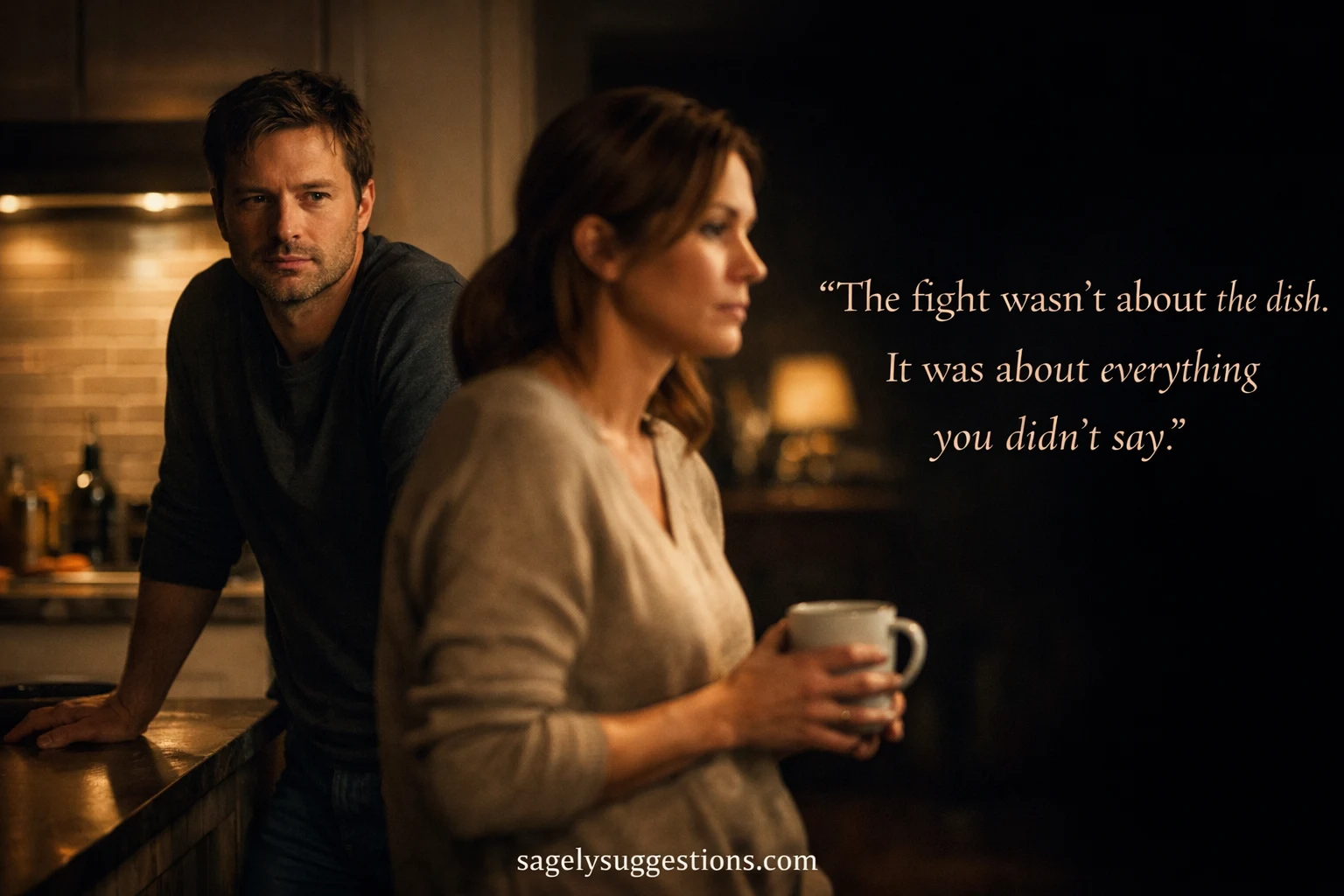
Stop gunnysacking with 8 proven strategies for better marriage communication & emotional regulation. Evidence based guide to Newly Wed Husband to prevent blowup
Gunnysacking: A Newly Wed Husband’s Proven Guide
You’ve already read the version of this advice that tells you to “just communicate more.” Great. Very useful. Here’s the thing — you weren’t not communicating because you hadn’t thought of it. You were doing it because every unspoken irritation felt smaller than the conversation it would take to raise it. And then one Tuesday, a dirty dish broke something open and you heard yourself say words you can’t un-say.
This piece isn’t about communication tips dressed up in a tie. It’s about the actual neurological and behavioral mechanics of why the sack fills, why men flood faster than women, and exactly what to do in the window between “that bothers me” and “I’ve been storing that for six months.” Evidence-backed, specific, and skipping straight to what works — starting right now.
💡 Idea 1 — The 2-Hour Micro-Complaint Window Skill Type: Life | Evidence: Strong
The Idea: You’re not storing grievances because you’re conflict-averse — you’re storing them because small irritations feel too small to mention. But research on cumulative annoyance shows that every unspoken irritation compounds. One low-key sentence delivered within 2 hours of the incident stops the storage before it starts. Size-small now beats sack-busting later.
Why This Works: Unaddressed irritations don’t dissolve — they compound. Addressing them at emotional threshold 2 prevents the explosion that arrives at threshold 10.
Why This Beats Common Advice: “Communicate more” is fog. This gives a specific delivery window before the grievance gets filed away permanently.
Real-Life Situation: She leaves the coffee cup on the counter again. James says: “Hey babe, can we sort a spot for mugs? Drives me a little crazy” — and goes back to his phone.
Immediate Micro-Action: Text yourself right now: “Next small thing that bugs me — one sentence within 2 hours. That’s it.”
Do NOT Apply When: You’re already flooded. Wait until calm; then deliver the one sentence.
🧠 Idea 2 — Name the Emotion Before You Open Your Mouth Skill Type: Soft | Evidence: Strong
The Idea: Before James decides whether to speak or swallow, he pauses and names the exact emotion — “I’m feeling dismissed” instead of just “I’m pissed.” UCLA neuroscientist Matthew Lieberman’s fMRI research found that precise emotion labeling immediately reduces amygdala activation. Vague rage can’t be aimed. Precise emotion can be delivered. This is the circuit breaker between feeling something and either storing it or detonating it.
Why This Works: Naming an emotion activates the prefrontal cortex and quiets the amygdala — the brain’s brakes engage before the mouth does.
Why This Beats Common Advice: “Count to 10” suppresses emotion. Precise labeling processes it — cutting reactivity at the neurological source itself.
Real-Life Situation: Before approaching his wife, James pauses and thinks: “I feel unappreciated — specifically, like my effort at work is invisible here.” He now has a workable feeling, not a grenade.
Immediate Micro-Action: Think of one current irritation. Name it in this format right now: “I feel ___ when ___ happens.”
Major Caveat: This requires precision. “Angry” triggers reactivity. “Dismissed” gives you something actionable to say.
Do NOT Apply When: You’re mid-argument. Label emotions beforehand — not while the fight is happening.
“Naming the emotion is hitting the brakes. Swallowing it is cutting the brake line and hoping for the best.”
Here’s something worth sitting with: If you’ve ever looked back on an explosion and thought “that wasn’t even really about the dish” — you were right. What was it actually about?
⚡ Idea 3 — The Pre-Agreed Flood Signal Skill Type: Life | Evidence: Strong
The Idea: When James’s chest is tight and his heart is hammering during an argument, his prefrontal cortex has essentially clocked out. Gottman’s research on physiological flooding found that men reach Diffuse Physiological Arousal — the point where rational thought goes offline — faster than women, requiring less provocation. The explosion isn’t moral weakness; it’s biology. The skill is recognizing the flood before the dam breaks, and having a pre-agreed exit ramp with your wife before you ever need it.
Why This Works: A 20-minute break reduces cortisol and restores rational processing. Under 20 minutes? You’re still flooded — the research is specific on this.
Why This Beats Common Advice: “Take a break” fails without pre-agreement. A coded signal makes the pause mutual and removes the abandonment read.
Real-Life Situation: James and his wife agree in advance: if he raises a hand and says “pause,” she knows he’ll be back in 25 minutes — no walking out, no cold shoulder, no drama. Just physiology needing to reset.
Immediate Micro-Action: Tonight, tell your wife: “If I say ‘timeout,’ I’m not shutting down — I’m flooded. I’ll be back in 25 minutes to finish the conversation.”
Do NOT Apply When: Your partner needs immediate reassurance that you’re not abandoning the relationship. Comfort first; timeout only with consent.
🗓️ Idea 4 — The 10-Minute Monday Check-In Skill Type: Life | Evidence: Moderate
The Idea: James stores grievances partly because there’s no designated container for them. A weekly 10-minute check-in — one gripe each, no piling on, hard stop — gives small frustrations a landing pad. The sack can’t fill if it gets emptied on a schedule. Conflict avoiders thrive with structure because structure removes the “ambush” quality that makes raising issues feel threatening in the first place.
Why This Works: Scheduled disclosure removes the threat response. Knowing a grievance has a designated place to go reduces mid-week rumination and the pressure that drives explosions.
Why This Beats Common Advice: Random check-ins feel like ambushes. Scheduling transforms conflict from a surprise attack into a known meeting with a known agenda.
Real-Life Situation: Every Monday after dinner, James and his wife share one thing — nothing more. They shake on it and go watch TV. The week starts with a clean slate.
Immediate Micro-Action: Text your wife right now: “Can we try a 10-minute Monday thing? One gripe each, no drama, and then we’re done.”
“A scheduled complaint is a meeting. An unscheduled complaint is an ambush. Your marriage doesn’t need more ambushes.”
Major Caveat: Without a one-item limit, this becomes a grievance marathon. One thing each. Hard stop at 10 minutes. No carryover to Tuesday.
Do NOT Apply When: A serious issue needs immediate attention. Urgent matters don’t wait for Monday — only the small stuff does.
✍️ Idea 5 — Write the Complaint Before You Say It Skill Type: Soft | Evidence: Strong
The Idea: James called his wife “lazy” — that’s a criticism as defined by Gottman’s four-decade research program, and it’s the opening act in a well-documented sequence toward relationship breakdown. The antidote isn’t better willpower in the moment. It’s writing the complaint out on your phone 30 minutes before the conversation. Writing forces the prefrontal cortex online. You arrive with “When dishes pile up after I’ve worked a 10-hour shift, I feel like my effort isn’t seen” — not “you’re lazy.”
Why This Works: Writing converts emotion into language, engaging the prefrontal cortex before the conversation. You stop reacting and start communicating deliberately.
Why This Beats Common Advice: “Use I-statements” assumes you can form them mid-emotion. Pre-writing them while calm guarantees it actually works.
Real-Life Situation: James opens his Notes app and types: “When I come home to a messy kitchen after a 10-hour job, I feel unvalued. Can we build a system?” He saves it, waits 30 minutes, then has the conversation.
Immediate Micro-Action: Open your phone right now. Write one complaint using this format: “When ___, I feel ___, and I need ___.”
Major Caveat: Don’t read the note verbatim. Use it to get your head straight before the talk — the actual conversation should still sound human.
Do NOT Apply When: You’re already mid-argument. Pre-writing is a before-the-conversation tool only.
And here’s the question nobody asks: Is what you’re feeling right now actually about what just happened — or is today just the day the sack finally split?
🔍 Idea 6 — The “Old Bag or New Issue?” Interrupt Skill Type: Soft | Evidence: Moderate
The Idea: Most of what erupts from a gunnysack isn’t about the current event — it’s months of stored resentment dressed up in today’s clothes. Before James reacts, he asks himself one internal question: “Is this new, or am I actually still mad about something from 3 months ago that I never said?” The answer determines the right move. New issue: use the micro-complaint. Old baggage: schedule it for Monday. Either way, no explosion required.
Why This Works: Attribution errors drive gunnysacking. Misattributing stored resentment as present anger produces reactions wildly disproportionate to the current event — which is exactly what happened with the dish.
Why This Beats Common Advice: “Stay on topic” assumes you already know the real topic. This question clarifies it before you open your mouth.
Real-Life Situation: His wife forgets to call during his lunch break. James feels the rage dial up to 11. He pauses: “Is this about the call — or is this about the last six months of feeling like an afterthought?” That’s a very different conversation.
Immediate Micro-Action: Next time you feel disproportionate anger, ask out loud: “Am I reacting to right now, or is this an old pattern wearing a new outfit?”
Major Caveat: This is a tool for self-awareness — not an excuse to dismiss current feelings as “just old baggage.” Sometimes it really is about the call.
Do NOT Apply When: The current event is genuinely serious and deserves its own full, unqualified reaction.
“Most eruptions aren’t about the spark. They’re about how much gas you left sitting in a closed room for six months. The spark is almost beside the point.”
🎯 Idea 7 — Pre-State Your Intent Before Every Hard Conversation Skill Type: Soft | Evidence: Moderate
The Idea: James avoids raising things because in his head, raising an issue equals starting a fight. That fear comes from conflating his real intent — wanting to feel like a team — with the imagined impact — a full war. Research on the intent-impact gap in interpersonal communication shows that naming your reason out loud before a complaint rewires how both people enter the conversation. “I’m bringing this up because I want us to feel like we’re on the same side” changes the atmospheric pressure before a single grievance is aired.
Why This Works: Stating intent activates cooperative framing. Both partners shift from combat posture to problem-solving mode before the first complaint even lands.
Why This Beats Common Advice: “Pick the right time” focuses on timing. This changes the emotional frame — which matters far more than the clock.
Real-Life Situation: Before mentioning the dish issue, James says: “I want to raise something, and I want you to know it’s coming from wanting us to work better as a team — not from being angry at you.” That’s a completely different opening than silence followed by explosion.
Immediate Micro-Action: Write this sentence and fill it in: “I’m bringing this up because I want ___.” Use that sentence the next time you open a hard conversation.
Major Caveat: If used insincerely or without follow-through, this phrase loses all credibility fast. Mean it every time or skip it.
Do NOT Apply When: Your real intent is to vent, punish, or score points. Clarify your own motives before you open your mouth.
🌱 Idea 8 — The Appreciation Offset Skill Type: Life | Evidence: Moderate
The Idea: After delivering any complaint — even a small one — James follows it with one specific, genuine thing he appreciates about his wife. Gottman’s 5:1 positive-to-negative ratio research shows that couples with strong appreciation buffers can hear complaints without feeling globally condemned. The offset isn’t a flattery trick — it’s relationship maintenance that keeps a single complaint from reading as a verdict on her character.
Why This Works: Positive sentiment override buffers criticism. One specific appreciation restores the collaborative frame before defensiveness has a chance to harden into a wall.
Why This Beats Common Advice: The generic “feedback sandwich” is manipulative and obvious. One genuine, specific appreciation after a complaint is honest, targeted, and protective.
Real-Life Situation: After the dish conversation, James adds: “And I mean it — the way you had the whole apartment cleaned before my mom visited last month meant a lot. That’s not nothing.” And he means it.
Immediate Micro-Action: Text your wife one specific thing you genuinely appreciated this week. Not “you’re great” — name an actual moment and say why it mattered.
Do NOT Apply When: Your partner is already visibly emotional. Comfort and acknowledgment come first — appreciation can follow once the temperature drops.
And here’s one more question worth carrying around: What would it feel like to say one small true thing right now — instead of carrying it until the weight breaks you both?
| What James Usually Does | What the Research Suggests Instead |
|---|---|
| Stores 6 months of dish irritation in silence | One low-key sentence delivered within 2 hours of the event |
| Explodes and says “you’re lazy” (character criticism) | Pre-written: “When dishes pile up, I feel unvalued — can we fix the system?” |
| Tries to keep arguing while physiologically flooded | Pre-agreed 25-minute pause signal — no drama, just biology resetting |
| Holds all grievances until the sack ruptures | Monday 10-minute check-in — one item each, hard stop |
| Assumes raising issues always means starting a fight | States intent first: “I want us to feel like a team — here’s what I need” |
| Wonders what he’s actually reacting to mid-explosion | Asks first: “Is this new, or am I wearing old resentment like a new coat?” |
Where to Start 🎯
If you only try two, start with Idea 2 (name the emotion precisely before you say anything) and Idea 4 (the 10-minute Monday). When both of those click, something subtle shifts — you stop dreading small conversations because they stopped being ambushes. The sack stays light because it gets emptied on a schedule, and the charge behind each grievance has been defused before it ever leaves your mouth.
That’s not the version of peace where you’re white-knuckling your silence. That’s the version where you actually mean it when you say “I’m good.”
You weren’t a monster. You were a man with a full sack, a flooded nervous system, and no system for either. Fix the system. — The Seasoned Sage
Discover more from Sagely Suggestions
Subscribe to get the latest posts sent to your email.