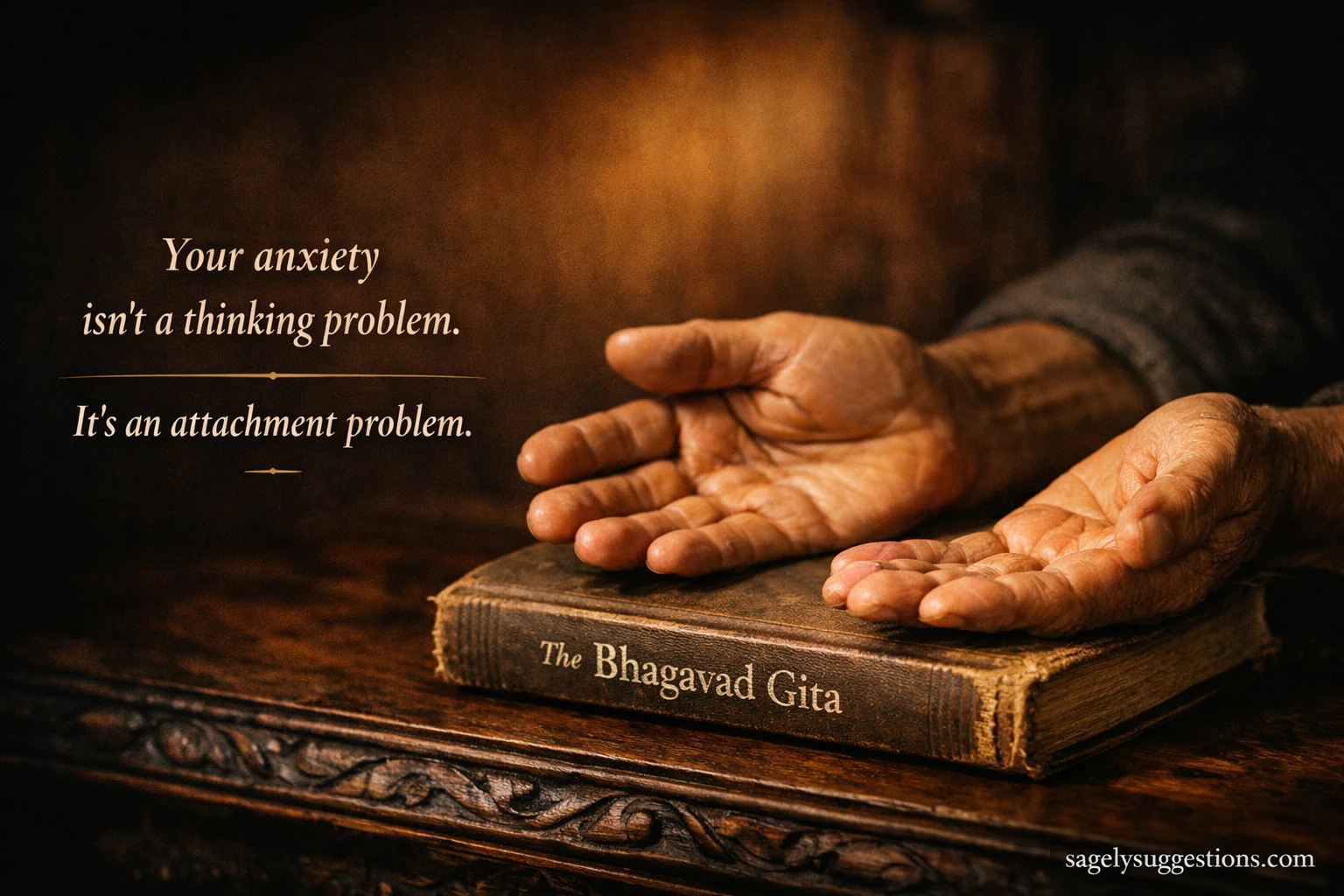
Bhagavad Gita for anxiety: 7 ancient verses that don’t tell you to stop overthinking — they rewire what your mind is attached to. Read and finally break the loop.
Your Brain Isn’t Broken. It’s Just Attached to the Wrong Things.
When a blacksmith tempers a blade, she doesn’t protect it from heat. She drives it into the furnace until it glows, then plunges it — screaming metal, violent steam — into cold water. Then she does it again. The blade that comes out isn’t the same steel. Same molecules, completely rewritten structure. It no longer shatters under pressure. It holds an edge because of the heat, not despite it.
I thought about that forge the first time I actually sat with the Bhagavad Gita. Not skimmed it. Not absorbed it through someone’s motivational Instagram carousel. Sat with it. Because here was Arjuna — history’s most famous case of anxiety-induced paralysis — standing between two armies, trained his entire life for this exact moment, and his bow was on the ground. Hands shaking. Vision blurring. A warrior prince, completely short-circuiting.
He didn’t need more information. He had every fact. He knew every soldier on that battlefield by name. That’s sort of the point: anxiety doesn’t care how smart you are. It cares how attached you are.
Here’s the misdiagnosis the self-help industry has been confidently peddling for the last two decades: overthinking is a thinking problem. Just stop. Breathe. Be present. As if your brain — which has been doing laps around the same three catastrophic scenarios since Tuesday — can be coaxed out of it like a raccoon from a trash can. The Bhagavad Gita doesn’t tell you to stop thinking. It tells you what your thinking is doing wrong, which is an entirely different diagnosis. And a different diagnosis means a different treatment. Seven verses. That’s your starting dose — not the whole scripture, not a semester of Sanskrit. Seven verses that, if you actually sit with them, will reorganize the molecular structure of how your mind holds pressure.
The Actual Problem (Which Is Not What You Think It Is)
Before the verses, you need the diagnosis. Because if you skip it, the verses are just fortune cookies in ancient Sanskrit.
Here it is: you are not overthinking the problem. You are overthinking your relationship to the outcome. “What if I fail the interview?” is not actually about the interview. It’s about what failure would mean about you — your worth, your identity, the story you’ve been telling yourself since someone gave you a gold star in third grade and you decided that was who you are now. The thought loop is a symptom. The attachment is the disease.
This is what verse 2.47 has been trying to tell you: “You have a right to perform your actions, but not to the fruits thereof.”
Every motivational poster in every dentist’s waiting room has some version of this. Which is precisely why you read it and felt nothing. So let me put the actual teeth back in it. Imagine you’re playing chess and you’re so fixated on whether you’ll win that your next move is terrible — because you’re playing the scoreboard, not the board. The moment you release the outcome and just play the next move correctly, you play better. Not because you stopped caring, but because you stopped attaching your entire sense of self to which way the king falls.
Your anxiety is a chess player who can’t stop staring at the scoreboard. And no one performs well when they’re playing two games at once.
Verse 2.14: The Thing About Shapes
“The contacts between sense-objects and the senses give rise to heat and cold, pleasure and pain. They come and go; they are impermanent. Endure them, O Arjuna.”
I know. That sounds like a cosmic shrug — things are hard, deal with it, good talk. But there’s something structurally important buried under that translation that most people miss entirely.
Your anxious spiral feels infinite because your nervous system has no internal clock telling you “this ends at 9:47 PM.” So it feels permanent. It feels like the new default. It feels like who you are now. But it has a shape — it rises, peaks, and passes. Every single time. The clinical literature on emotional regulation is full of studies showing that intense emotional states, left alone without amplification, peak in about 90 seconds. Ninety seconds. You’ve been white-knuckling through what amounts to a minute and a half, stretched out by everything you’re adding to it.
The practical move here is almost embarrassingly unglamorous: when the spiral starts, you don’t fight it. You name its architecture. “This is the kind of thing that rises and passes.” You become the blacksmith watching the steel in the furnace, rather than the steel that doesn’t know what the heat is for.
Verse 6.5: The One Nobody Quotes at You (For Obvious Reasons)
“Lift yourself by yourself. Do not degrade yourself. For the self alone is its own friend, and the self alone is its own enemy.”
This verse has the nerve to be blunt. No cosmic reassurance here. No “the universe is rooting for you.” Just a clean, slightly uncomfortable observation: you are doing this to yourself, and you also have everything required to undo it.
Sit with that before you bristle. Because here’s the jiu-jitsu hidden inside it: the part of you generating the anxiety is the same part that can redirect it. You’re not fighting a foreign invader. You’re negotiating with a part of yourself that got very good at predicting danger in an environment that no longer exists — a threat-detection system running software from 2009 on 2026 hardware. That’s not a character flaw. That’s a calibration problem.
And a calibration problem is solvable. You already have the machinery. That’s what the verse is saying, in its characteristically uncoddling way.
Verse 3.16: The Guilt-Trimmer
A lot of anxiety is guilt wearing worry’s clothes. “I should be doing more.” “I should have said something different.” “I should have known.” The Gita doesn’t have a word for “should” — but verse 3.16 gets at it from a different angle:
“He who does not follow the wheel thus set in motion is evil-living, indulging the senses, and lives in vain, O Arjuna.”
Harsh landing on first read, I know. But the chakra — the wheel — refers to the natural cycle of action, consequence, and regeneration. To live “in vain” is to be extracted from that cycle: hovering above your own life, watching it, narrating the worst-case scenarios about it, instead of being in it.
Anxiety is a form of spectatorship. You’re sitting in the press box of your own life, doing commentary. The verse is essentially saying: stop watching. The guilt and the worry are the same thing — they’re the mind that’s opted out of participating. The antidote isn’t a self-compassion workshop. It’s re-entry into action, however small, however imperfect. Pick up the bow, even with shaking hands. The shaking doesn’t mean stop. It means start.
Verse 2.20: The One That Shifts the Whole Calculus
“The soul is never born nor dies at any time. It has not come into being, does not come into being, and will not come into being. It is unborn, eternal, ever-existing, and primeval. It is not slain when the body is slain.”
You don’t need to take this as metaphysics. Try it as a structural observation instead.
Notice that there’s always a part of you that notices “I’m anxious right now.” That witness, the one doing the noticing — it isn’t anxious. If it were, it couldn’t observe the anxiety from any kind of distance at all. There’s a you that watches the spiral, which means that you is definitionally outside the spiral. That’s what this verse is pointing at. The witness is not trapped in the loop. It can’t be. And if you can locate that witness — even for a second, even just by saying “I notice I’m panicking right now” — you’ve created a gap. And in the gap, you can breathe.
Modern psychology calls this “metacognitive awareness.” The Gita called it the atman. Same phenomenon, three thousand years apart. Bold move by the Gita, getting there first.
Verse 6.35: The Permission Slip You Actually Needed
Here’s what no wellness influencer has ever said to you, because it doesn’t make a great thumbnail: “Undoubtedly, O mighty-armed one, the mind is difficult to control and restless.”
Undoubtedly. Krishna — the divine intelligence of the entire Gita — opens his chapter on mental discipline by acknowledging that yes, the mind is, in fact, a spectacular nightmare to manage. Not “with practice it gets easier” as the opener. Not “you just need the right morning routine.” The very first word is: undoubtedly.
You’re not failing at something that’s supposed to be easy. You’re doing something genuinely difficult, and the most ancient systematic psychology on record agrees. The “practice and detachment” that follows isn’t a passive prescription — it’s a loop. You try, the mind wanders, you notice, you return, without grading yourself on how gracefully you returned. What neuroscience now calls attention regulation, the Gita described as abhyasa and vairagya. Let me save you about seven years of expensive therapy: the goal was never to silence the mind. The goal was to stop hating yourself every time it drifts.
Verse 18.66: The One You Save for 3 AM
“Abandon all varieties of dharma and just surrender unto Me. I shall deliver you from all sinful reactions. Do not fear.”
If the devotional framing doesn’t land for you, translate it sideways: release your grip on controlling every outcome. Whatever higher order you trust — reason, nature, probability, the statistical fact that most of what you’re catastrophizing about will not come to pass — lean into that instead of your own projections. Hand the scoreboard to someone else.
“Do not fear” isn’t a dismissal. It’s not a spiritual bypass — the ancient equivalent of “good vibes only.” By verse 18.66, Krishna has walked Arjuna through the nature of the self, the mechanics of action, the structure of the mind, and seventeen chapters on why outcome-attachment is the engine of suffering. “Do not fear” is a conclusion. One that was earned. It arrives at the end of the argument, not the beginning. Which is, frankly, the only place it’s ever true.
The blacksmith doesn’t temper the blade once and retire. Every time the blade is used hard — every time life puts you against the whetstone — the metal reorganizes itself a little more. That’s not weakness. That’s how structural integrity actually works.
Arjuna’s hands stopped shaking. Not because Krishna removed the war. Both armies were still standing there, in full detail, waiting. The stakes were still brutal. His bow went back up because he stopped fighting his own mind and started working with it — understanding what it was doing, why it was doing it, and what it was actually attached to.
The Gita doesn’t promise you calm. It promises something considerably more useful: the structural capacity to stay present inside the storm. To hold an edge under pressure. To know, somewhere beneath the noise, that the heat isn’t trying to destroy you.
It’s just the tempering.
Got a verse that’s been living rent-free in your head? Or one whose depth only revealed itself on the second read? Drop it in the comments — I’ve been wrong about at least three of these before, and I’ll probably be wrong about one more.
Discover more from Sagely Suggestions
Subscribe to get the latest posts sent to your email.