Weaponized incompetence in marriage isn’t a mystery — it’s a system. Here’s how to name it, test it, and actually stop carrying it alone.
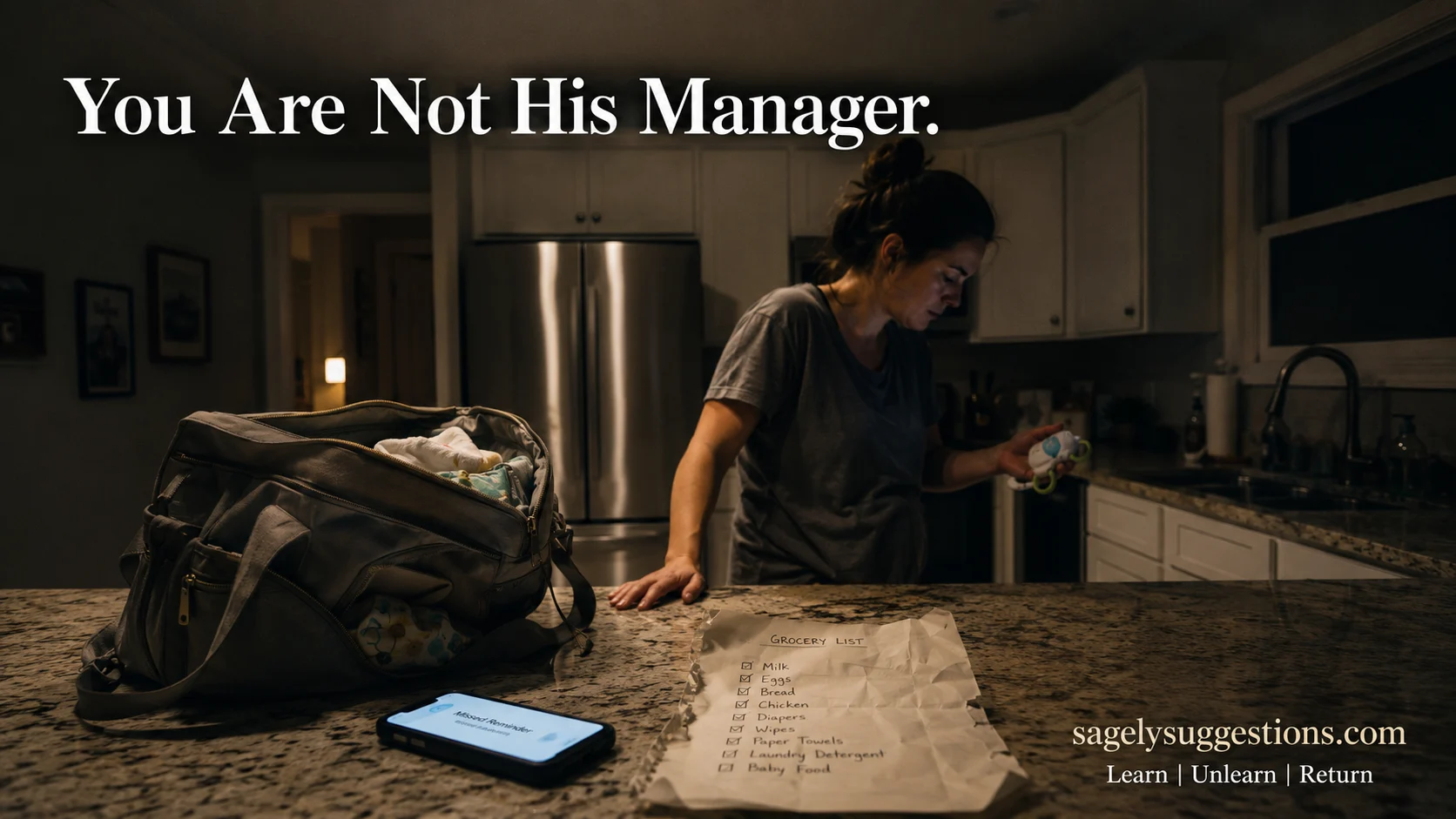
It’s 9 PM on a Tuesday, and Maya is standing in her kitchen holding a bag of the wrong formula, again, mentally re-running her husband’s grocery trip like a chart that came back wrong. She runs triage for a living — keeps four crashing patients alive at once, easily. And she still can’t get one grown man to remember which formula fits their toddler.
That gap is what weaponized incompetence actually looks like from the inside. It’s not really about the formula.
What Weaponized Incompetence Actually Is (and Isn’t)
Weaponized incompetence is when someone capable of doing a task performs it poorly, or claims they simply can’t, so it permanently migrates to someone else — and the person left holding it ends up managing not just the task, but the noticing, the reminding, and the quality control around it, indefinitely. The task was never really the problem. Becoming the household’s quiet supervisor was.
Here’s the thing worth sitting with before you get angrier: this usually isn’t a plot. Most partners aren’t lying awake calculating how to dodge laundry. It’s closer to a habit that got rewarded so many times it hardened into a personality trait. That doesn’t make it less exhausting to live inside — it just changes what you’re actually negotiating with.
Watch where the incompetence shows up, because it’s rarely evenly distributed. A man who can master a new fantasy football scoring system in an afternoon, or figure out a new video game in a weekend, but genuinely “can’t remember” which day the trash goes out after five years in the same house, doesn’t have a skill gap. Competence that shows up reliably for the things he wants and disappears for the things he doesn’t isn’t incompetence — it’s a filter, and the filter tells you where to look next.
This is also, worth saying plainly, exactly the dynamic educator Laura Danger named the “nag paradox” — one partner standard-setting, deciding, and managing, while the other waits to be directed. Danger, whose book No More Mediocre addresses this directly, puts it about as bluntly as it can be put: “Domestic labor matters. Connecting with your partner matters. You’re not a nag for wanting partnership.” That’s not a permission slip. It’s a correction to a story you’ve probably been told about yourself.
Run This Test Before You Do Anything Else
For one week, notice — without commentary, without redoing anything — whether the “can’t” is stable or selective. You’re probably already running a rougher version of this test in your head every time he shrugs at something; this just makes it official and puts a number on it.
Does the forgetting land everywhere — his own appointments, his own plans, his own hobbies — or only ever on things that were never really his to begin with? If it’s the second one, you already have your answer.
And if part of you is thinking maybe I’m just pickier, maybe my standards are the problem — that’s worth taking seriously rather than dismissing, because sometimes it’s true. But “different standards” explains why the folding looks off. It doesn’t explain why the trash still hasn’t gone out after five years, or why the appointment still didn’t get made. Standards and stability are different questions, and this test is only asking the second one.
If part of you is also thinking but maybe he has ADHD, maybe I’m being unfair calling this manipulation — that instinct is fair to have, and it doesn’t cancel out what you’re seeing. Genuine executive-function struggles and a comfortable pattern of avoidance can both be true in the same marriage, and either way, the mental load still has to move off you specifically. The fix looks slightly different depending on which one you’re dealing with. The fact that it has to move doesn’t change.
The Three Ways Out — Pick the One That Fits Your House
You’ve been carrying this long enough that “just communicate more” probably makes your jaw tighten. Fair — that advice has failed you before because it was never a plan, just a wish. Here are three actual mechanisms. Pick based on what’s actually broken in your house, not all three at once.
Structural: Give Him Full Ownership, Not Just a Chore
You’ve already tried assigning tasks, and it’s reasonable that it didn’t stick — assigning a task and transferring ownership of it aren’t the same move, and nobody told you that going in. The mechanism here comes from Eve Rodsky’s Fair Play system, and it’s more specific than “divide the chores.” Rodsky’s rule is that whoever owns a task owns all three parts of it — conception, planning, and execution — meaning he doesn’t just load the dishwasher when told; he notices it needs doing, decides when, and does it, with none of it routed back through you.
For Maya, this would mean picking one full domain — pediatrician logistics, say — and genuinely stepping back from the noticing, not just the doing. If he drops it anyway, that’s not proof the method failed. It’s information about whether this is a system problem or a willingness problem, which is exactly what the next lever is built to test.
Behavioral: Stop Rescuing, on Purpose
This next one is going to feel worse before it feels better, and that’s normal, not a sign you’re doing it wrong. This is a different lever entirely — not renegotiating who owns what, but removing the reward that’s been keeping the old pattern alive. As long as someone quietly fixes, reminds, or redoes a poorly done task, there’s no real cost to doing it poorly. Multiple therapists writing on this independently land on the same conclusion: withdraw the rescue completely — no reminders, no fixing, no redoing it after he’s gone to bed — and the incentive structure that’s been propping up the “I can’t” starts to genuinely shift, because the discomfort finally lands where it belongs.
This is also where “but if I let him do it his way, I’ll just end up fixing it anyway” shows up loudest, and it’s a fair worry — you’ve been burned by exactly that before. The difference this time is duration: fixing it once, quietly, is what kept the pattern alive; letting the consequence actually land, even for something small like the kids eating cereal for dinner, is what breaks it. If he still hasn’t adjusted after several weeks of genuinely no rescue, that’s not a failed method — it’s a sign you’re not dealing with a skills gap, and it’s worth naming that to him directly before moving to anything bigger.
Linguistic: Cut the Word “Help” Out Entirely
The smallest lever, and possibly the fastest one to try tonight. Swap “can you help with dinner” for “dinner’s yours tonight.” The first sentence frames you as the owner asking for a favor; the second states a fact. This is the direct answer to the objection probably already loaded in your head — he’ll just call me controlling, or say I’m nagging — because the nag paradox Danger describes exists precisely because one partner ends up issuing repeated feedback to someone waiting for instructions. Change the sentence, and you stop playing the role the paradox assigns you.
The One Time You Should Not Try This Alone
Everything above assumes one thing: that your house is fundamentally safe to experiment in. If that’s true for you, good — use it. If it’s not, pausing here isn’t a failure of nerve, it’s correct judgment, and it deserves to be said without softening: stepping back and letting consequences land only works if withdrawing your usual over-functioning doesn’t put you at risk.
If letting things fall apart would mean raised voices that scare you, retaliation, or a gut-tightening sense of what happens next, this isn’t the moment for a boundary experiment. The next call isn’t a workbook — it’s the National Domestic Violence Hotline at 1-800-799-7233, confidential and available around the clock, to help you think through what safety actually looks like in your specific house. Where things are stuck but not unsafe, the credible next step is a couples therapist who specifically works with equity and mental-load dynamics, not general marriage counseling — which can spend months on communication style without ever touching who’s actually conceiving, planning, and executing at home.
What Changed in Maya’s House
None of this fixed things in a weekend. Somewhere around week three of genuinely not rescuing the pediatrician logistics she’d handed off, her husband texted the office himself, unprompted, because he’d forgotten and didn’t want to explain that to the doctor.
The relationship doesn’t change because you explain the problem more clearly than the last hundred times. It changes the day you stop being the fail-safe and pick the one lever — structural, behavioral, or linguistic — that actually matches what’s keeping the pattern alive in your specific house. If you’ve recognized your own resentment building the way gunnysacking builds inside a marriage, or wondered if you’ve drifted into something closer to co-managing a household than actually being married, that recognition is useful. What you do with it next is the part that moves you.
FAQ
Is weaponized incompetence always intentional?
Not always. It can start as a genuine skill gap that gets reinforced into a habit once someone realizes underperformance gets rescued. The intent matters less than the outcome: either way, the mental load keeps landing on one partner, and that’s what needs to change.
How do I know if it’s weaponized incompetence or a real disability like ADHD?
Check whether the “can’t” is consistent or selective. Genuine executive-function struggles tend to show up everywhere, not just on tasks that were never his to begin with. Either way, the solution still involves shifting ownership off you.
Will Fair Play work if my husband refuses to engage with it at all?
Not on its own — Fair Play requires both partners’ participation to redistribute conception, planning, and execution. If he won’t engage, pairing it with genuinely stepping back from rescuing shows you faster whether it’s a system problem or a willingness one.
What if stepping back makes things at home fall apart?
Some short-term chaos is expected and part of how the pattern breaks — but if withdrawing support ever feels physically or emotionally unsafe, that’s different from discomfort, and it’s the signal to contact the National Domestic Violence Hotline instead of continuing the experiment.