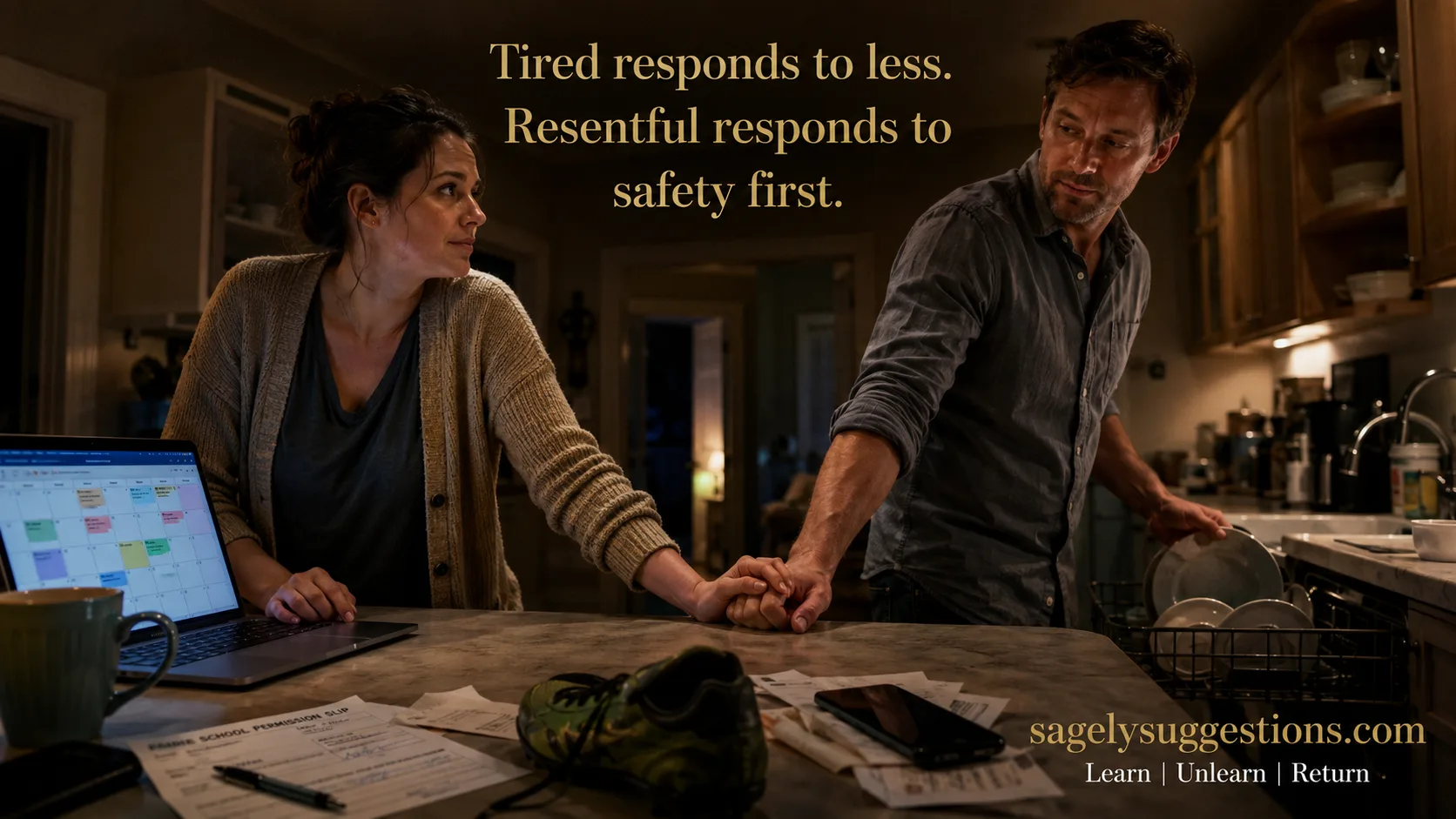
Stuck in the roommate phase of marriage? Learn the real difference between exhaustion and resentment — and the exact Gottman-backed fix for each one.
You’re Not Falling Out of Love. You’re Out of Bandwidth. (Or You’re Not — Here’s How to Tell)
You already tried the obvious fix for the roommate phase of marriage. A recurring date night, penciled onto two overloaded calendars like a dentist appointment. Maybe you even scheduled sex, because someone online said that works, and for a couple of weeks it did. Then the conversations on those dates drifted right back to who’s picking up which kid from which practice, because that’s genuinely what’s on both your minds by 8 p.m., and the whole experiment quietly died the way most well-intentioned calendar invites do.
If that sounds familiar, you’re not doing marriage wrong. You’re just asking the wrong question. The question that actually matters isn’t “how do we talk more.” It’s this: are you and your spouse tired, or are you resentful? Those are two completely different problems wearing the same disguise, and almost nothing written about the roommate phase bothers to tell them apart.
The Roommate Phase Has a Name Now — And a Current Data Point Behind It
The short answer: you’re not imagining this, and you’re not alone in it. 2026 has produced real research connecting marital exhaustion to the specific pressures of raising kids on two incomes, and it’s showing up in therapy rooms right now, not just on TikTok.
A study published this year in the journal Healthcare, reviewing research going back to 2010, argues that parental burnout isn’t just common — it’s a documented driver of marital breakdown. A companion study out of the Journal of Marriage and Family this spring backs it up from the other direction: exhaustion predicts marital dissatisfaction, and dissatisfaction predicts more exhaustion, feeding each other in a loop most couples never notice they’re stuck in.
Melissa Paul, a couples therapist in Brooklyn, told PureWow this pattern comes up constantly in her practice — and in her own marriage. “Whenever I have a minute of relaxation… and my husband and I are laughing about something stupid, I’m like: ‘Oh right, I really do like you,'” she said. “But the circumstances to uncover that time together can be so taxing.” Not a lack of love. A lack of leftover energy to spend on it.
Paul points to something specific about this generation of dual-income parents: two people who entered the relationship ambitious and career-driven, then hit child-rearing years that demand far more labor than previous generations put in. Add a pandemic that scattered whatever village support used to exist, and you get exactly what you’re living now.
The Question Nobody’s Asking You: Tired, or Resentful?
Here’s the diagnostic that actually matters, and it’s the one piece almost every roommate-phase article skips: exhaustion and resentment look identical from the outside — flat conversations, early bedtimes — but they need opposite fixes, and using the wrong one wastes the little energy you have left.
What exhaustion actually looks like day to day
If you’re tired, the affection is still there underneath, just buried under a schedule with no slack in it. You’d still choose him if you had the bandwidth to remember why. The conversations stay logistics-only not because you’ve stopped caring what he thinks, but because logistics are the only category of thought you have leftover processing power for after 9 p.m.
One woman navigating this with three kids under three put it plainly: raising them left her and her husband exhausted and emotionally disconnected, and what pulled them back was something almost embarrassingly small — saying thank you daily until it made them feel like teammates again, not adversaries keeping score. That’s exhaustion. It responds to small, structural changes because the goodwill was never gone, just unused.
What resentment actually looks like (and why it’s not the same thing)
Resentment is quieter and colder, and it shows up as irritation at things that used to register as neutral — the pace he loads the dishwasher, the sigh before he takes on a task. If your logistics-only conversations feel less like exhaustion and more like distance you’ve built on purpose, that’s a different animal. We’ll come back to exactly what to do about it, because pretending it’s the same problem as tiredness is where most well-meaning advice falls apart.
One commenter in an online thread about this exact fork asked the sharpest version of the question directly: are you both exhausted with each other, or exhausted with life and unsure how to build each other back up? Sit with that before you read another word. Your honest answer decides everything that follows.
Why the Obvious Advice Keeps Not Working
You’re not wrong that you already tried something, and the instinct to schedule connection is a good one — it’s just aimed at the wrong target when what’s actually depleting you is logistics, because a date night is one more logistical event to plan, staff a sitter for, and survive on four hours of sleep.
That’s precisely the trap one person described online after adding “mandatory dates and sex” to their weekly routine: the schedule held for a while, then the content of those dates reverted right back to logistics and food, because proximity on a calendar doesn’t automatically produce connection. If that’s your exact experience — you built the perfect recurring event and it still didn’t hold, which would offend the project manager in you if it weren’t so relatable — you weren’t failing at the fix. You were solving the wrong layer of the problem.
If You’re Tired: Two Protocols That Don’t Cost You an Evening
Here’s the direct answer: if exhaustion is your actual problem, you don’t need more romance — you need less invisible workload and a shorter, cheaper ritual than date night. Two specific, research-backed ways to get both.
The Stress-Reducing Conversation, in practice
Start with the one that costs nothing but attention. Drs. John and Julie Gottman spent decades studying what separates couples who stay connected under pressure from ones who drift, and one of their most consistently cited tools is the Stress-Reducing Conversation — a daily 20-minute check-in where each partner talks about stress from outside the relationship. The rule that makes it work: the listener isn’t allowed to fix anything. No advice, no problem-solving, just “that sounds really hard” and actual attention.
Here’s how this fits your evenings specifically: this isn’t another calendar item requiring a sitter or a reservation. It’s twenty minutes after the kids are down, phones face-down, where the job isn’t to plan tomorrow’s carpool — it’s to be heard about today. That’s the one conversation in your day that isn’t secretly about logistics.
If twenty straight minutes feels impossible some nights, consistency beats duration — even a shorter version most nights outperforms a perfect version once a week. What it won’t fix, and we’ll get to this, is a conversation where one partner is already bracing for criticism instead of listening for it.
The Fair Play move that changes the math fastest
Next, the one that isn’t about talking at all. A lot of what reads as emotional distance in dual-income households isn’t emotional — it’s structural. Eve Rodsky’s Fair Play system, built after she catalogued her own invisible household labor into what she called the “Sh*t I Do” list, argues the real fix isn’t “helping more.” It’s full ownership: one partner takes complete responsibility for a task’s Conception, Planning, and Execution — not just the doing, but the noticing it needs doing and the figuring out how.
Applied to your household: pick one recurring source of mental static — the travel-soccer schedule, the grocery list, the pediatrician calendar — and hand it over completely, not just the driving-there part. One Fair Play practitioner described her husband taking full ownership of a single card as “worth ten cards,” because of how many mental minutes it freed up, not because of the task itself. Do this once, this week, with the one item currently living rent-free in your head, and notice what’s different by Friday. That’s the actual currency you’re short on. Not hours. Headspace.
The six-second reset (yes, really)
Last, the one that takes six seconds and no planning at all. Gottman’s research, drawing on neuroeconomist Paul Zak’s work on bonding hormones, found that a kiss lasting six seconds or longer is long enough to trigger oxytocin release and measurably lower cortisol — the stress hormone running the show by 6 p.m. on a school night. A one-second peck on the way out the door doesn’t register the same way biologically. Six seconds does, which feels like a strange thing to schedule and works anyway.
Applied here: this costs you nothing you don’t already have. You’re already kissing goodbye and hello — you’re just doing it too fast to matter. Try it at the two transition points your day already has built in, and let it be the one piece of physical connection that doesn’t require energy you don’t have.
If You’re Resentful: Why Skipping to Connection Rituals Backfires
If your honest answer above was resentment, that’s not a worse answer than tiredness — it’s just a harder one to sit with, because it means the problem isn’t that you’ve run out of time, it’s that some part of you has stopped extending goodwill by default. That’s a completely reasonable place to land after enough small letdowns stack up, and it doesn’t mean the tired-track fixes above were wrong for you. It means they’re not the first move.
Gottman’s research names a specific state called negative sentiment override — the point where enough small hurts have piled up that even a kind gesture gets read as suspicious, or too little, too late. When that’s present, leaning straight into a structured check-in like the Stress-Reducing Conversation can backfire, because a partner already braced for another disappointment hears a calm question as one more thing being asked of them, not an olive branch. That’s a documented pattern, not a hedge — it’s the actual reason connection rituals sometimes make things feel worse before they feel better.
The credible alternative: don’t push harder on vulnerability first. Rebuild a baseline of fondness and admiration — small, low-stakes, no-strings acknowledgments — before attempting anything that requires emotional exposure. In practice, that can be as plain as naming one specific thing he did that day without adding a request onto it: “I noticed you got Emma to practice early, that helped.” No ask, no segue into what you still need from him — just the observation, said out loud, for a stretch of days before you try anything bigger. If that doesn’t visibly shift within a few weeks, the next real step is professional support, not another round of trying harder alone. That’s not giving up. That’s matching the tool to the actual problem.
How to Bring This Up Without It Sounding Like “We’re Failing”
The instinct to stay quiet makes sense — nobody wants a calm Tuesday to turn into “we need to talk” and a spiral neither of you asked for. But naming a pattern out loud, in a low-stakes moment, isn’t the same as declaring a crisis, and treating it that way is usually what turns it into one.
Try leading with observation instead of verdict: “I’ve noticed our evenings are mostly logistics lately — I miss the other stuff.” That’s a data point, not an accusation, and it leaves room for him to say “yeah, me too” instead of getting defensive. Left unaddressed long enough, this kind of quiet drift is often what opens the door to bigger ruptures — whether that’s financial secrets one partner starts keeping alone or an emotional need that finds somewhere else to go entirely. Naming it early is the cheaper option, even when it feels like the harder one.
The Bottom Line
Before you try to talk more, figure out honestly whether you’re tired or resentful — because tired responds to subtraction, not addition. A shorter ritual, less invisible labor, twenty freed-up mental minutes a day. Resentment needs safety rebuilt first, connection second, and mistaking one for the other is the real reason the obvious advice keeps not working for you.
FAQ
Is the roommate phase of marriage normal after having kids?
Some version of it is common in dual-income households — 2026 research links parental burnout directly to marital strain. Common doesn’t mean permanent, and the right fix depends on whether the root cause is exhaustion or resentment.
How do busy parents reconnect without scheduling another date night?
Try the Gottman Stress-Reducing Conversation — a 20-minute daily check-in about outside stress, not another evening event requiring childcare. It rebuilds connection through consistency, not a calendar slot.
What is negative sentiment override in marriage?
A Gottman-identified state where accumulated small hurts cause neutral or kind behavior to be read as hostile or suspicious. When present, structured check-ins can backfire until appreciation is rebuilt first.
Why didn’t scheduled date nights fix our disconnection?
Scheduling proximity doesn’t fix logistics-only conversation — it adds one more event to plan. The real fix targets the underlying cause, exhaustion or resentment, not the lack of shared time itself.