Jealousy in relationships often hides as care. Learn subtle signs of emotional control, protect boundaries, and understand modern dating dynamics. Read now.
When Caring Becomes Surveillance:
Jealousy’s Disguise
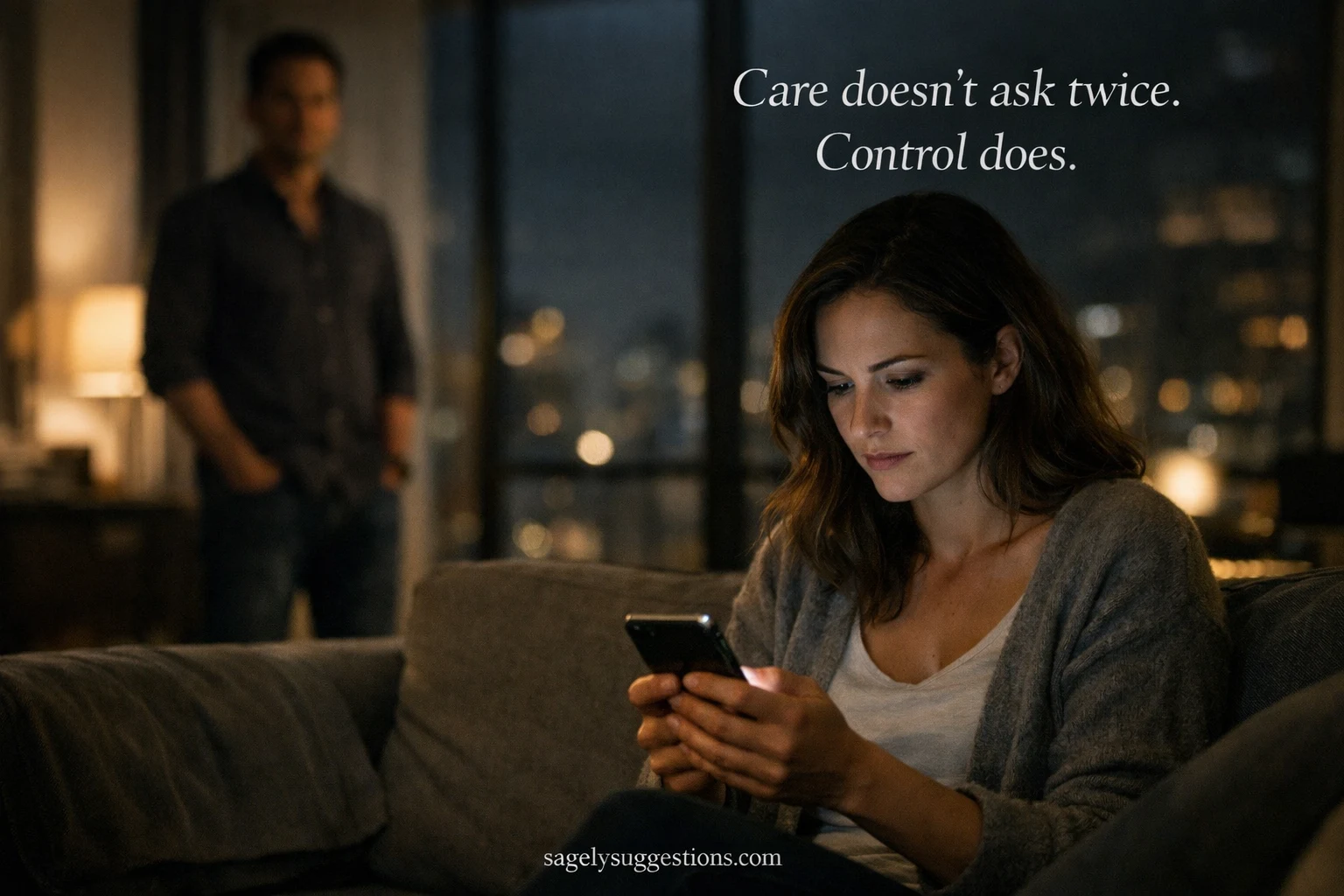
You call it love. But it tracks location, checks replies, and monitors the timestamp on your last post. This is what jealousy looks like when it learns to wear a caring face.
That is not curiosity.
We need to establish what it is before we can decide what to do with it.
Jealousy doesn’t announce itself. It doesn’t arrive as a scene from a bad movie — screaming, accusations, a slammed door you can point to later as evidence. It arrives as someone who loves you very much, and needs to know where you are. It arrives with your wellbeing on its lips and its fingers on the lock.
Part One
What This Is Not
What you are experiencing is not care.
Here is what care actually does. Care, in its functional form, says “I’m glad you’re home” without needing a debrief. It asks about your evening and waits for the parts you choose to share. It trusts that the version of you who walked out the door that morning is the same version who walked back in — and that trust is not a vulnerability. It is the structural material that intimacy is actually made from.
What this does is different. This asks where you were and then asks again. This notices when your phone screen lights up from across the room and doesn’t say anything — but you notice it noticing. This is present in your location on Find My, in the timestamps of your Instagram stories, in the three-second delay before you hear “of course I trust you.” This reaches into the space between your day and his knowledge of your day, and it does not leave that space alone.
This is not care. And continuing to call it care — holding that label in place because the alternative feels too large, too accusatory, too final — is the first and most costly thing we need to stop doing.
Jealousy’s most effective disguise is not possessiveness. It is attentiveness. The most vigilant partner — the most present, the most concerned — is often the one whose concern has become indistinguishable from surveillance.Contrarian Insight
The Anatomy of Deniable Control
There is a concept well-documented in psychological research on coercive relationship dynamics that consumer content almost never translates into plain language: behavioral deniability. It works like this — every controlling behavior is packaged inside language that cannot be argued with without sounding unreasonable. “I just worry about you.” “I don’t think you understand how much I care.” “I asked because I wanted to know you were safe.” The behavior and its justification arrive together, bonded, and if you object to the behavior, you appear — by implication — to be objecting to the care it is dressed in.
This is not gaslighting in the clinical sense. Gaslighting requires deliberate intention — the conscious manufacture of doubt. What behavioral deniability often involves is something subtler and genuinely harder to name: a partner who has sincerely convinced themselves that their surveillance is love. The jealous partner does not experience themselves as controlling. They experience themselves as caring more than you appreciate.
That sincerity is exactly what makes this so difficult to see clearly.
The specific phrases have a grammar of their own. Notice them: “I’m not checking up on you, I just wanted to see if you were okay.” “Why does it matter if I looked at your phone — I wasn’t going to find anything.” “I thought you’d want me to know where you are.” Each sentence uses care as its primary noun. But the subject being acted upon is always you. Your location. Your replies. Your timeline. The language of concern, pointed outward. Functioning as a net.
The gap between gaslighting and behavioral deniability is important — not to protect the partner, but to give you something more precise than “he’s abusive” or “I’m overreacting.” Emotional control in relationships rarely arrives as a single dramatic act. It arrives as a grammar — a consistent structure of language and behavior that keeps accountability permanently off the table, because every behavior has its cover story baked in.
Part Two — Pillar Two
The Surveillance Taxonomy
Let’s trace the specific behaviors without softening them, because softening them is precisely how they survived this long.
-
Location
Monitoring It begins as a practical exchange — “text me when you get there” — and in the early months it is indistinguishable from genuine concern. Then it becomes a default expectation. Then a standard by which absence is measured. If you don’t text when you arrive — not because anything happened, but because you were talking and forgot — the conversation that follows is not relief. It is correction. The care was never about your safety. It was about his certainty. -
Phone
Access “I don’t have anything to hide” ends the conversation before it begins. And you may not have anything to hide — that is not the point. Privacy is not secrecy. A person can live transparently and still be entitled to a moment, a message, a thought that belongs only to them. When “nothing to hide” becomes the operating principle of a relationship, what has been surrendered is not secrecy. It’s selfhood. -
Social Media
Monitoring This one is the most invisible because looking at public things is unremarkable. But you know the difference — you feel it in your body — between someone who saw your post and someone who is cataloguing it. Who knew, without being told, that the person who left a comment works in the same industry as your ex. Who mentioned, casually, that you seemed to post more on certain evenings. This is not looking. This is logging.
None of these behaviors, taken individually, produces a smoking gun. That is precisely the design. Research on controlling relationship patterns consistently shows that coercive dynamics are maintained not through dramatic episodes but through accumulated small corrections — each one explainable, none of them alone sufficient to be named, all of them together forming a structure you live inside.
Jealousy-as-surveillance operates like a carbon monoxide detector with a faulty sensor — it goes off constantly, without visible smoke, until you begin to wonder if the alarm itself is the problem. You stop trusting your own air.Unexpected Analogy
The Part Nobody Tells You
Here is the piece that almost no relationship content is willing to say directly, because it requires making a distinction that feels like blame and isn’t: you are not only a recipient of this system. You are, partially and without fault, its co-architect.
Not because you wanted this. Not because you were weak. Because you loved him. And because somewhere early — probably before you had language for what was happening — you made a calculation, likely without conscious awareness, that if you were transparent enough, the jealousy would stop. If you texted first. If you mentioned the coworker’s name before he had a chance to ask. If you kept your Instagram private. If you offered your location voluntarily so the question would never have to be asked.
What you have been calling honesty or openness has a different, more precise name: preemptive appeasement. Honesty is information you share freely, for the intimacy and pleasure of being known. Preemptive appeasement is compliance structured by anxiety. The distinction matters more than you may want it to, because preemptive appeasement does not satisfy jealousy. It trains it. It teaches the system that if it generates enough ambient tension, you will produce the information it needs. And you will call this openness.
You are not transparent because you have nothing to hide.
You are transparent because hiding feels dangerous.
That is the sentence that carries the weight of this entire piece, and it deserves to be read slowly. If you recognized yourself in it — if something in your body confirmed it before your mind could argue — then the confusion you’ve been carrying is not a failure of your intelligence. It is evidence of how long you have been managing a system that was never yours to manage. When presence starts to feel like performance, the exhaustion runs deeper than most relationship advice accounts for.
The question — the one that requires some stillness to sit with — is when did you stop being able to tell the difference between choosing to share and needing to report?
Part Two — Pillar Four
What Its Absence Actually Looks Like
This is not the section where you’ll be told how to fix it. You’re intelligent enough to know that “tips” isn’t what you came here for, and this article respects you enough not to pretend otherwise.
This is the section where we hold the contrast up — because you have been inside this long enough that you may have genuinely forgotten what it looks like from outside.
A partner who is not operating from jealousy does not need to know who you were with to know that you are his. He asks about your evening because he wants to hear it — not to audit it. When your phone lights up across the room, he does not recalibrate. When you come home later than expected, he is glad to see you — and that relief is uncomplicated. Not loaded. Not preceded by a pause that means something.
He does not require preemptive transparency, because the asking would not have happened. There is no ambient tension that needs managing. His care for you is not an alarm system running in the background of your daily life, requiring constant maintenance to prevent going off.
This is what it looks like to be with someone whose love does not require your surveillance. You text when you get there not because you’re afraid not to — but because you thought of him and wanted to. You share your day not as a debrief, not as a performance of openness, but as a gift. Freely given. Received without inspection.
The difference between these two realities is not dramatic. It is not a scene from a better movie. It is quieter than that. It is the absence of a feeling you have become so accustomed to that you stopped calling it by its name.
Here, then, is what the evidence shows.
The pattern — the location checks, the loaded questions, the phone access, the monitoring disguised as incidental noticing, the three-question “did you have a good time” — is not a collection of isolated moments from a person who loves imperfectly. It is a system. It operates continuously. It uses the language of care as its interface, which is precisely why you have been confused for as long as you have. You are not confused because you are naive. You are confused because the system was designed to be confusing — not necessarily with deliberate intent, but with the functional precision of something that has learned, over time, what it needs to survive.
And you — through love, through the genuine and admirable hope that transparency would be enough, that one more explanation would finally close the distance between his fear and his trust in you — have kept the system running.
You do not need to decide today what to do with any of this. You do not need to call it abuse. You do not need to call yourself a victim. You do not need a plan, a conversation, or a breakup checklist. What you have, as of this sentence, is something more useful than all of those things: a word for it. A clear, evidence-based, forensically grounded word for the pattern you have been living inside and politely explaining away for months.
You have a word for it now.
What you do with that word is entirely yours.
© SagelySuggestions.com · Relationships & Emotional Intelligence
Discover more from Sagely Suggestions
Subscribe to get the latest posts sent to your email.