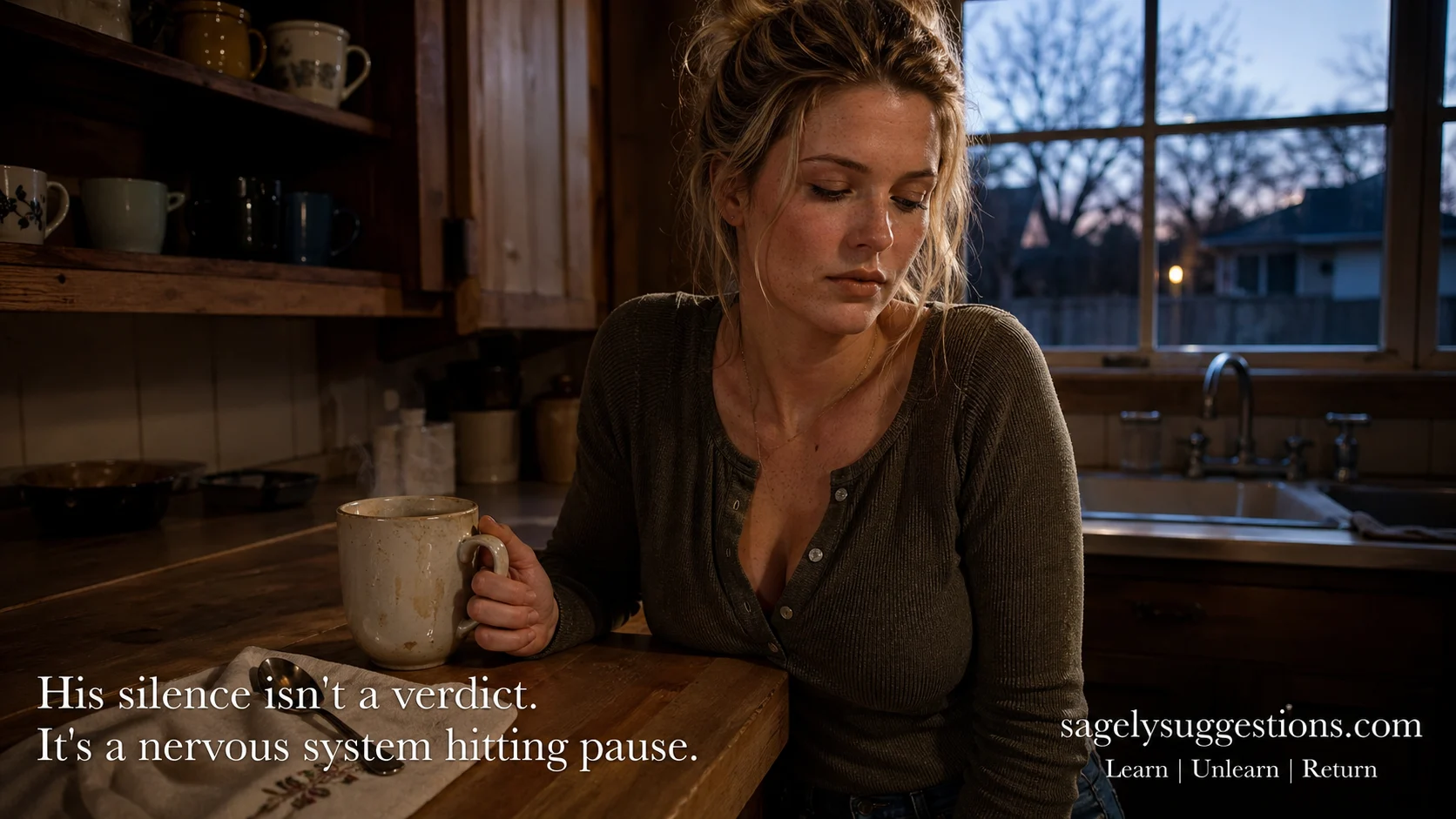
Husband shuts down during talks? Discover Gottman-backed scripts to reconnect without pressure. Practical tools for newlywed wives seeking emotional intimacy tonight.
Practical Scripts, Proven Frameworks, and Honest Truths for the Wife Who Keeps Hitting a Wall
I Married the Man, Not the Wall
The spaghetti was getting cold.
She’d timed it perfectly — or tried to. Waited until he’d been home for an hour. Fed the dog, poured herself a glass of water, picked a moment when the TV was off and the dishes were done. She’d run through what she was going to say at least eleven times between when she decided to bring it up and when she finally did.
“I just felt a little left out when you didn’t text me back all afternoon. That’s all. Like — I know you were busy. I just wanted to say it.”
He looked at the wall above the refrigerator for three full seconds. Then he said, “Okay.” Then he got up and walked to the bedroom. Not slammed the door. Not raised his voice. Just — walked. Like she hadn’t said anything at all.
She stood in the kitchen. The spaghetti sat in the pot. She didn’t eat for another hour, and when she did, she ate standing over the sink.
If you are four months into your marriage — or eight, or fourteen — and you just read that and felt it somewhere behind your sternum, you’re in the right place.
And I want to say something before we go any further: this guide is not going to tell you to go to couples therapy. Not because therapy is bad — it isn’t — but because right now, “go to therapy” feels like being handed a plane ticket when what you need is a ride across town. You need something you can use tonight. That’s what this is.
You’ve probably already tried texting him your concerns so he can “process” before the conversation. You know how that went — three days of nothing and then he acted like you never sent it. You’ve tried waiting until he’s in a good mood, but by the time he is, you’ve either forgotten the thing or worked yourself up enough that the conversation goes sideways anyway. You may have even tried bringing things up in the car, because you read somewhere that less eye contact helps. It didn’t help on your husband.
None of that makes you bad at communication. You are articulate. You know how to frame a message. These are your skills. And none of them are working, which means this isn’t a skill deficit. This is a specific dynamic — one with a name, a neurological explanation, and an actual strategy — and nobody handed you the manual for it.
Like, am I wrong for wanting to just talk? You’re not wrong. You’re just missing a piece of information that changes everything.
Here it is.
What’s Actually Happening in His Head (It’s Not What You Think)
Here’s the thing nobody told you on your wedding day: your husband is not ignoring you. His brain is protecting him.
I know. That might be the most frustrating sentence you’ve ever read from the kitchen floor of your brand-new marriage. But stay with me, because this actually matters.
Dr. John Gottman — a psychologist who has spent decades studying couples and can predict with striking accuracy whether a marriage will succeed or fail just by watching a couple talk for a few minutes — found something that completely reframes what’s happening when your husband goes quiet. During conflict, men’s cardiovascular systems respond to stress more intensely than women’s, and they return to baseline more slowly. Not because they care less. Because their bodies process relational stress more dramatically, and when that stress hits a certain threshold, the nervous system does something that looks, from the outside, exactly like stonewalling: it shuts down all conversational outputs in order to manage the internal alarm.
Gottman calls this “flooding.” It’s the moment a person’s body has decided this conversation is a physical threat — heart rate climbing, breathing constricting, stress hormones moving through the bloodstream. And the self-protective response that kicks in is not the mature, thoughtful one. It’s the survival one.
Gottman’s research found that 85% of the people who stonewall in relationships are men. That’s not a character flaw distributed unevenly across gender. It’s a physiological pattern. Men’s bodies, on average, flood faster and recover more slowly during emotionally charged conversation. By the time she’s ready to talk, his nervous system has already filed the exchange under “threat.”
Here’s what flooding looks like on your husband specifically. His jaw goes tight. His eyes drift somewhere that isn’t the room. His answers shorten to one word, then to nothing. He might physically leave — walk to another room, find a reason to go outside, pick up his phone like it’s a life raft. He’s not punishing you. He’s not indifferent. His body has hit the equivalent of an emergency exit, and he’s going through it.
Know These Signs Before the Wall Goes Up
You can learn to recognize when his nervous system is already past the point where this conversation is going anywhere useful. Watch for the one-word answers that weren’t one-word answers five minutes ago. A stillness in the face that isn’t peace — it’s blankness, the expression of a person who has gone somewhere internal. His body turning slightly away from you, even a few degrees. His breathing going shallow. His eyes tracking past you, above you, anywhere that isn’t your face.
When you see two or more of those at the same time, the conversation — as it’s currently happening — is over. Not because he’s chosen to end it. Because his nervous system already did.
Here’s the distinction that matters: what your husband is doing when he goes quiet like that is flooding, not stonewalling. Stonewalling is a deliberate act — an intentional withdrawal meant to shut the other person out. What flooding looks like from the outside is identical, but the cause is different, and so is the remedy. He is not trying to hurt you. He is overwhelmed, and his body is doing what overwhelmed bodies do.
His silence is not a verdict on your worth.
It is not a verdict on your marriage.
It is a nervous system doing what nervous systems do when they run out of room. And now that you know what you’re actually dealing with, you can stop trying to break through a wall and start learning how to find the door.
What You’re Doing That Makes It Worse (And Didn’t Know It)
I need you to hear this chapter in the voice of someone who is completely, unwaveringly on your side. Because what I’m about to say is going to feel like criticism — and it isn’t. It’s information. There’s a difference.
The reason your best, most carefully timed, most heartfelt attempts to connect keep landing sideways isn’t because you’re doing it wrong as a person. It’s because you’re doing it in a way that his flooded nervous system reads as a signal to retreat further. And most of us don’t figure that out until we’ve lost two or three years to the loop.
Here’s the audit. Go through it honestly.
The Accidental Escalation Audit
Do you bring things up right when he gets home? The first 30 to 45 minutes after a person returns from work is one of the worst windows for an emotionally weighted conversation. His stress hormones haven’t come down from the day yet. His body is still processing. Any conversation that registers as conflict will be handled by a nervous system that’s already running hot — which means flooding happens faster, and the wall goes up sooner.
Do your sentences contain “you always” or “you never”? I know you’ve heard this before. But hear it again, because those two phrases are documented escalation triggers in Gottman’s research. The moment “you always” enters a sentence, his brain categorizes what’s happening as a character attack. Not a complaint about a specific thing — an indictment of who he is. The wall goes up not because he’s being defensive on purpose, but because that’s what a brain does with attacks.
Did you cry? This one is the hardest to say, so I want to be careful with it. Your tears are not manipulation. They are a real, involuntary response to pain. But here’s what his nervous system hears when you cry mid-conversation: danger, danger, danger. Evolutionary biology did not prepare men to remain calm when the woman they love is in visible distress. His flooding accelerates. He withdraws harder — not because your pain doesn’t matter to him, but because it matters so much that he has no idea what to do with it in that moment.
Did you pursue harder when he went quiet? Of course you did. You wanted connection, and the silence felt like a door slamming. But research on the demand-withdraw pattern is consistent here: when one partner increases pursuit, the other increases withdrawal. Not because they want to. Because the threat level just went up, and the threat level going up is precisely what causes the retreat.
Did you bring up more than one thing at a time? This is the one nobody talks about. When one emotionally loaded topic piles onto another, his processing bandwidth — already strained — hits a ceiling. Two grievances in one conversation can feel, to a flooding nervous system, like twice the attack.
Changing your approach is not admitting defeat.
It’s choosing connection over being right about how you’ve been trying to connect.
Those are completely different things, and the second one is the one that actually works.
The Soft Startup — How to Begin Without Detonating Anything
The first sentence of a conversation does most of the work.
Not all of it. But most of it — which is more leverage than you might realize. Gottman’s research found that how a difficult conversation begins predicts, with remarkable consistency, where it ends. A conversation that opens hard almost always ends hard. A conversation that opens soft has a fighting chance.
The “soft startup” isn’t a trick. It’s not a way to bury what you actually feel. It’s a sentence structure that leads with your experience rather than his behavior — which means his nervous system doesn’t have to process an accusation at the same moment it’s trying to process the rest of what you’re saying. He gets to hear you without having to defend himself simultaneously. That ten-second difference in his internal experience changes almost everything about what comes next.
The structure is: I feel [emotion] when [situation] because [your need]. Not “you made me feel.” Not “you always.” Just: I feel. When. Because.
It sounds stupidly simple. It is. The hard part isn’t learning the structure — it’s retraining yourself to lead with it when every instinct you have wants to lead with the thing he did.
The Hard Version vs. The Soft Version — Side by Side
Here are six conversations that come up in year one. The left side is how it usually comes out when you’re hurting. The right side is what you can try instead.
| Topic | Hard Version | Soft Version |
|---|---|---|
| Feeling unseen | “You never actually listen when I talk to you.” | “I feel invisible sometimes and I want to tell you about it — can we sit together for a few minutes?” |
| Chores | “You just leave everything for me to handle around here.” | “I’m feeling overwhelmed with the house stuff, and I need your help figuring out how we can split it better.” |
| His family | “Your mom calls too much and you never back me up.” | “I feel like I’m on the outside looking in when the family stuff happens, and I want to feel more like we’re a team.” |
| Money | “You spent how much without even telling me?” | “I got scared when I saw the account — can we talk about how we want to make decisions like this going forward?” |
| Intimacy | “You don’t even seem interested in me anymore.” | “I’ve been missing being close to you. I don’t want to pressure you — I just wanted you to know.” |
| Quality time | “We never actually do anything together.” | “I really miss you. Is there any night this week where we could just be together without our phones?” |
Read the hard versions out loud and feel what they do in your chest when you imagine being on the receiving end. Now read the soft versions. Same need — exactly the same need — and an entirely different nervous-system signal.
The other piece of the soft startup that nobody mentions is timing. Not just “don’t bring it up right when he gets home” — though please, do not — but the specific conditions that make a conversation possible in the first place.
He needs food in his body. He needs at least thirty minutes of decompression after work has ended. He needs the phone face down. And — this is the one that took me the longest to figure out — he needs to have already said at least three sentences that weren’t in response to a direct question. When someone is already talking, they’re already open. That’s when you walk through the door, not when it’s closed.
One more thing: watch your volume and your speed. A voice that rises in pitch or accelerates in pace reads, to a flooding nervous system, as escalation — even if the words themselves are soft. Slower is almost always better. Lower is almost always better. Not because you’re performing calm. Because calm is actually what you’re going for.
The 20-Minute Reset — How to Ask for a Pause That He’ll Actually Honor
There’s a version of this you’ve already experienced that felt like the worst possible thing: you push harder, he goes somewhere behind his eyes, and then either walks out of the room or shuts down so completely that it takes two days to get back to anything like normal. That’s an unstructured withdrawal — the kind nobody asked for and nobody knows how to come back from.
The 20-minute reset is the opposite of that. It’s a structured pause, one that both of you know has a beginning, a middle, and a promised return. It’s the difference between a person walking out of the building without a word and a person saying, “I need five minutes and I’ll be right back.” One feels like abandonment. The other feels like someone who knows their own limits and trusts the relationship enough to name them.
The Gottman Institute’s research recommends at least 20 minutes for a flooded nervous system to return to a state where productive conversation is actually possible. Less than that, and the body is still running hot. More than 30 or 40 minutes without reconnection starts to feel like the silent treatment — which is a completely different thing, and not what either of you wants.
So here’s how to propose it. Not wait for him to disappear, but actually suggest it — before the wall goes all the way up.
When you see those flooding signs — the jaw, the eyes, the syllables getting shorter — here is what you say:
“I can feel this conversation getting hard for both of us. Can we take twenty minutes and come back to it? I want to actually talk to you, not just talk at you.”
That last sentence is the important one. “I want to actually talk to you” is a reassurance that this conversation isn’t over, that you’re not leaving the relationship — you’re pausing one exchange inside of it. That’s what his nervous system needs to hear in order to be able to step away without the step-away calcifying into a wall.
Then you add what I call the “I’m coming back” phrase: “I’ll come find you in twenty minutes.”
Not “let me know when you’re ready” — that puts an undefined, pressured clock on something that already feels out of control to him. You coming back is a promise. A promise changes what the pause means.
What You Do During Those Twenty Minutes
Do not sit and run the conversation forward in your head. Do not draft a better argument. Do not text him anything, even something gentle. Your nervous system needs to calm down too, and running mental simulations keeps the cortisol flowing long after it should have stopped.
Do something physical that occupies enough of your brain to interrupt the loop. Take the dog around the block. Wash the dishes — not as punishment, just as something to do with your hands and the warm water. Do fifteen minutes of a show you’ve already seen, something that asks almost nothing of you. The goal is to bring a different person back to the conversation than the one who left.
Re-Opening After the Reset
When you come back, here’s the re-entry line: “Hey. I’m back. I’m glad we took a minute. Can I try again?”
Not “okay, are you ready to talk now” — that’s still pressure. “Can I try again” puts the softness on you. It signals that you’re not returning to win. You’re returning to connect.
A planned pause is the opposite of stonewalling. It is a promise to reconnect, said out loud, before either of you walks away. Used consistently, it becomes something else entirely: a signal to both of you that this marriage is a place where hard things get revisited, not abandoned.
The Attachment Mismatch — Why You Pursue and He Retreats
You didn’t marry a man who doesn’t love you. You married a man who learned something different about what love looks like when things get hard.
Attachment theory — the psychological framework developed by John Bowlby and expanded by decades of researchers since — says that we all develop, in early childhood, an emotional operating system based on whether the people who cared for us were reliably present. If they were, we develop what’s called secure attachment: a nervous system that trusts connection to be safe. If our caregivers were sometimes present and sometimes not, we may develop what researchers call anxious attachment — a nervous system that’s always scanning for signs of rejection and reaches harder when it thinks it finds them. If our caregivers were physically there but emotionally unavailable, we may develop avoidant attachment — a nervous system that learned, long before conscious memory, I am safer when I handle this alone.
Research consistently links avoidant attachment to withdrawal during conflict, and anxious attachment to pursuit — to demanding more connection precisely when the other person is pulling away. Put those two in a marriage and you get the classic demand-withdraw dance. She pursues. He retreats. She pursues harder. He retreats further. Neither of them is trying to hurt the other. Both of them are responding to the other in exactly the way their nervous systems were trained to respond — years before they ever met.
Your husband grew up in a house where the unspoken was king. That’s not a character flaw. That’s a survival strategy that worked for him for twenty-some years, and his nervous system is still running it — automatically, below the level of conscious choice — every time a conversation starts to feel like a referendum on something he can’t fix fast enough.
If you’re the kind of person who talks through feelings, who wants more closeness when things get hard, who reads silence as a signal that something is wrong — that’s not neediness. That’s your emotional wiring saying: connection is how you survive this.
The problem is that your connection-seeking, from where he’s standing, looks like threat-signaling. And his retreat, from where you’re standing, looks like not caring. You’re both completely wrong about the other. You’re both completely sincere in your interpretation.
The Reassurance Bid — One Move That Interrupts the Loop
Here is the one thing that short-circuits the cycle before it starts: offer the reassurance he can’t ask for.
Avoidant partners don’t pursue connection when they feel threatened — they move away from it. But what they need, underneath that move, is confirmation that the relationship itself is not under threat. They don’t know how to ask for that. Often they don’t even know they need it. So they don’t ask. And the silence fills the room.
Before a difficult conversation, try this sentence: “I want to talk about something, and I want you to know I’m not mad at you and I’m not going anywhere. I just need you to hear something.”
That sentence tells his nervous system: this is not a threat to us. It is a small number of words doing a large amount of work.
You’re not incompatible. You’re running two different software programs written in two different childhoods. And you can learn each other’s code — not by erasing who you are, but by understanding what the other person’s system is actually doing when it does the thing that drives you crazy.
Scripts for the Five Hardest Newlywed Conversations
Some conversations come for every marriage in the first year. Doesn’t matter how much you love each other or how good the honeymoon was. These five show up eventually — and they’re the exact ones most likely to trigger withdrawal, because they all touch something that feels, to a man who floods, like a verdict about whether he’s enough.
He’s not withdrawing because he doesn’t care about these things. He’s withdrawing because he cares too much and doesn’t have words for it yet.
Each script below has three parts: how to open, how to hold the middle if he goes quiet, and how to close gracefully so the conversation ends as a connection and not a standoff. The language is adapted from soft-startup principles, written for the specific emotional landscape of year one.
1. Feeling Emotionally Neglected
Opening: “I’ve been feeling a little lonely lately and I realized I needed to tell you, because the alternative is just sitting with it and that’s not good for either of us. It’s not about one specific thing you did. I just miss you.”
Middle (if he goes quiet): “You don’t have to fix it right now or even say much. I just needed you to know.”
Graceful close: “That’s really all I needed to say. Thank you for sitting here with me.”
2. Household Responsibilities
Opening: “I want to figure out the house stuff with you, because I’m feeling stretched thin and I know that’s not what either of us signed up for.”
Middle: “This isn’t about blame — I don’t think you’re doing it on purpose. I just think we don’t have a system, and I’d love to make one together.”
Graceful close: “Could we spend fifteen minutes on Sunday figuring out a plan? That would take so much off my plate.”
3. His Family’s Involvement
Opening: “Can I talk to you about something that’s been hard for me? I want to bring it to you as a team thing, not a complaint.”
Middle: “I love your family. I want to be part of it. I just need us to figure out where our marriage fits inside all of it — because right now I sometimes feel like I’m on the outside looking in.”
Graceful close: “I’m not asking you to choose. I’m asking you to help me understand where I fit.”
4. Sexual Frequency
Opening: “I want to talk about the closeness-between-us part of us, because I’ve been missing it and I don’t want to just keep missing it without saying anything.”
Middle: “This isn’t a complaint. It’s me trusting you enough to be honest.”
Graceful close: “We don’t have to solve anything tonight. I just wanted to put it out there.”
5. Financial Priorities
Opening: “I want us to make a money plan together — not because I want to fight about it, but because I think we haven’t actually talked through what we each expect, and I’d rather do that now than let the gap grow.”
Middle: “Tell me what matters most to you when it comes to money. I genuinely want to understand it.”
Graceful close: “Okay. Here’s what I need. Let’s see where we overlap.”
The thing all five of these share: they lead with your experience, they name the relationship as a safe place, and they leave room for him to be somewhere in the conversation too. Hard conversations don’t have to start hard. Sometimes, with the right first sentence, they barely have to be hard at all.
The Wall Was Never the Final Word
About eight months into my marriage, I stood in a kitchen that looked a lot like yours.
The dinner was cold. My husband had gone to the other room. I stood there with a specific feeling — not quite sadness, not quite anger, something more like bewilderment. Like I had followed every instruction I’d ever been given about communication, and the thing still wouldn’t turn on.
I did not fix my marriage that night. I want to be honest about that, because any version of this story that ends with a single breakthrough isn’t a real story. What happened was smaller than that and more lasting. I stopped trying to break through the wall, and I started looking for the door.
The door, it turned out, wasn’t a secret technique. It was learning that the wall was not personal — even when it felt like the most personal thing in the world. It was learning to say “I’m coming back in twenty minutes” instead of pushing until the conversation died. It was learning that the first sentence of a difficult conversation carries more weight than almost everything that comes after it, and that I got to choose what that sentence was.
Some conversations still went sideways. Some nights he still went somewhere behind his eyes and I still stood in the kitchen. But something shifted — the space between those moments changed. It became less charged, less of a verdict about everything, more just a moment that would pass because both of us were committed to the next one.
Your husband is not a bad communicator. He is a person who has never been handed the words for what happens inside him when things get hard. Most people haven’t. You came to this marriage with a particular language, and he came with a different one, and what feels like a wall between you is mostly a translation problem you haven’t solved yet.
You are already doing the work. The fact that you went looking — that you’re here at all, reading this at whatever hour it is, trying to understand instead of just resigning yourself to the silence — that is already the work.
The spaghetti in the pot, the kitchen light on, the woman standing there deciding to try one more time.
That is not nothing.
That is, actually, everything.
About the author: I’ve been in this exact kitchen. About eight months into my own marriage, I realized I’d become a person who rehearsed conversations in the shower and then watched them fall apart at the kitchen table. My husband isn’t a bad communicator — he’s a good man who grew up in a house where the unspoken was king. It took me two years, a lot of wasted arguments, and a deep dive into Gottman’s research to understand what was actually happening between us — and more importantly, what to do about it. I’m not a licensed therapist, but I am a certified Prepare/Enrich facilitator and a longtime member of the Married and Thriving community, where I’ve worked with over 400 newlywed women navigating this exact dynamic. This guide is everything I wish I’d had in that first hard year.
Discover more from Sagely Suggestions
Subscribe to get the latest posts sent to your email.