Why You Procrastinate Has Nothing to Do with Time
The behavioral science reframe that changes everything about how you deal with delay.
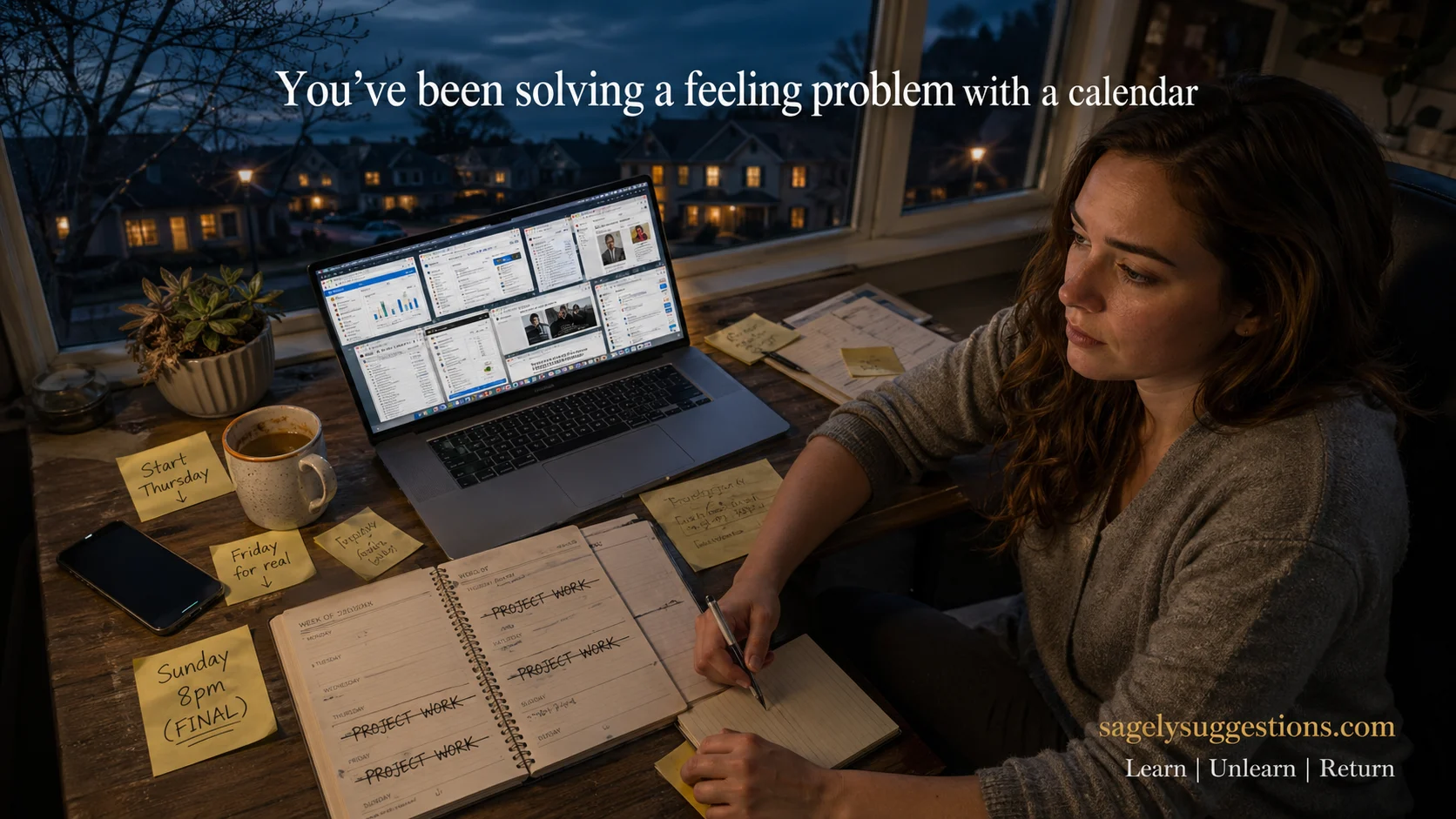
Sunday evening, 8:47 p.m. The project has been sitting in your browser tabs since Thursday — seventeen of them, open, blinking, mildly accusatory. You have blocked out this exact window to work. The kids are finally quiet. The kitchen is clean enough. There is no legitimate reason not to start. And yet here you are, rearranging your desk, reading a newsletter you don’t remember subscribing to, and now somehow thinking about whether you need a new desk organizer. You do not need a new desk organizer. The generic productivity advice — time-block your calendar, set a timer, break it into smaller steps — has been repeated to you so many times it has worn smooth, like a river stone with nothing sharp left to hold onto. This article goes somewhere that advice never does: the actual mechanism behind why you delay, verified by behavioral scientists who have spent careers watching the pattern unfold. If your experience of procrastination feels more like an itch you can’t name than a scheduling problem you’ve failed to solve, that recognition is the first useful thing you’ll find here.
💡 Idea 1 Skill Type: Life | Evidence: Strong
Idea: Identify the precise negative emotion a task triggers before you attempt to begin it.
Why This Works: When you name what you are actually feeling about a task — boredom, self-doubt, resentment, anxiety — the avoidance impulse loses some of its automatic power. Sirois and Pychyl’s landmark framework established that procrastination activates when a task is perceived as aversive, generating negative emotion that the brain then prioritizes escaping over completing the work. Sirois & Pychyl, Social and Personality Psychology Compass, 2013 (Note: foundational study — 2013; mechanism confirmed across subsequent replications.) Naming the emotion disrupts the automatic escape route.
Why This Beats Common Advice: “Just start” assumes motivation is the obstacle. This targets what actually blocks starting: the unnamed emotion that makes the task feel threatening rather than merely inconvenient.
Real-Life Situation: You keep pushing back your performance review self-assessment at work, telling yourself you’re waiting for a clearer head. The real feeling is dread of confronting the gap between where you are and where you wanted to be.
Immediate Micro-Action: Open a Notes app. Write one sentence: “The feeling this task gives me is ___.” Do not write “stressed.” Be granular: is it boredom, shame, resentment, fear of judgment? Stop there. That’s the session.
Major Caveat: Labeling alone is preparation, not action. If it becomes another way to delay starting, set a two-minute cap.
Do NOT Apply When: The task is overdue by more than 48 hours — begin first, label second.
💡 Idea 2 Skill Type: Life | Evidence: Strong
Idea: Design an “if-then” trigger that links a specific cue to the first two minutes of the task.
Why This Works: “If it is 9 a.m. and I am at my desk, then I will open the document and write one sentence” transfers the decision from willpower to environment. Gollwitzer and Sheeran’s meta-analysis of 94 studies found a medium-to-large effect of if-then planning on goal attainment (d = .65), specifically because it automates initiation — the moment where emotion-driven avoidance most often wins. Gollwitzer, American Psychologist, 1999; meta-analytic review by Gollwitzer & Sheeran, 2006 (Note: foundational study — 1999; effect replicated across 94 studies.)
Why This Beats Common Advice: “Set a reminder” asks you to re-decide each time. If-then planning eliminates the re-decision by making the situational cue do the choosing for you.
Real-Life Situation: You have a side project that lives in a folder labeled “Q1 Goals” — a folder you open, then immediately close after browsing three unrelated tabs. The project needs a standing trigger, not good intentions.
Immediate Micro-Action: On a sticky note or phone note, write: “If [specific cue: coffee in hand, desk lamp on, 8 a.m.], then I will [one named first action, under 2 minutes].” Post it where the cue appears.
Major Caveat: The cue must be highly specific and reliably present. Vague triggers (“when I feel ready”) defeat the mechanism entirely.
Do NOT Apply When: The task requires creative warm-up — use a low-friction starter ritual instead.
“The planner on your wall has never once felt the dread. Only you have. That’s the gap every scheduling system skips.”
💡 Idea 3 Skill Type: Life | Evidence: Strong
Here is something behavioral science confirmed that most advice still hasn’t caught up with: the procrastination–stress loop runs backward from how most people imagine it. You assume you are stressed because you have procrastinated. That’s true. But the stress was also present before you delayed, and it was precisely that stress — the low-grade anxiety of a task that feels bigger than you can manage right now — that activated the avoidance in the first place. Fuschia Sirois’s 2023 stress-context model, published in the International Journal of Environmental Research and Public Health, shows that stressful contexts deplete the very coping resources that allow you to tolerate the discomfort of aversive tasks. In plain terms: the more overwhelmed your broader life is, the lower your threshold for tolerating an unpleasant task, and the more easily procrastination wins. Sirois, Int J Environ Res Public Health, 2023 The practical implication is counterintuitive: before you try to tackle the task you’ve been avoiding, briefly reduce the ambient stress load through a five-minute walk, two minutes of slow breathing, or any genuine state-change — not to delay starting, but to raise the threshold at which avoidance kicks in. In practice, the tactic is not relaxation as reward; it is stress-reduction as a preparation for engagement.
⚡ Micro-Action: Before sitting down to a task you’ve been avoiding, take exactly five minutes to do something that physically changes your state — a short walk outside, washing your face with cold water, or five minutes of slow box breathing (four counts in, four hold, four out, four hold). Then sit down. The window for beginning is highest in the three minutes immediately after.
Heads up: This is not a license to make stress-reduction the main event. If five minutes reliably becomes forty-five, set a phone timer and treat it as a non-negotiable handoff. Skip this if the task is already past its deadline — the cost of further delay outweighs any threshold benefit.
💡 Idea 4 Skill Type: Life | Evidence: Strong
Idea: After procrastinating, forgive yourself for it in writing — specifically and briefly.
Why This Works: Self-blame after procrastination increases the negative affect associated with the task, which makes avoidance more likely next time, not less. Wohl, Pychyl, and Bennett’s study of 119 first-year university students found that those who forgave themselves for procrastinating before a first exam showed reduced procrastination before the second exam. The mechanism was the reduction of negative affect — not accountability, which remained intact — but the specific emotional weight attached to re-engaging with the task. Wohl, Pychyl & Bennett, Personality and Individual Differences, 2010 (Note: foundational study — 2010; mechanism replicated in subsequent self-compassion research by Sirois and Neff.)
Why This Beats Common Advice: Conventional wisdom says guilt motivates action. Evidence shows it mostly motivates further avoidance of the thing that triggered the guilt.
Real-Life Situation: You delayed filing that insurance claim for three weeks. Now every time you think about it, the guilt about not having done it earlier piles on top of the original task friction, making it feel twice as heavy as it actually is.
Immediate Micro-Action: Open Notes. Write: “I put off [specific task]. That happened. I’m not carrying it forward.” Read it once. Close the note. Do not re-read. Takes under 90 seconds.
Major Caveat: Self-forgiveness is not self-excusing. The task still exists. This only removes the accumulated shame layer so you can approach the task with less emotional weight.
Do NOT Apply When: The delay caused harm to someone else — acknowledge that directly first.
💡 Idea 5 Skill Type: Life | Evidence: Strong
Idea: Separate the task you’re avoiding into two categories: the emotion about it versus the actual work involved.
Why This Works: Blunt and Pychyl’s research identified boredom, frustration, and resentment — not complexity — as the dimensions of task aversiveness most predictive of procrastination. Crucially, research from Wypych and colleagues (2024, PMC) found that procrastination-related aversive feelings do not escalate once work begins — it is the anticipation, not the task itself, that is intolerable. The task feels like climbing a wall; doing it tends to feel like walking uphill. Wypych et al., PMC, 2024
Why This Beats Common Advice: Telling yourself “it’s not that bad” is unconvincing. Separating the emotional anticipation from the actual task mechanics gives you a concrete reality check grounded in what the work actually requires.
Real-Life Situation: Drafting a difficult email to a colleague you’re in conflict with. The email itself takes nine minutes to write. The emotional dread of it has been present for four days — which is the real task you’re carrying, not the email.
Immediate Micro-Action: On paper or in Notes, write two columns: “What I feel about this task” and “What the task actually requires step-by-step.” Time how long column two realistically takes. The gap between the two columns is where the delay lives.
Major Caveat: Some tasks that feel enormous actually are emotionally significant — a difficult conversation, a medical appointment deferred. Don’t rationalize away genuine weight.
Do NOT Apply When: The task genuinely requires skills you currently lack — that gap is real, not emotional.
“Nobody procrastinates on things they feel neutral about. Follow the avoidance and you’ll find the feeling.”
| What You’re Usually Told | What Behavioral Evidence Says Instead |
|---|---|
| Schedule it. Block time on your calendar. | Scheduling doesn’t reduce the aversiveness of the task — it only changes when avoidance happens. |
| Just start. Any action beats none. | If-then environmental triggers — not willpower — reliably bridge the emotion-to-action gap at initiation (Gollwitzer & Sheeran, d = .65). |
| Feel guilty — it’ll motivate you. | Guilt increases the negative affect attached to the task, making avoidance more likely next time (Wohl, Pychyl & Bennett, 2010). |
| You need better time management skills. | Procrastination is a failure of emotion regulation, not time organization (Sirois & Pychyl, 2013; confirmed in multiple systematic reviews). |
| Productive delay and procrastination are the same thing. | Strategic delay (collecting information before deciding) is adaptive. Avoidance-driven delay is defined by negative emotion and expected future costs — a measurable distinction (Svartdal & Nemtcan, 2022). |
💡 Idea 6 Skill Type: Life | Evidence: Moderate
Idea: Learn to distinguish avoidance-driven delay from productive strategic delay — they require opposite responses.
Why This Works: Svartdal and Nemtcan’s 2022 research in Frontiers in Psychology identified that standard procrastination scales conflate two genuinely different behaviors: irrational delay marked by expected negative consequences, and rational delay where more information or time produces better outcomes. Svartdal & Nemtcan, Frontiers in Psychology, 2022 Treating all delay as pathological means sometimes fighting a behavior that is actually working for you. You can learn to tell them apart by one question: if you could guarantee no external consequence for delaying, would you still feel relief — or would you feel dread?
Why This Beats Common Advice: Standard advice treats all delay as failure. This distinction lets you act precisely: intervene when the delay is emotionally driven, protect the pause when it’s strategically sound.
Real-Life Situation: You haven’t responded to a job offer. It feels like procrastination. But you’ve asked for two references and are waiting on information. That’s productive delay. Meanwhile, you haven’t started your taxes because the folder gives you a low-level panic. That one is avoidance.
Immediate Micro-Action: For each delayed task today, write one word: “Avoiding” or “Waiting-for.” If “Waiting-for,” name the specific thing you need. If you can’t name it, it’s “Avoiding.” Takes under three minutes for a full task list.
Major Caveat: This self-assessment is vulnerable to rationalization. The brain is very good at reframing “Avoiding” as “Waiting-for.” Apply skepticism when you find yourself always in the latter category.
Do NOT Apply When: High-stakes irreversible decisions — those may genuinely benefit from deliberate waiting.
💡 Idea 7 Skill Type: Life | Evidence: Strong
The piece of this that will feel most counterintuitive — the one that takes a moment to actually land — is this: self-criticism after procrastinating is not the antidote to the pattern. It is the fuel for it. Here’s how that works. You delay a task. You feel guilty. That guilt becomes new negative affect, which now attaches to the task along with the original dread that caused you to delay it in the first place. So next time the task appears, it carries both the original aversiveness and the emotional weight of having failed to do it. The behavioral load doubles. Kristin Neff’s systematic review in the Annual Review of Psychology (2023) found that self-compassionate people — those who treat their own lapses with the same reasonable understanding they would offer a friend — engage in fewer self-handicapping behaviors, including procrastination. Neff, Annual Review of Psychology, 2023 This is not “be kind to yourself” as platitude. It is a specific mechanism: reduce the emotional penalty for having delayed, and you reduce the avoidance barrier for the next attempt. Somewhere around the fourth week of trying to build a new habit, when the guilt about the days you skipped starts to feel heavier than the habit itself — that’s the moment self-compassion earns its place on the intervention list, not as self-indulgence, but as genuinely practical neuroscience.
⚡ Micro-Action: After a day where you avoided a key task, write one sentence using this template: “A lot of people would have found this task difficult for the same reasons I did, and that doesn’t mean I can’t begin again tomorrow.” Read it once. Do not edit it into something harsher. Takes 45 seconds and interrupts the shame-accumulation cycle before it compounds.
Heads up: Self-compassion is not the same as lowering your standards — research is consistent on this. The risk is conflating the two, which undermines the value of the technique for people who are already prone to giving themselves too many passes. If the internal conversation after using this sounds like “it’s fine, I don’t really have to do it,” that’s not self-compassion — that’s avoidance wearing a friendlier mask. Skip this if a pattern of chronic non-completion with zero consequence is already established.
“You’ve been solving a feeling problem with a calendar. Small wonder the calendar hasn’t worked.”
It’s still Sunday evening — or a version of it. The tabs are still open, the desk organizer idea is still quietly circling. What has changed is what you are actually looking at when you see that stack of deferred work: not a time management failure, not a character flaw, but a very human set of emotions that needed somewhere to go and found the easiest exit. If you only try two of these, start with Idea 1 and Idea 4 — naming the emotion before you start, and forgiving the delay after. Those two together address the leading and trailing edge of the avoidance cycle: what stops you from beginning, and what makes it harder the next time. Everything else you’ve read here sits between those two anchors. Procrastinating doesn’t make you lazy. It makes you someone whose brain learned a reliable, if costly, way to feel better. You can teach it a slightly less expensive route.
The planner was never broken. The task, it turns out, had feelings about itself.
— The Seasoned Sage
Want to understand the other side of this? The emotion regulation strategies that keep self-compassion from sliding into avoidance are closely linked to how you handle perfectionism and fear of failure more broadly — a pattern worth exploring if procrastination surfaces most acutely around work you care about.
The distinction between avoidance-driven delay and productive strategic delay also connects directly to how you approach decision fatigue and deliberate delay in decision-making — not all pauses are problems.
If the stress-threshold idea from Idea 3 resonated with you, the fuller picture of how chronic stress impairs self-regulation and habit formation is worth understanding on its own terms.
Discover more from Sagely Suggestions
Subscribe to get the latest posts sent to your email.