America’s Semiquincentennial doesn’t require Philadelphia crowds. Discover overlooked Revolutionary War sites where history breathes quieter—and deeper. Plan your 2026 trip now.
Hidden Historic Sites for America’s Semiquincentennial
So there I was, standing in line at Independence Hall in 2019, watching my teenager scroll TikTok while we waited 90 minutes to see a room he’d already seen in textbooks. That’s when I realized: famous doesn’t mean meaningful. Your brain isn’t designed to absorb history while processing elbow-to-elbow navigation and the existential dread of overheated tourist crowds.
What if the best places to experience America’s Semiquincentennial aren’t on most America250 official maps?
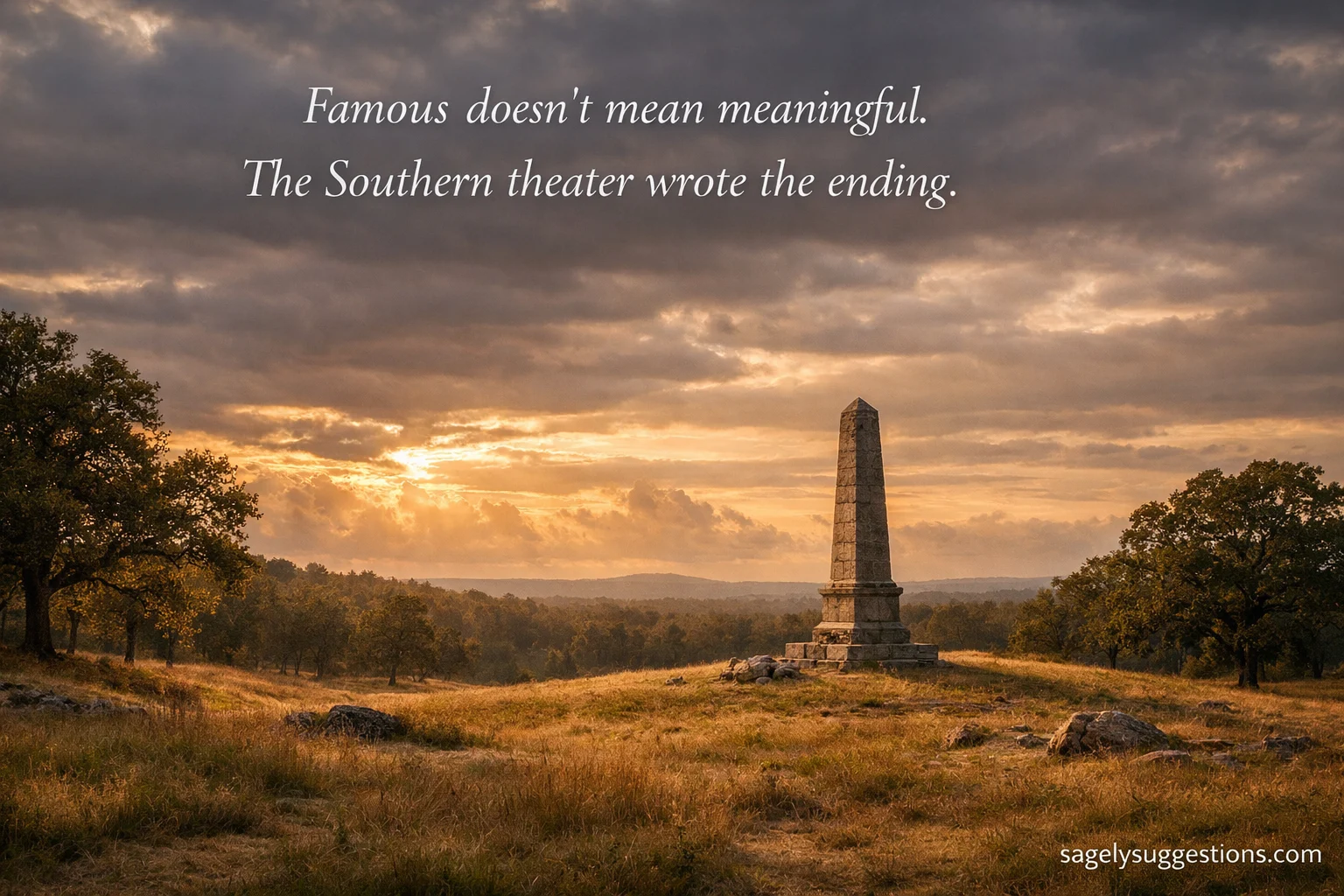
July 4, 2026 lands on a Saturday, and the major sites are already bracing for what could be the largest patriotic gathering in a generation. Philadelphia. Boston. DC. The triumvirate of obvious choices. And here’s the thing nobody tells you: visiting only those three for the Semiquincentennial is like reading only the first chapter of a novel and claiming you understand the plot. The Southern theater wrote the ending.
Let me save you about seven years of nonsense. The sites I’m recommending have room to think. Room to ask questions. Room for your teenager to actually engage instead of mentally checking out by the second stop. Because you’ve tried the Freedom Trail already. You watched their eyes glaze over at Old North Church. You spent two thousand dollars and came home with nothing but guilt and a fridge magnet.
2019 family trip, teenager disengaged by stop three, $2,000 spent, zero retention.
This isn’t about finding “alternatives.” It’s about finding the actual story while everyone else fights for selfies at the highlight reel.
The Southern Battlefields: Where the War Was Actually Decided 🏛️
Here’s what your high school history textbook compressed into a footnote: the Revolutionary War wasn’t won in the North. It was won in the Carolinas, through a series of battles that get maybe ten percent of the attention they deserve.
Kings Mountain National Military Park, South Carolina
October 7, 1780. A thousand Patriot militia climbed a rocky ridge and destroyed a Loyalist force in less than an hour. No famous generals. No Continental Army uniforms. Just backcountry fighters who understood the terrain better than the British did. The battlefield sees about 175,000 visitors annually—which sounds like a lot until you compare it to Independence Hall’s daily summer crowds.
175,511 annual visitors at Kings Mountain vs. 2+ million at Independence Hall
Source: National Park Service Visitation DataWalk the 1.6-mile Battlefield Trail. The interpretive signs don’t just tell you what happened; they show you why the Loyalists had no chance once the Patriots reached the summit. Your teenagers can actually hear themselves think here. You can stop mid-sentence to explain tactical positioning without a tour guide shushing you.
Cowpens National Battlefield, South Carolina
January 17, 1781. Daniel Morgan’s double envelopment tactic here is still studied at military academies. The visitor center shows a short film that contextualizes the battle within the broader Southern Campaign—critical for helping kids understand why this mattered. Note: the center is undergoing renovations starting January 2026, but the battlefield itself remains accessible.
The paved path makes this accessible for multigenerational groups. No one gets left behind. No one complains about hiking. And the 845-acre site means your family can spread out instead of clustering like sardines.
Guilford Courthouse National Military Park, North Carolina
March 15, 1781. Cornwallis technically “won” this battle but lost so many men he couldn’t capitalize on it. That’s the kind of paradox that makes teenagers lean in instead of zone out. The park offers free self-guided audio tours through the NPS app—let your kids control the narrative for once.
Open 8:30 AM to 5:00 PM daily except major holidays, located six miles north of downtown Greensboro. You can visit this in a morning, grab lunch in the city, and still have afternoon energy for something else. That’s not tourist math; that’s family sanity.
Forgotten Forts: Where Ordinary People Held the Line 🏰
Battlefields show you where armies clashed. Forts show you where regular humans lived through a war. There’s a difference, and your kids will feel it.
Fort Mifflin on the Delaware, Pennsylvania
Minutes from Center City Philadelphia, yet somehow invisible to most America250 itineraries. This is one of the country’s only completely intact Revolutionary War battlefields. The British bombarded this fort for six weeks in 1777—the greatest bombardment of the entire war.
Walk through the bombproof shelters. Stand where gunpowder was stored. Let your teenagers touch the actual walls that absorbed cannon fire. That tactile connection does something no textbook ever could.
🏰 One intact fortress > ten recreated “experiences”
Fort Mose Historic State Park, Florida
Here’s where the story gets complicated—in the best way. Fort Mose was the first legally sanctioned free Black settlement in what became the United States. Enslaved people escaped British colonies, reached Spanish Florida, and gained freedom in exchange for defending the territory.
The grounds are open daily from 9 AM to 5 PM, 365 days a year. Admission is free. The visitor center charges $2 per adult—less than a gumball machine. This is the kind of site that makes your family conversation interesting on the drive home. Not “what did we see?” but “what did we just learn about the story we tell ourselves?”
If you’re planning a Florida stop, book for mid-February 2026 when several St. Augustine state parks offer free admission days. That’s not budget travel; that’s strategic travel.
Unsung Homes and Taverns: Where Decisions Actually Happened
Wars aren’t won on battlefields alone. They’re won in rooms where people argued, planned, and made terrible decisions under pressure.
The problem with famous founder homes? They’re museums now. Polished. Protected. Distant. What you need are spaces that still feel like spaces—where your family can imagine actual humans making actual choices.
Look for local patriot meeting houses in the regions you’re visiting. Cornerstone Mansion in Pennsylvania. Local taverns that hosted militia planning sessions. These sites don’t have gift shops the size of small airports. They have rooms where you can stand and think about what happened there.
- No gift shop larger than the exhibit space
- Ranger availability for questions
- Parking under $10
- Restroom access without purchasing admission
If you’re feeling uncertain about planning a trip that actually serves your family’s educational goals, think of it like navigating a career maze—the framework is similar. Career uncertainty got you stuck? The Maze-based framework helps Americans navigate job search confusion.
Native and Marginalized Sites: The Story We Don’t Tell
Here’s the uncomfortable truth: most America250 content clusters around the same founding narratives. Same founders. Same battles. Same perspective. Your teenager knows this. They’ve known it since middle school. They’re just waiting for you to acknowledge it.
Taos Pueblo, New Mexico
Continuous habitation for over 1,000 years. The Spanish arrived. Then the Americans. The Pueblo remained. This isn’t a Revolutionary War site, but it’s an American history site—and the Semiquincentennial is about America, not just the Revolution.
Angel Island, California
The “Ellis Island of the West,” where Asian immigrants were processed between 1910 and 1940. Some were detained for years. The poetry carved into the barracks walls tells a story that doesn’t fit neatly into July 4th celebrations—but fits perfectly into honest history.
Including these sites doesn’t diminish the Revolution. It contextualizes it. Your kids will respect you more for the honesty than they ever would for a sanitized version.
Making It Actually Happen: Planning Without the Panic
You’re reading this in March 2026. That’s four months out from July 4th. Here’s what the data says: most travelers are booking about 11 months ahead for 2026 trips, and the average trip is expected to last 11 days. You’re behind the curve. But you’re not doomed.
Booking Timeline Reality Check
Major cities (Philadelphia, Boston, DC): Accommodations are likely already constrained for July 4th weekend. If you’re set on these, book immediately and expect premium pricing.
Lesser-known sites (Kings Mountain, Cowpens, Guilford Courthouse): You have 3–4 months of flexibility. Book 6–9 months ahead for summer visits to secure reasonable rates.
Southern sites will have 40–60% fewer visitors than Northern counterparts during peak season. That’s not speculation; that’s based on comparative NPS visitation patterns.
Educational Preparation (The Part Nobody Mentions)
Don’t just show up. Prepare your kids with specific questions before each visit:
- “What would you have done if you were the commander here?”
- “What’s one thing about this place that surprised you?”
- “What story isn’t being told in this exhibit?”
Cognitive load from crowds blocks memory encoding. Quiet sites allow conversation. Conversation creates retention. That’s not travel advice; that’s neuroscience.
Budget Ranges (Per Family of Four)
| Site Type | Admission Cost | Crowd Level |
|---|---|---|
| Southern Battlefields | $0–$20 total | Low |
| Fort Mose | $8 (visitor center) | Low |
| Fort Mifflin | $40–$60 family | Medium |
| Independence Hall | Free + fees | Extreme |
| Freedom Trail | Free–$50 tours | Extreme |
| Accommodations (South) | 30–50% lower | Variable |
The Moment to Watch For
Every site I’ve recommended has one specific moment—the point where your teenager might actually lean in instead of checking their phone.
The initial quiet—no lines, no crowds, just space.
Reading the first sign without rushing.
The summit view, the film, the video—that thing that lands.
Questions happen naturally, not forced.
They remember it next week. That’s the win.
What the Best Historic Sites Have in Common
They’re quiet enough for questions. They’re specific enough to be memorable. They’re honest enough to be trustworthy. They don’t try to be everything to everyone.
The 2026 travel trends show a shift toward “off-the-beaten-path” destinations and intentional travel. That’s not a trend; that’s a correction. People are realizing that meaning doesn’t scale. You can’t mass-produce a moment that matters.
So there’s your choice. You can join the thousands fighting for parking at Independence Hall, waiting 90 minutes to see a room your kids will forget by dinner. Or you can take them somewhere the story breathes. Where the ground still holds the weight of what happened. Where conversation is possible.
Your habits are snitching on your goals. If your goal is meaningful family engagement with history, then famous sites are working against you.
The Question You’re Not Asking
You’re wondering if skipping the famous sites means your family will miss something essential. Here’s the truth: your family will miss the crowds. They won’t miss the history.
The Southern battlefields decided the war. The forgotten forts show daily reality. The marginalized sites tell the complete story. None of this is alternative. It’s foundational.
July 4, 2026 is coming whether you plan or panic. The difference between those two outcomes isn’t luck. It’s whether you’re willing to trust that meaning lives in the places guidebooks skip.
Bold move. Questionable to most people. But bold.
Start with one site. Kings Mountain if you’re East Coast. Fort Mose if you’re heading South. Book it this week. Show your teenager the battlefield before you show them the gift shop. Let them ask the first question.
Then watch what happens when history isn’t competing with a thousand other people’s selfie sticks.
Discover more from Sagely Suggestions
Subscribe to get the latest posts sent to your email.