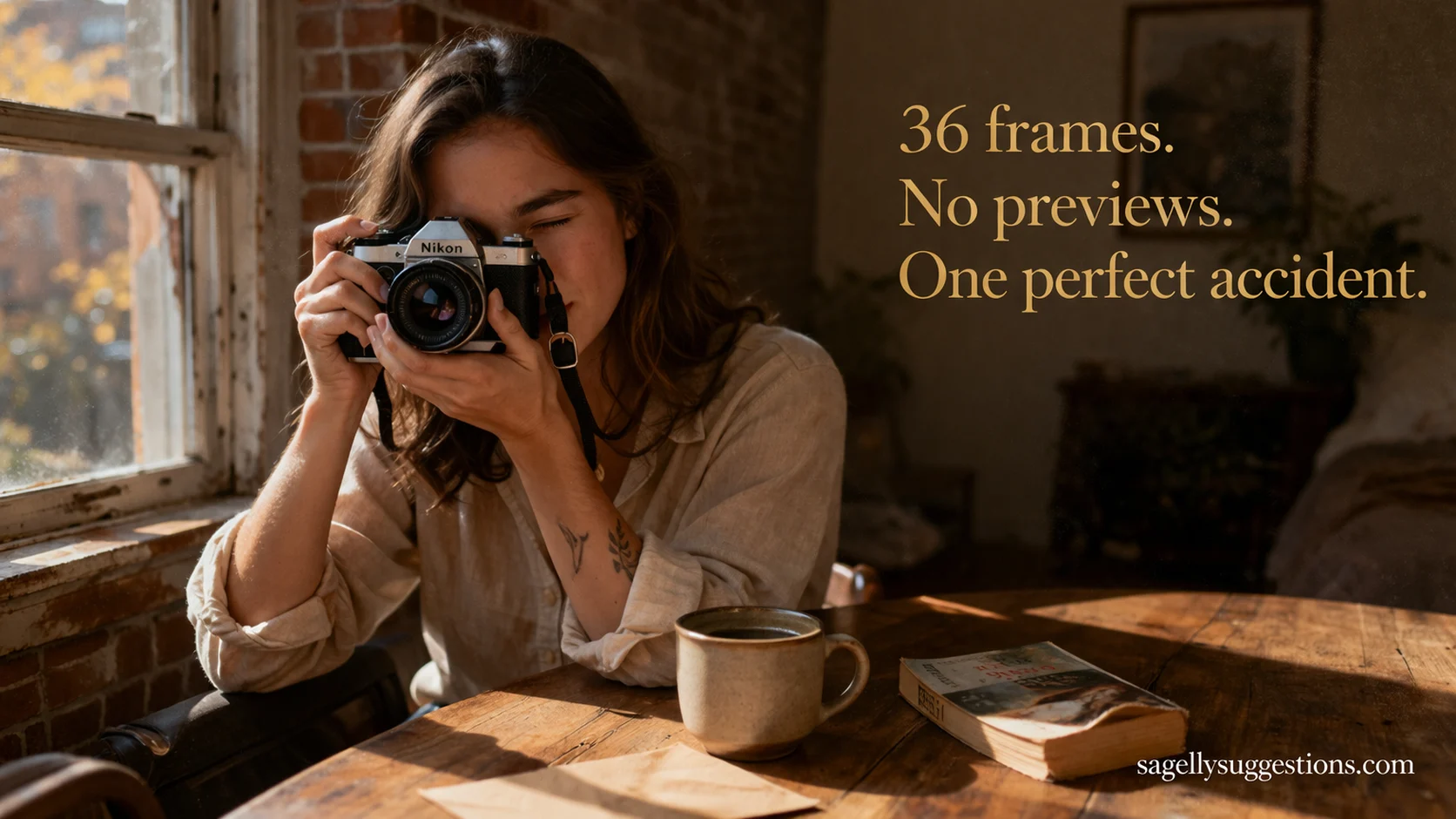
Film photography for beginners decoded: real costs, first-roll truths, and gear advice. Discover why the wait and the grain are the whole point. Start smart.
Film Photography Is Expensive, Chaotic, and Completely Worth It
The roll cost me $21. The lab cost me $22. Shipping was $8. The wait was eleven days. I got back 36 scans, of which four were good, one was great, and one was a pure accident that I’ve since framed and put on my wall. I have never felt so insane about something in my entire adult life. Anyway, here’s everything you need to know before you start.
If you’ve been quietly stalking the film photography corners of the internet — the TikTok “film dumps,” the Reddit threads, the suspiciously beautiful grain in photos of mundane things — you already know you’re interested. You’re also, probably, slightly suspicious of your own interest. Is this real, or am I just attracted to an aesthetic? Fair question. This article is going to answer it honestly, which means it’s going to tell you things that other articles won’t — including the actual costs, the actual learning curve, and what it genuinely feels like to shoot your first few rolls.
No mood board. No gear worship. Just the reckoning.
The Real Cost Math Nobody Wants to Show You
Every film photography article contains a perfunctory line like “film can be expensive, but the results are worth it!” — and then pivots immediately to camera recommendations. This is the journalistic equivalent of telling someone that surgery “can be uncomfortable.” Technically true. Aggressively uninformative. Let’s do better.
A single roll of Kodak Ultramax 400 — the go-to beginner color stock, the one everyone recommends, the one you’ll either fall in love with or rapidly outgrow — runs roughly $10–18 depending on where you buy it. Specialty retailers like the Film Photography Project or Film Supply Club can get you closer to $10–12. Camera shops and B&H run $15–18. A boutique analog store in a city that has started using the word “curation” unironically will charge whatever they feel like, and you will leave quietly. Budget $14 as your working average.
Then there’s development. You can take it to a local lab — if you’re lucky enough to live near one that isn’t also a FedEx outlet — or use a mail-in service. Labs like The Darkroom and Indie Film Lab are the standard recommendations: reliable, good scans, turnarounds that won’t make you age visibly. Processing typically runs $15–22 per roll, plus $7–10 for return shipping. So your effective cost per roll, all in, is somewhere between $32 and $50. Here’s what that looks like at scale.
The Annual Math, at Two Shooting Speeds
| Line Item | Casual (2 rolls/mo) | Enthusiastic (5 rolls/mo) |
|---|---|---|
| Film (~$14/roll) | $336 | $840 |
| Processing + scanning (~$20/roll) | $480 | $1,200 |
| Return shipping (~$9/roll) | $216 | $540 |
| Annual Total | ~$1,032 | ~$2,580 |
Camera not included — budget $80–200 for a solid used SLR. Also not included: the specific and very real risk that you fall down a film stock rabbit hole and start buying Kodak Portra 400 in bulk because you “wanted to try it once.”
The cost isn’t the punishment — it’s the mechanism. When a roll of film runs you $40 all-in before you see a single image, you shoot differently. You look longer before you press the shutter. You make a deliberate choice instead of a reflexive one. The financial commitment and the compositional care are not coincidentally related. This is a paid hobby, the same as golf or rock climbing or collecting anything worth collecting. Frame it accordingly, and you’ll never feel played by it.
The Psychological Architecture of Waiting
Here is a sentence that appears in virtually every film photography beginner’s guide: “Film teaches you to slow down.” It is technically accurate and almost completely useless as information. It’s the kind of sentence you nod at and immediately forget, because it doesn’t tell you anything about what actually happens — only that something does. Let’s be specific.
When you shoot digital — or your phone — feedback is instant. You press the shutter, you see the result, you adjust, you shoot again. Your entire creative process is iterative and immediate. You are, in effect, editing while you’re still shooting. This isn’t bad. It’s a different cognitive loop, and it produces a different kind of attention: responsive, reactive, constantly self-correcting.
Film doesn’t teach you to slow down. It teaches you to compose before you shoot, not after. That’s a different cognitive discipline entirely — and it changes how you look at everything.
Film photography structurally breaks that loop. You have 36 frames on a roll. You cannot review them mid-roll without ruining the film. When the roll is finished, you mail it to a lab. Services like Indie Film Lab run 7–14 business days from receipt — which means you’re waiting ten days to two weeks while having absolutely no idea what you got. Whether the exposure was right. Whether the light you chased at golden hour landed the way you hoped. Whether your subject blinked in every single frame, which does happen, and which will make you feel both amused and specifically targeted.
The wait is not the limitation. The wait is the entire point. Because when you know you won’t see the result for two weeks, you stop shooting-and-checking, and you start actually looking — at the angle, the quality of light, the fraction-of-a-second moment — before you press the button. The shutter becomes a commitment instead of a draft. Over time, this rewires how you see things. Not just how you photograph them.
Film photography is structurally like writing a letter instead of sending a text. The constraint isn’t the limitation — it’s the whole point. Nobody sends a handwritten letter and says “I wish I could edit this before it arrived.” The impermanence is the intimacy. The wait is the weight. You’re not capturing a moment; you’re committing to one.
There’s also something genuinely strange about getting your scans back ten days after you shot them. By that point, whatever you photographed has already become a memory — a camping trip, a dinner party, a quiet afternoon in November that felt like nothing at the time. The photos arrive with emotional distance already built in, which makes them feel less like documentation and more like artifacts. They already belong to the past in a way that a phone photo, instantly accessible and chronologically indexed, never quite does.
One of the frames will surprise you. One will disappoint you in a way that’s still oddly beautiful. And one — at least one — will be something you couldn’t have planned or staged, something you almost didn’t shoot because you weren’t sure it was worth 1/36th of a roll. That’s the one you’ll come back to.
Your First Three Rolls: A Brutally Honest Preview
Nobody tells you what the first three rolls actually look like, because the truth is less aspirational than the aesthetic that sold you on this. Here’s the truth. You deserve it before you spend $150 discovering it yourself.
At least one zone of underexposure that will make you suspect the camera is broken. It isn’t — you just forgot that ISO 400 doesn’t mean “shoots fine anywhere,” it means it’s more light-sensitive than ISO 100, which still doesn’t help you in a dim bar at 9 PM. There will be at least one motion blur from a shutter speed too slow for a moving subject. There will be one accidental double exposure you didn’t know was possible and will spend two days trying to reverse-engineer. And there will be two or three frames that are genuinely lovely — maybe startlingly so — that will make you think: okay. I see it. I’m in.
You’ve read your camera’s manual now, or watched a YouTube video about it while eating cereal at 11 PM, which absolutely counts. You understand the exposure triangle at a conceptual level. You’re more deliberate. The results are more consistent — and sometimes, paradoxically, less interesting. Some photographers will tell you their worst work came when they were trying hardest. First contact with this phenomenon is humbling in a specifically instructive way. You’ll still have one frame you can’t explain and love without qualification.
Cognitively, not literally — though it does click literally with a satisfying mechanical sound that you will find embarrassingly charming. By your third roll, you’ve developed a seeing eye. You know what your camera does in low light. You know your most common mistake. You’re starting to anticipate moments instead of reacting to them. The hit rate on your scans is noticeably better, and you feel briefly like a genius, and then you remember you’ve only shot three rolls total and appropriate humility is warranted, and you immediately load roll four. This is the rhythm. Welcome to it.
The “grain and imperfection” aesthetic isn’t nostalgia — it’s a rejection of algorithmic perfection. In 2026, AI can generate a technically flawless photograph of anything imaginable. Real imperfection — the imperfection that proves something actually happened, that a specific light fell on a specific face at a specific unrepeatable moment — is becoming increasingly rare. Film photography is, oddly, the most anti-AI thing you can do with a camera. The grain isn’t a flaw. It’s evidence.
How to Buy Your First Camera Without Getting Played
Film cameras are having a documented cultural moment. Harman/Ilford has been expanding production capacity to meet surging demand, Kodak has reintroduced discontinued emulsions, and the vintage camera market has responded to all of this with the enthusiasm of someone who just discovered arbitrage. Prices on eBay and Etsy have inflated noticeably. Navigation is required.
Start with the trap. Cameras listed as “tested and working” on eBay often aren’t, or they work but have developed light leaks — small gaps in the body seal that expose your film to ambient light. This typically shows up as orange or pink streaks across your frames. Charming exactly once as an unexpected accident. Actively infuriating when it’s your weekend photographs. Buy from sellers with detailed photos, return policies, and a history of film camera listings specifically. Or buy from a local camera shop that actually tests their inventory. If a listing price seems high and the only stated reason is that it’s “vintage” and “aesthetic” — that’s not a camera. That’s vibes with a lens mount.
Three cameras that earn your money right now:
Pentax K1000 — Full Manual, Fully Mechanical
$60–120 used and workingNo battery required for the shutter — it operates on optics and spring-loaded physics alone, which feels appropriately anachronistic in the best way. Every setting is manual and deliberate, which means you cannot hide behind automation. Photography teachers used to start students on this camera for exactly that reason. The learning curve is real but front-loaded: you’ll understand exposure in a way that serves you on every camera you ever touch afterward, digital or analog.
Canon AE-1 Program — Semi-Automatic, Beginner-Friendly
$100–200 depending on conditionHas a Program mode that handles exposure automatically while you focus on composition — a genuinely useful training wheel for the first couple of rolls. The most produced film SLR in history, which means community support, parts, and an ocean of Reddit advice are available whenever you need them. As the shutter mechanism ages, it develops a distinctive squeal that has generated approximately one thousand forum threads. You’ll come to find it endearing. It is a known progression.
Minolta X-700 — The Underrated Option
$60–150Optically excellent, comfortable in the hand, and currently underpriced relative to its actual quality because it lacks the brand recognition of the Canon or the Pentax. The analog community’s open secret. If you want the best dollar-for-dollar value in a first film camera available right now, the X-700 is the honest answer — and the honest answer is rarely the most prominent one.
If you’re weighing a point-and-shoot against an SLR for your first camera — a genuinely common and reasonable question — we’ve covered that decision in detail in our guide to analog hobbies worth starting in 2026. The short version: start with an SLR. The control you gain from manual settings accelerates your development faster than any automatic will, regardless of the point-and-shoot’s reputation. You’re here to learn to see, not to have the camera see for you.
Here’s what nobody writes at the end of a film photography article, because it doesn’t fit neatly into the enthusiasm-or-warning binary that most of this content inhabits:
“The grain isn’t nostalgia.
It’s proof.”
Film photography in 2026 exists in genuine tension with the moment we’re living in. AI generates technically flawless images on demand. Mirrorless cameras deliver clinical precision at speeds that would have been incomprehensible twenty years ago. Algorithmic perfection is free, instant, and everywhere. Which means real imperfection — the kind that proves something actually happened, that you were actually there, that the light was actually that particular gold at that particular hour — has become rare. And rarity changes meaning.
The screen-exhausted, screen-aware person who wants a practice that structurally refuses to let her half-pay attention doesn’t need another app, another filter, another optimization. She needs something physical, deliberate, and constitutionally incapable of being checked mid-process. Film photography is, weirdly, one of the best available answers to that specific need. And if that sounds too earnest for a hobby that is, at its core, just chemistry and light — well. The best things usually do.
Your one action step: don’t buy a camera yet. Spend 20 minutes in r/analog, looking at what actual beginners are shooting on their first and second rolls. Notice whether you feel something — a pull, a recognition, a want. If you do, you already have your answer. The camera is just the formality. And if you want to think through the broader question of which creative hobbies are genuinely worth committing to right now, our piece on creative hobbies worth starting in 2026 might save you some decision fatigue and a couple of abandoned projects.
Go find your first camera →Discover more from Sagely Suggestions
Subscribe to get the latest posts sent to your email.