Making friends as an adult feels impossible because the old blueprints are broken. Discover the “Fourth Space” concept and how to hack your social life.
The Quick Answer: What Exactly is a “Fourth Space”?
A Fourth Space is a modern social environment that prioritizes shared purpose and hyper-niche interests over simple geography or alcohol-fueled mingling. Unlike a traditional “third place” (a coffee shop or local bar where the goal is open-ended socializing), a fourth space bridges online communities with real-world action. Examples include amateur running clubs, maker spaces, community gardens, or niche hobby meetups. They remove the pressure of forced conversation by anchoring social interaction to a shared, slightly awkward, or highly specific activity.
The “Third Place” Is Dead. Here’s the Secret “Fourth Space” Hack That’s Actually Saving Us.
You know that specific flavor of panic that hits around minute forty-five of sitting alone at a local coffee shop? You’ve nursed the same $7 oat milk latte until it’s room temperature. You’ve arranged your laptop, your notebook, and your phone at angles designed to project “I am deeply engrossed in creative work,” while simultaneously leaving enough physical space to signal “I am approachable and would welcome a charming conversation.”
Nobody walks over. The barista gives you a look that clearly communicates it’s time to buy a second pastry or leave. You pack up your things, walk home, and feel a quiet, heavy shame wash over you, wondering why making friends in your late twenties or thirties feels like trying to assemble IKEA furniture in the dark, missing half the dowels.
If this scene feels painfully familiar, I need you to hear me out: You aren’t failing at friendship. You are just trying to build a social life using an architectural blueprint that expired about fifteen years ago. We’ve all been handed the same outdated advice—go to a bar, hang out at the local pub, grab a coffee and strike up a chat. But those traditional “third places” (the spots outside of home and work where community happens) are quietly collapsing under the weight of inflation, remote work, and a shifting cultural landscape.
The good news? A new infrastructure is rising from the rubble. It’s not about where you go anymore; it’s about why you go. Welcome to the Fourth Space.
The Great American “Third Place” Collapse
Let’s look at the structural failure of our current social infrastructure. Sociologists have long relied on the concept of the “third place”—a physical anchor outside of your home (the first place) and your workplace (the second place) where you can decompress and build community [[4]]. Think of the diner from Seinfeld, the bar from Cheers, or the neighborhood pub where the bartender knows your order.
But the math behind the traditional third place simply doesn’t work for the modern American adult.
First, there’s the inflation problem. When a casual hangout requires you to drop $25 on a cocktail and an appetizer just to justify taking up a table, “dropping by” becomes a financial calculation rather than a spontaneous social act. According to the Survey Center on American Life, only 54 percent of Americans in 2025 still have a “third place” they frequent regularly [[6]].
Second, there’s the remote work factor. Without the forced proximity of an office water cooler, we lost the daily, low-stakes interactions that used to naturally graduate into weekend plans. The result is a profound isolation that isn’t just emotionally draining; it is physically dangerous.
The data on this is terrifyingly clear. According to a recent poll by the American Psychological Association, 30% of adults say they have experienced feelings of loneliness at least once a week over the past year, with 10% reporting they feel lonely every single day [[54]]. AARP research pushes that number even higher, noting that 40% of U.S. adults now report being lonely, a significant jump from previous decades [[55]].
This isn’t just a vibe; it’s a public health crisis. The U.S. Surgeon General has officially classified loneliness as an epidemic, warning that poor social relationships and social isolation increase your risk of heart disease by 29% and your risk of stroke by 32% [[62]]. To put a finer point on it, the health impact of chronic loneliness is comparable to the risk of smoking 15 cigarettes a day [[64]].
When the old structures fail, the resulting void makes us feel broken. We read articles telling us to “put ourselves out there” and assume the failure lies in our personalities, rather than recognizing that the physical venues designed to facilitate connection have fundamentally changed their business models. We are trying to run modern software on obsolete hardware.
Enter the “Fourth Space”: Where Purpose Replaces Geography
If the third place is about where you are, the fourth space is entirely about why you are there.
Coined by sociologists and tracked heavily in recent consumer behavior reports, a fourth space is an environment where purpose, health, and belonging intersect in real life [[43]]. It is the physical manifestation of an online niche. It is the bridge between the hyper-specific Reddit thread you read at 2 AM and the physical world you inhabit on a Tuesday night.
Think about the psychological scaffolding required to make a new friend at a bar. You are relying entirely on your wit, your charm, and your ability to sustain a conversational thread with a stranger while loud music plays and you both try to maintain an aura of effortless cool. It is a high-wire act of performative socializing, and for many of us, it is utterly exhausting.
Now, compare that to the architecture of a fourth space.
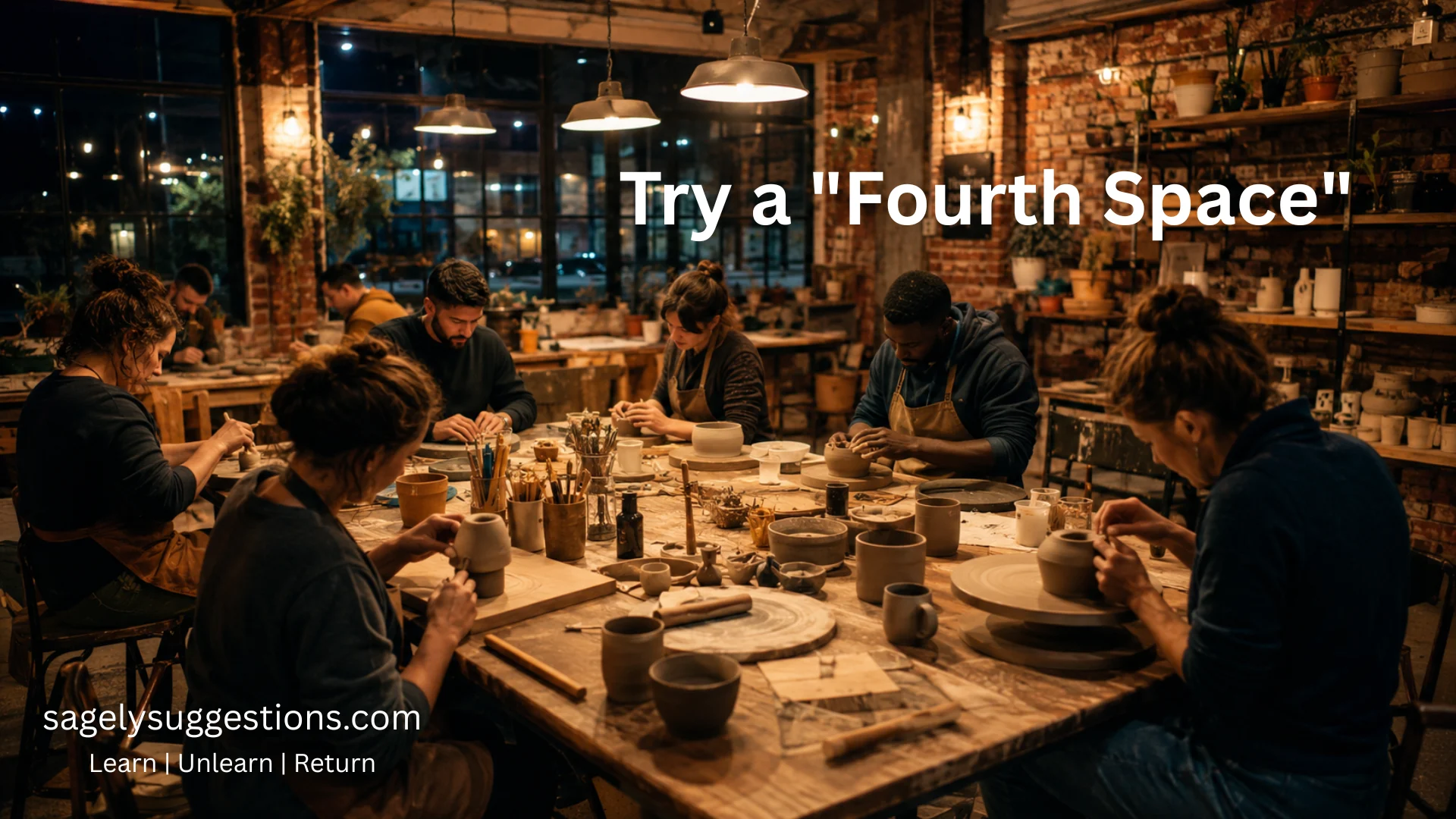
Imagine a weekly beginner’s pottery class where half the people are drinking cheap wine and struggling to center a lump of clay. Imagine a Saturday morning “slow run” club that explicitly advertises a 12-minute mile pace, ending at a local taco truck. Imagine a community listening party for a niche true-crime podcast, held in the back room of an independent bookstore.
In these spaces, the pressure is immediately off. You don’t need to be charming; you just need to be holding a piece of clay. You don’t need to carry a conversation; you just need to complain about your shins during the cool-down stretch. The activity itself acts as a buffer, a shared focal point that removes the terrifying burden of sustained, unbroken eye contact.
This is why amateur running clubs that feel like “cults” are suddenly everywhere. They aren’t really about cardiovascular health. They are highly efficient fourth spaces disguised as fitness routines. They provide the consistency of a weekly ritual, the shared struggle of a physical task, and the built-in excuse to grab a carbohydrate-heavy meal afterward.
By shifting our focus from geography (I’m going to the pub because it’s close) to intentionality (I’m going to this abandoned warehouse because 40 other people want to learn how to build mechanical keyboards), we bypass the awkwardness of the “getting to know you” phase. We skip the small talk and jump straight to the shared passion. We are no longer strangers trying to impress each other; we are collaborators trying to figure out why the glaze keeps cracking.
Why “Just Go to a Bar” Doesn’t Work Anymore
To fully appreciate the fourth space, we have to autopsy the myth of the traditional third place.
We’ve been sold a cinematic vision of adulthood where the local watering hole serves as the ultimate social glue. We expect that if we just sit at the mahogany bar long enough, we will organically stumble into a tight-knit tribe of chosen family. But this “Cheers” effect relies on an economic and social ecosystem that no longer exists for the average urban or suburban dweller.
The reality of the modern bar scene is that it is optimized for high-volume, high-margin turnover, not lingering community building. The lighting is designed to make the drinks look good, not to facilitate reading the micro-expressions of a potential new friend. The noise level requires you to shout, which prevents any conversation from moving past the superficial layers of “what do you do for work?” and “where did you grow up?”
Furthermore, the financial barrier to entry has quietly priced out the very demographic that needs community the most. If you are a young professional navigating the crushing reality of the modern housing market—perhaps reading up on the challenges of solo aging and planning without a traditional family safety net—the idea of spending $80 every Friday night in the hopes of striking up a meaningful conversation is a terrible return on investment.
We are left performing connection rather than experiencing it. We curate our outfits, we optimize our opening lines, and we treat socializing like a networking event where the currency is charm. It is no wonder that so many of us retreat to our apartments, order delivery, and convince ourselves that we just “prefer our own company.” We don’t necessarily prefer isolation; we are just fatigued by the performative architecture of the spaces we’ve been told to inhabit.
How to Find (or Build) Your Own Fourth Space
So, how do you actually execute this? How do you pivot from the exhausting hunt for a third place to the intentional cultivation of a fourth space? It requires a slight rewiring of how you view your free time.
1. Follow the Niche, Not the Crowd
Stop looking for general “social events” or generic “meet and greets.” Those are trapdoors of awkwardness. Instead, audit your digital life. What hyper-specific rabbit holes do you fall down on YouTube? What obscure subreddits do you lurk in? What kind of weird history podcasts do you listen to on your commute?
Your fourth space is the physical embodiment of that digital niche. If you love mid-century modern furniture restoration, there is a maker space in your city that rents out workshop time. If you are obsessed with urban foraging, there is a local mycology society that does weekend walks. You are looking for a micro-community, not a macro-gathering. The smaller and weirder the niche, the stronger the immediate bond with the other people in the room. You already have a shared language; you just need a shared room.
2. Embrace the “Shared Focus” Rule
When evaluating a potential fourth space, ask yourself: What are our hands doing?
The most successful modern social infrastructures involve a shared physical or intellectual task. You are painting a mural, you are sorting donated books, you are playing a cooperative board game, you are walking a specific trail. The “shared focus” acts as a psychological shock absorber. If the conversation lulls, it’s not a failure; you just go back to the task. It gives you an easy out, a natural rhythm to the interaction that prevents the claustrophobia of a one-on-one coffee date.
This is also why we are seeing a massive shift in how adults approach the concept of a designated person in their lives. We are moving away from relying solely on a romantic partner or a lifelong best friend to fulfill every emotional and social need. Instead, we are building a decentralized network of fourth-space companions—the running friends, the pottery friends, the trivia night friends—who collectively form a robust, low-pressure social safety net.
3. Consistency Over Intensity
The biggest mistake people make when trying to build community is trying to go deep too fast. You don’t need to trauma-dump on your new board game group, and you don’t need to invite the beginner pottery class to your birthday dinner after week two.
The magic of the fourth space relies on the “mere exposure effect”—the psychological phenomenon where people tend to develop a preference for things merely because they are familiar with them. Show up every Tuesday at 7 PM. Be the person who always brings the good snacks. Be the person who asks the instructor the clarifying questions. Over weeks and months, the scaffolding of the activity fades into the background, and the genuine friendship takes over. You aren’t forcing intimacy; you are allowing it to accrue naturally through the compound interest of shared, repeated time.
The Takeaway
We are living through a massive transition in the architecture of American social life. The old blueprints—the local pub, the corner diner, the neighborhood block party—are being dismantled by economic shifts and digital fragmentation. It is incredibly easy to look at that demolition and feel a sense of profound, personal failure. You look at your phone on a Friday night and assume the defect is in you.
But the defect isn’t in you. The defect is in the infrastructure.
By recognizing the rise of the fourth space, you take back your agency. You stop trying to force yourself into environments that were built for a bygone era, and you start seeking out the pockets of intentionality that are popping up all around you. You stop waiting to be chosen by a community, and you start choosing a purpose, trusting that the right people will be standing right there next to you, holding the same lump of clay.
What’s your “Fourth Space” hack? Have you stumbled into a weird, niche local group that accidentally became your favorite part of the week? Drop a comment below or share this with the friend who has been “meaning to get out more” but just needs a better excuse than a crowded bar.