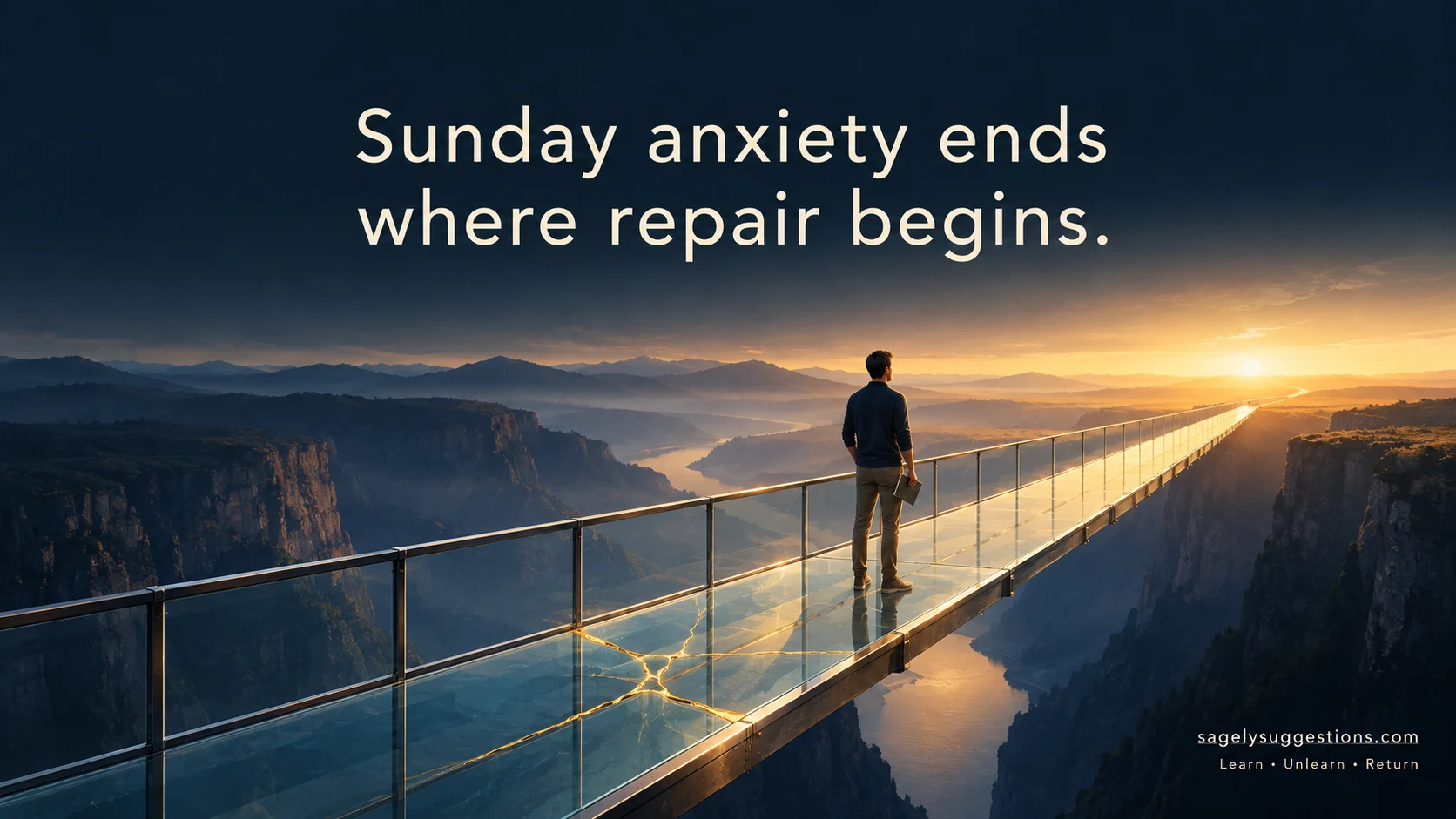
Sunday anxiety may be less about Monday itself and more about unfinished work, Friday’s mistakes, and unresolved worries. Learn practical, evidence-informed ways to reflect, repair, and recover.
Sunday Anxiety Isn’t Always About Monday—Sometimes It’s About Friday’s Mistakes
Why unfinished work, regret, and unresolved responsibilities follow us into the weekend—and how science, psychology, philosophy, and religious wisdom can help us respond constructively.
PROBLEM
It’s Sunday evening. The weekend is almost over, and a familiar uneasiness begins to build.
You think about Monday’s meetings, your inbox, the people you need to face, and the work waiting on your desk. But sometimes, the anxiety isn’t really about what Monday will bring. It’s about what happened on Friday.
Perhaps you missed a deadline, made an avoidable mistake, ignored an important message, postponed a difficult conversation, or left someone waiting for an answer. Maybe you made a decision you now regret. Or perhaps you spent Friday avoiding something that you knew mattered.
Monday becomes the moment when those unfinished matters return to your attention.
This is a useful distinction. Anticipatory anxiety concerns what might happen in the future. Regret concerns something that has already happened. Unfinished responsibilities connect the two: a past action or omission creates uncertainty about a future consequence.
Research published in 2026 found that unfinished work tasks are associated with increased work-related thoughts during nonwork time, including rumination. These thoughts can interfere with psychological recovery.
The title of this article offers a way to examine one common pattern, not a universal explanation for Sunday anxiety. Workload, financial insecurity, difficult management, caregiving, health concerns, and unpredictable schedules can all contribute. Sometimes Monday really is the problem.
The aim here is narrower: to understand what happens when we carry avoidable mistakes and unresolved responsibilities from the working week into our time off—and how to respond without either punishing ourselves or pretending nothing happened.
MINI SCENARIO
Consider Alex, a project coordinator at a midsize company.
On Friday afternoon, Alex realizes that an important report contains an error. Correcting it would take about an hour, but the weekend has already begun in Alex’s mind. Instead of telling the manager, Alex decides to deal with it on Monday.
That evening, Alex tries to relax. On Saturday, friends invite Alex to lunch, but the conversation keeps drifting back to the report. Alex checks work email twice, hoping the manager hasn’t noticed.
By Sunday afternoon, the worry becomes more specific. What if the manager asks about the error? What if the client has already seen the report? Alex starts rehearsing explanations, imagining an uncomfortable meeting, and criticizing the decision to postpone the correction.
At 8 p.m., Alex opens the laptop, reviews the report, and closes it again without making a plan.
The problem is no longer simply the report. It is the combination of an actual mistake, uncertainty about its consequences, and repeated thinking that produces no useful next step.
Alex doesn’t need to guarantee that Monday will go well. Alex needs to distinguish what requires repair from what cannot be resolved through another evening of worrying.
THE QUESTION
How can we take responsibility for Friday’s mistakes without allowing regret and uncertainty to consume the weekend?
WHAT SCIENCE SAYS
Unfinished tasks can follow us home
The scientific starting point is not that every unfinished task produces anxiety, but that unresolved goals can remain mentally active after the workday ends.
A 2026 meta-analysis by Johannes Wendsche, Oliver Weigelt, and Christiane Syrek examined the relationship between unfinished work tasks and work-related thoughts during nonwork time. The researchers found positive associations at both the between-person and within-person levels, with stronger associations for affective rumination. The findings suggest that unfinished tasks can interfere with recovery, although they do not establish that unfinished tasks cause Sunday anxiety in every individual. This helps explain why Alex’s report remains mentally present after the laptop is closed.
The task has not disappeared. Its status is uncertain, and its possible consequences remain unresolved. The mind may keep returning to it, sometimes in an effort to find a solution and sometimes simply replaying the problem.
The distinction matters: thinking about a task is not necessarily harmful. Reviewing a mistake, identifying a correction, or planning a conversation can be productive. Repeatedly imagining consequences without gaining new information or deciding what to do is a different process.
Recovery requires more than physical time off
Psychological detachment is the experience of mentally disengaging from work during nonwork time. It does not mean forgetting one’s responsibilities or becoming indifferent to professional obligations.
A 2015 review by Sabine Sonnentag and Charlotte Fritz found that work stressors, particularly workload, are associated with reduced detachment. Lower detachment is in turn associated with greater strain and poorer well-being. Much of this literature is observational, so these relationships should not automatically be interpreted as proof of causation.
A 2023 systematic review by Anastasiia Agolli and Brian Holtz assessed 159 empirical studies of factors influencing detachment. It highlighted the importance of both workplace conditions and individual circumstances. A person cannot always mentally disengage simply by deciding to do so, particularly when demands remain high or work intrudes into personal time. This has an important practical implication: a worker facing excessive demands may need changes in workload, staffing, expectations, or boundaries—not another lecture about personal discipline.
Evidence strength: Moderate
A 2021 meta-analysis of 30 studies involving 3,725 participants found that interventions designed to improve psychological detachment had a statistically significant positive average effect (standardized effect size, d = 0.36). Interventions addressing work stressors and how people appraise those stressors showed benefits, although results varied by intervention and context.
A separate 2021 meta-analysis of psychological interventions found average reductions in rumination and worry, alongside smaller improvements in some health outcomes. The findings support the usefulness of psychological approaches to repetitive negative thinking, but they do not establish that a particular Sunday routine will prevent anxiety or correct an unhealthy workplace. The reasonable conclusion is that detachment and structured problem-solving are worth testing. They are not guarantees of a worry-free weekend.
WHAT PSYCHOLOGY SAYS
Psychology helps distinguish three processes that can feel almost identical on a Sunday evening.
1. Productive reflection
Productive reflection examines a specific event and generates information or action.
For example:
- What exactly went wrong with Friday’s report?
- Which part was my responsibility?
- What correction is possible?
- Who needs to know, and when?
This kind of thinking is directed toward a problem that can be addressed.
2. Rumination
Rumination repeatedly revisits an upsetting experience without producing a proportionate amount of new understanding or useful action.
Alex might replay the conversation with the manager, mentally criticize the Friday decision, and imagine several versions of the same uncomfortable meeting.
The content may be related to a genuine mistake, but repetition alone does not repair it.
A useful test is: Has this round of thinking given me a new fact, a clearer decision, or a concrete next step?
If the answer is consistently no, continuing to think may not be helping.
3. Worry
Worry is more future-oriented. It involves repeatedly imagining uncertain or threatening outcomes.
Alex’s report may lead to questions such as whether the manager will be angry, whether the client will complain, or whether the mistake will damage future opportunities.
Some concern is reasonable. The difficulty begins when the mind treats a possible outcome as though repeatedly imagining it could control it.
The American Psychological Association describes anxiety as an anticipatory response to perceived danger or misfortune. It can involve both mental apprehension and physical tension.
Replace vague guilt with specific responsibility
Guilt and regret can sometimes direct attention toward behavior that needs to change. But global self-condemnation—”I’m irresponsible,” “I always ruin things”—does not identify what needs repair.
A more useful formulation is:
“I submitted an inaccurate report, delayed telling my manager, and need to correct the error and communicate clearly.”
That sentence separates the behavior from the whole identity of the person who made the mistake.
It also turns a diffuse emotional problem into a set of actions.
This is consistent with cognitive-behavioral approaches, which help people identify unhelpful thought patterns, examine their accuracy, and change behaviors that maintain distress. CBT has substantial clinical support for anxiety disorders, although ordinary self-reflection is not equivalent to a course of therapy.
Why a concrete plan can help
A plan does not guarantee that the outcome will be favorable. Its value is that it clarifies what the person can do next.
Instead of repeatedly asking, “What if my manager finds out?”, Alex can write:
- Monday, 9 a.m.: correct the report.
- Before the first meeting: notify the manager of the error.
- In the message: explain the correction, the potential impact, and the prevention step.
The plan has a time, an action, and a defined purpose.
This also makes it easier to distinguish a problem that can be acted on from uncertainty that must temporarily remain unresolved.
The psychological objective is not to eliminate every uncomfortable thought. It is to reduce the extent to which repetitive thinking determines what a person does with the rest of the weekend.
WHAT PHILOSOPHY SAYS
Stoicism: distinguish your actions from other people’s responses
In the Enchiridion, chapter 1, Epictetus distinguishes what depends on our own agency from what does not. Judgments, intentions, and choices are treated differently from reputation, external circumstances, and other people’s actions.
Applied to Alex’s situation, the distinction is practical.
Alex can decide whether to correct the report, communicate honestly, and prepare for a reasonable discussion. Alex cannot determine exactly how the manager will respond, whether the client will complain, or whether every consequence will be avoided.
The Stoic exercise is not to declare those consequences irrelevant. It is to stop treating another person’s reaction as though it were entirely under one’s command.
Core idea → Direct effort toward one’s own judgments and actions rather than demanding control over external outcomes.
Reasoning → Distress can be intensified when we treat something dependent on other people or circumstances as if it were ours to guarantee.
Practical relevance → Identify the next responsible action, take it, and allow the remaining uncertainty to remain uncertain.
Stoicism does not imply that workplace injustice, financial insecurity, or unfair treatment should simply be accepted. External conditions can be addressed through negotiation, collective action, or changes in employment. The distinction concerns the limits of individual control, not the absence of social responsibility.
WHAT RELIGIOUS / TRADITIONAL WISDOM SAYS
Religious traditions can offer ways to interpret responsibility, regret, and uncertainty. Their teachings have theological and philosophical foundations that are not established or disproved by psychological experiments.
Two perspectives are particularly relevant to the problem.
The Bhagavad Gita: act without making the outcome your possession
In the Bhagavad Gita 2.47, Krishna addresses Arjuna about action, its results, and the danger of attachment to inaction. One established English rendering by Swami Adidevananda reads:
To work alone you have the right, and not to the fruits.
The verse also cautions against making the fruits of action one’s sole motive and against attachment to inaction.
The surrounding dialogue is important. Arjuna is facing a moral and existential crisis about action and duty. The verse is not simply a productivity instruction or a claim that outcomes do not matter.
In the Gita’s broader teaching, disciplined action is connected with dharma, spiritual understanding, and liberation. Different Vedantic traditions interpret its relationship to duty, agency, devotion, and liberation in distinct ways.
For someone reflecting on Friday’s mistake, the practical application is limited but meaningful: perform the correction that responsibility requires without demanding that the correction guarantee forgiveness, approval, or a perfect future.
Nor should the verse be used to justify neglect. Its final clause explicitly rejects attachment to inaction.
Core idea → Responsible action should not be abandoned merely because its results are uncertain.
Practical relevance → Correct what can be corrected, communicate what needs to be communicated, and recognize that the eventual outcome is not yours alone to determine.
This is a practical application of the verse, not a claim that the Gita prescribes a modern workplace anxiety technique.
Christianity: attend to today’s responsibilities without borrowing tomorrow’s troubles
In the Gospel of Matthew 6:25–34, Jesus addresses anxiety about necessities and the future. Matthew 6:34 concludes the passage by directing attention away from being consumed by tomorrow’s troubles.
The passage appears within the Sermon on the Mount and is framed by trust in God and the priority of God’s kingdom and righteousness. It is not merely an argument for positive thinking or a promise that practical difficulties will disappear.
Christian traditions differ in their interpretations of providence, human responsibility, work, and the appropriate relationship between planning and trust.
Applied carefully, the passage offers a distinction between responsible preparation and becoming consumed by imagined future difficulties.
Alex can prepare for Monday, make an honest correction, and seek guidance without attempting to mentally experience every possible consequence before it happens.
For a Christian reader, this may be an invitation to prayer and trust in God while continuing to fulfill one’s responsibilities. For a reader outside Christianity, the passage can still be understood in its historical and theological context without adopting its religious claims.
Neither tradition should be treated as an empirical treatment for anxiety. Their contribution is to offer frameworks for understanding what responsible action means when certainty is unavailable.
WHERE THEY CONVERGE
Science, psychology, Stoicism, and the religious perspectives discussed here have different aims and foundations. Nevertheless, several practical themes overlap.
| Theme | Contribution |
|---|---|
| Specific action | Psychology encourages concrete problem-solving; Stoicism emphasizes one’s own choices; the Gita emphasizes action and rejects inaction. |
| Limits of control | Psychological approaches distinguish actionable problems from uncertain outcomes; Stoicism and the Gita provide philosophical or theological accounts of why outcomes cannot be wholly possessed or commanded. |
| Mental disengagement | Recovery research emphasizes detachment from work; philosophical and religious approaches provide ways to relate differently to recurring thoughts. |
| Responsibility without self-punishment | Cognitive-behavioral methods examine thoughts and behaviors; religious and philosophical frameworks offer accounts of duty, moral responsibility, and the limits of human agency. |
The overlap is useful because it suggests that responsibility and recovery need not be opposites.
A person can acknowledge a mistake, take a corrective step, and still allow the remainder of the weekend to be personal time.
The common practical theme is not that all traditions share the same understanding of human nature or suffering. It is that repeatedly experiencing distress is not, by itself, the same as fulfilling a responsibility.
WHERE THEY DIFFER
The differences matter just as much as the overlap.
– Science and philosophy: Scientific research investigates observable relationships and tests hypotheses. Stoicism offers arguments about agency, judgment, and flourishing. An empirical association between rumination and poor recovery does not prove Stoic metaphysics.
– Psychology and religious wisdom: CBT evaluates thoughts and behaviors partly by their relationship to distress and functioning. The Gita’s account of disciplined action is embedded in teachings about dharma, spiritual realization, and liberation. Christian teachings about anxiety are situated within a relationship with God and a broader moral and theological vision.
– Responsibility and acceptance: Acceptance of uncertainty does not imply accepting an unjust or unsafe workplace. Psychological recovery may require changes to working conditions, while philosophical reflection may help clarify what action is morally appropriate.
– The purpose of human life: Psychological interventions generally target specific difficulties or improvements in functioning. Stoic ethics concerns virtue and flourishing; the Gita connects action with spiritual liberation; Christian theology situates human life in relation to God. These are not interchangeable goals.
There is no need to settle these disagreements to use the practical distinction between correcting a mistake and repeatedly imagining its consequences.
THE PRACTICAL SOLUTION
The following six steps combine evidence-informed behavioral strategies with practical philosophical reflection. The behavioral strategies have research support in related settings; this exact six-step Sunday routine has not been established as a clinical intervention.
Step 1: Name the actual mistake
Action: Write down what happened without judging your entire character.
How to do it: Complete three sentences:
- The observable event was…
- My responsibility in it was…
- What I do not yet know is…
For Alex: “I submitted an inaccurate report. I should have checked it and notified my manager. I don’t know whether the client has seen it.”
Why it helps: Specific descriptions make it easier to distinguish facts, responsibility, and uncertainty. They also reduce the risk of treating an entire imagined future as an established fact.
Step 2: Separate repair from punishment
Action: Identify whether anything can still be corrected.
How to do it: Ask whether the problem requires an apology, a correction, a conversation, additional information, or a change in future behavior.
If the answer is yes, identify the next action and when it can reasonably be taken.
If no meaningful action is currently available, write down what information or opportunity would allow you to act.
Why it helps: This directs attention toward problem-solving rather than repetitive self-criticism. It also prevents the mistaken belief that feeling worse is a form of making amends.
Step 3: Write an if-then plan
Action: Turn the next step into a specific response to a recognizable situation.
How to do it: Use this format:
“If , then I will .”
For example: “If my manager asks about the report on Monday, I will explain the error, provide the corrected version, and describe how I will check future reports.”
Implementation intentions of this general kind are used in behavioral research to connect situations with planned responses. Their usefulness depends on whether the intended action is realistic and within the person’s control.
Why it helps: A written plan reduces the need to keep rehearsing the same response mentally. It does not guarantee that the situation will unfold as expected.
Step 4: Close the workweek deliberately
Action: Create a short end-of-week closure routine.
How to do it: On Friday, or at the earliest reasonable opportunity, list unfinished tasks, identify their next actions, communicate urgent issues, and set a realistic time for resuming work.
For unresolved tasks, write the next step rather than merely the task name.
“Fix report” is less actionable than “Check the figures in section three and send the corrected report to my manager.”
If Friday has already passed, a brief Sunday planning session can serve as a substitute without turning the evening into another workday.
Why it helps: Unfinished tasks are associated with greater work-related thinking during time off. A closure routine gives unresolved responsibilities a defined place in the next work period.
Step 5: Set a boundary around work
Action: Decide when your work preparation ends and personal time begins.
How to do it: Choose a reasonable time limit for Sunday preparation. Once you have reviewed your commitments and written down your next steps, close work applications and put away work materials.
If a genuine emergency or an agreed work obligation requires attention, respond appropriately. The boundary should reflect your actual working conditions rather than an unrealistic ideal.
Why it helps: Research on psychological detachment suggests that nonwork recovery is influenced by both work demands and the ability to disengage. A boundary can support recovery, but it cannot substitute for adequate staffing, reasonable expectations, or fair working conditions.
Step 6: Return to an activity that belongs to your life
Action: Choose one meaningful nonwork activity and give it your attention.
How to do it: Have dinner with a friend, take a walk, read, cook, play a sport, or spend time with family. Choose something that fits your circumstances and does not add unnecessary pressure to the evening.
If work-related thoughts return, acknowledge them and remind yourself of the next action you have already written down. Then return to the activity.
Why it helps: Psychological detachment is not simply the absence of work. It involves mentally engaging with life outside work. Research supports the relevance of recovery experiences, though no single leisure activity is guaranteed to work for everyone.
TRY THIS TODAY
The 15-minute Friday-to-Monday reset
15 minutes · Paper and pen or a notes app
Set aside one short period today. Do not open your work email unless a specific, necessary action requires it.
Your reset worksheet
Use these five prompts in order.
Minutes 1–3: Name the unfinished matter
Write one specific event or task that is contributing to your anxiety.
Minutes 4–6: Separate fact from prediction
Write one thing you know, one thing you are assuming, and one thing you do not know yet.
Minutes 7–10: Choose a corrective action
Write one action you can take, who needs to be involved, and when you will take it.
Minutes 11–12: Identify what must wait
Write down what cannot reasonably be resolved until Monday or until more information is available.
Minutes 13–15: End the review
Close your notes. Choose one nonwork activity for the next hour and begin it.
The observable result is not that you feel perfectly calm. It is that you have a written next step and have begun doing something outside work.
If the anxiety remains, you have not failed the exercise. The purpose is to change your response to the problem, not to demand an immediate emotional result.
7-DAY EXPERIMENT
This is a personal experiment, not a clinical trial. The purpose is to discover which small changes are useful in your actual working conditions.
Day 1 — Baseline and awareness
Record your Sunday anxiety from 0 to 10. Note when it starts, what you are thinking about, and whether the concern relates to an actual unfinished task or an uncertain outcome.
Day 2 — First intervention
Choose one unresolved task. Write down the facts, your responsibility, and the next corrective action. Give the action a realistic time.
Day 3 — Repeat and refine
When work-related thoughts return, ask whether they have produced new information or a useful next step. If not, return to the activity you were doing.
Day 4 — Environmental adjustment
Set a practical boundary around work notifications or work applications during personal time. Adjust it to your responsibilities and any legitimate on-call requirements.
Day 5 — Challenge and variation
Try a different form of recovery, such as a walk, a social activity, or a hobby. Observe whether the activity changes how long you spend thinking about work.
Day 6 — Consolidation
Prepare a short end-of-week closure list. Include unfinished tasks, their next actions, and any communication needed before signing off.
Day 7 — Review
Compare your observations with Day 1. Identify which actions helped, which were impractical, and whether your anxiety reflects a problem that requires a workplace change or professional support.
Seven days cannot establish that an intervention works scientifically, eliminate an anxiety problem, or establish a lasting behavioral change. It can provide useful personal observations.
If your work schedule does not follow a Monday-to-Friday pattern, adapt the experiment to your own workweek and the period immediately before your next shift.
MEASURE YOUR PROGRESS
Keep tracking simple. Three measures are sufficient for this experiment.
| Measure | What to record |
|---|
| Anxiety intensity | Rate your Sunday anxiety from 0–10, using the same personal scale each time. |
| Rumination duration | Estimate the total time spent replaying work problems without taking useful action. |
| Useful action | Record whether you completed the corrective action or scheduled it for a realistic time. |
Do not treat these measures as clinical assessments. A lower anxiety rating does not necessarily mean a mistake has been repaired, and completing a task does not guarantee that anxiety will disappear.
The purpose is to understand whether your behavior is becoming more constructive and whether the problem requires action beyond individual coping.
COMMON MISTAKES
1. Confusing acceptance with passivity
Accepting that an event happened does not mean accepting preventable harm or refusing to correct a mistake. If a report is inaccurate, correct it. If someone was harmed, consider what repair is appropriate.
2. Treating worry as proof of responsibility
Feeling anxious for three hours does not necessarily demonstrate more accountability than taking one honest corrective action. Emotional discomfort and ethical responsibility are different things.
3. Using Stoicism to suppress emotion
Stoicism is not simply an instruction to feel nothing. Its philosophical concerns include judgment, virtue, and the proper use of agency. Trying to force yourself to become emotionless can add another layer of frustration.
4. Using religious teachings to avoid practical duties
Neither the Gita’s teaching on action nor the Christian emphasis on trust should be used as an excuse to conceal errors, ignore obligations, or avoid reasonable planning.
5. Assuming every Sunday worry is self-created
An unreasonable workload, inadequate staffing, workplace harassment, discrimination, or unstable employment can create real and persistent stress. Individual reflection cannot fix every organizational problem.
6. Expecting a seven-day routine to cure persistent anxiety
A personal experiment is an opportunity to learn, not a substitute for treatment. If anxiety persists or significantly affects daily functioning, consider professional support.
WHEN THIS ISN’T ENOUGH
Occasional uneasiness before a workweek is a common human experience. Not every difficult Sunday indicates a mental health disorder.
However, recurring anxiety deserves attention when it begins to interfere with sleep, relationships, concentration, physical well-being, or the ability to enjoy time away from work.
The American Psychological Association notes that anxiety disorders can involve persistent worry and significant impairment in work, school, relationships, and other areas of life. Evidence-based treatments, including CBT, can be effective for anxiety disorders.
Consider speaking with a licensed mental health professional if:
- Anxiety is persistent, difficult to manage, or increasingly intense.
- You regularly lose sleep or cannot participate in ordinary personal activities.
- You repeatedly avoid work situations or important conversations because of fear.
- Self-help efforts have not meaningfully improved your functioning.
If the main problem is an unsustainable workplace, consider discussing workload, staffing, scheduling, or reasonable accommodations with an appropriate manager, human resources representative, employee assistance program, union representative, or other trusted resource.
If your workplace is unsafe or abusive, prioritize safety and seek appropriate support rather than assuming that better personal discipline will solve the problem.
For immediate danger or thoughts of harming yourself, seek urgent professional or emergency assistance. In the United States, call or text 988 for the Suicide & Crisis Lifeline; call 911 for an immediate emergency.
The central boundary is straightforward: self-help can support reflection and coping, but it should not be used to excuse harmful working conditions or replace professional care when it is needed.
REFLECTION QUESTIONS
Take a few minutes to consider these questions honestly. You do not need to answer all of them at once.
1. Which specific Friday action or omission keeps returning to my mind, and what part of it is genuinely my responsibility?
2. What am I trying to obtain through repeated worry: useful information, a guarantee of forgiveness, certainty about the future, or relief from guilt?
3. What corrective action would demonstrate responsibility even if nobody praised me, forgave me immediately, or guaranteed a favorable outcome?
4. Which part of my Sunday anxiety reflects a mistake I can repair, and which part reflects a workload or workplace condition that requires a broader change?
5. If I had completed the reasonable corrective action, what would I consider a legitimate reason to return my attention to my personal life?
LITERATURE & SOURCES
The following references support the article’s empirical claims, psychological framework, and philosophical and religious discussions. The evidence on work recovery is more directly relevant to the article’s central problem than research specifically on Sunday anxiety, which remains a narrower topic.
Scientific Research
1. Wendsche, J., Weigelt, O., & Syrek, C. J. (2026). Unfinished work tasks and work-related thoughts during off-job time: A meta-analysis of the Zeigarnik effect in a work-recovery context . Anxiety, Stress, & Coping, 39(4), 385–407. Directly relevant to unfinished tasks, rumination, and recovery.
2. Ovsiankina’s Great Relief: How Supplemental Work during the Weekend May Contribute to Recovery in the Face of Unfinished Tasks . A 2018 employee diary study examining unfinished tasks, weekend work, progress, and recovery experiences.
3. Agolli, A., & Holtz, B. C. (2023). Facilitating detachment from work: A systematic review, evidence-based recommendations, and guide for future research . Journal of Occupational Health Psychology. A review of 159 empirical studies.
4. Interventions for improving psychological detachment from work: A meta-analysis . A systematic review and meta-analysis of interventions intended to improve work detachment.
Psychology
1. American Psychological Association: How Psychologists Help With Anxiety Disorders . An accessible overview of anxiety, CBT, and evidence-based psychological treatment.
2. Health effects of psychological interventions for worry and rumination: A meta-analysis . A 2021 meta-analysis of psychological interventions and their effects on repetitive negative thinking and health outcomes.
3. Sonnentag, S., & Fritz, C. (2015). Recovery from job stress: The stressor-detachment model as an integrative framework . Journal of Organizational Behavior, 36, S72–S103.
4. Cleveland Clinic: How to Fight Off the Sunday Scaries . A contemporary clinical overview of anticipatory work anxiety and practical coping approaches.
Philosophy
1. Epictetus. The Enchiridion, Chapter 1 . Translated by Elizabeth Carter. A primary source for the Stoic distinction between what depends on our agency and what does not.
2. Hadot, P. (1995). Philosophy as a Way of Life: Spiritual Exercises from Socrates to Foucault. Blackwell. A scholarly exploration of ancient philosophy as a practice of living.
Religion / Theology
1. Bhagavad Gita, Chapter 2, Verse 47 . Gita Supersite, Indian Institute of Technology Kanpur. Provides the Sanskrit text and multiple English translations.
2. Bhagavad-gītā As It Is, 2.47 . Includes the Sanskrit verse, transliteration, and a translation with commentary from the Gaudiya Vaishnava tradition.
3. The Bible, Matthew 6:25–34, particularly 6:34. The Sermon on the Mount’s teaching on anxiety, trust, and the concerns of tomorrow. Readers can consult a reputable translation such as the New Revised Standard Version Updated Edition.
Further Reading
These books offer accessible routes into the underlying ideas, without suggesting that reading them is a substitute for clinical care.

The Happiness Trap
Russ Harris
An introduction to Acceptance and Commitment Therapy, including ways to relate differently to difficult thoughts while acting on personal values.

Mind Over Mood
Dennis Greenberger and Christine A. Padesky
A practical CBT workbook for identifying thoughts, emotions, and behavior patterns.

How to Think Like a Roman Emperor
Donald Robertson
An accessible introduction to Stoic philosophy and its relationship to modern cognitive approaches.

The Bhagavad Gita
Translated by Eknath Easwaran
An accessible translation for readers interested in the Gita’s broader discussion of action, duty, and spiritual life.
ONE-SENTENCE TAKEAWAY
You cannot undo Friday by worrying through Sunday, but you can take responsibility for what happened, plan the next honest action, and give the rest of your life permission to continue.